 Skip to content
From 1980 to 2025: How Car Loans have Changed
- Emma
- Car Finance
Estimated reading time: 10 minutes
Key Takeaways
Car finance looks nothing like it did 45 years ago. From punishing 20% interest rates and just a few high street lenders, things have changed fast. Now there is a digital marketplace. You can compare dozens of options in minutes.
- Interest rates dropped from 20% in the early 1980s to historic lows, making car ownership genuinely affordable. Recent inflation has raised rates to 3.75% by December 2025. However, borrowers still have many more options than in the 1980s.
- 52% of auto loans now start online. Digital applicants get decisions 21% faster than those using traditional routes.
- PCP agreements took over modern car finance, accounting for 76% of financed new cars by 2015. Lower monthly payments and end-of-contract flexibility made them the obvious choice over traditional loans.
- The FCA stepped in to stop widespread mis-selling. It banned discretionary commission models that cost borrowers up to £300 million each year. These costs came from inflated interest charges.
- EV financing is the newest frontier. Electric vehicles reached 19.6% of new registrations in 2024. Green finance options are growing, including salary sacrifice schemes. Government incentives are also expanding, with support up to £3,750.
Car loans have come a long way since 1980. What began as a simple product from a few high street banks is now a competitive market. It includes specialist lenders, online comparison tools, and options for borrowers of all credit profiles. We’ll walk you through exactly how that happened — from double-digit interest rates to the digital shift that changed everything.
The 1980s and 1990s: When Car Loans Became Accessible
“The scale of mis-selling was profoundly alarming, with hundreds of thousands of consumers affected and up to two million cases requiring review.” — Economic Secretary to the Treasury, Government official
Securitisation changed everything. This financial tool let lenders bundle car loans into securities and sell them to investors. It unlocked the cash needed to fund many more loans. Suddenly, car-loan lenders could offer competitive rates and reach borrowers they’d previously shut out entirely.
High street banks enter the car finance market
Banks spotted the opportunity and moved fast. The securitisation model gave them the funding to scale operations. It also helped them win customers with little prior access to car loans. Traditional dealer-only arrangements, which had dominated for decades, were no longer the only game in town.
Dealer finance emerges as a popular option
Manufacturers responded with tactics that were, frankly, extraordinary. By 1986, average auto loans sat between 7% and 11%. That spring, automakers slashed that to 2% and 3%. AMC went further still, offering 0% financing just to shift unsold Renault stock.
The public reaction said it all. Customers locked themselves inside cars at dealerships, refusing to budge until a salesman came to them. Fine print restricted which buyers and models qualified, but these programmes moved vehicles.
Interest rates and paying in the 80s and 90s
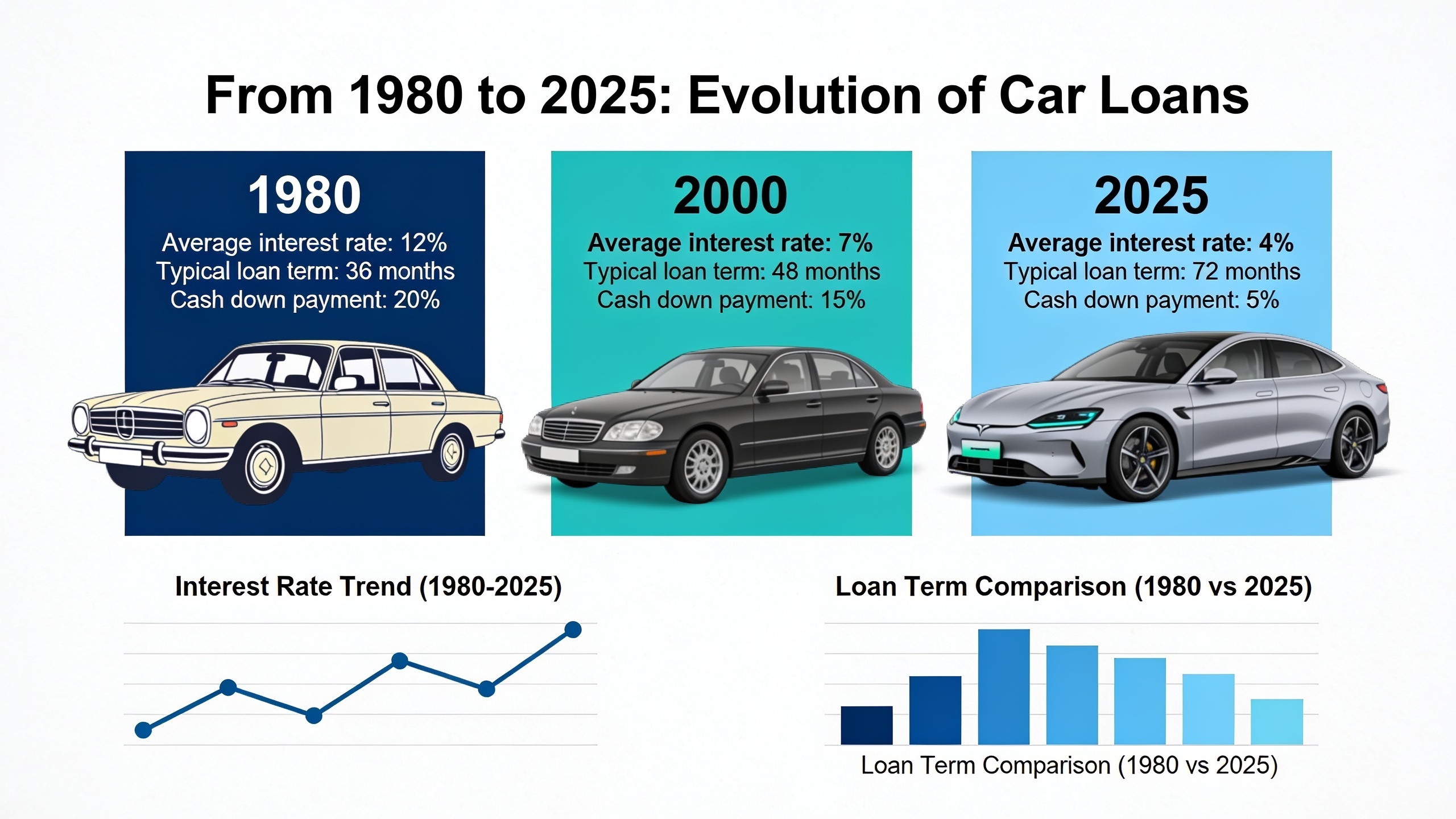
Twenty percent. That’s where interest rates sat in the early 1980s. Even solid credit couldn’t save borrowers from double-digit rates well into the 1990s. The pressure forced genuinely creative solutions.
Loan terms stretched to absorb the pain. The standard 24 to 36 months gave way to 48, 60, and even 72-month agreements.
Car leasing surged in popularity — no down payment, lower monthly costs than traditional car loans. Lenders had no choice but to adapt. Luxury vehicle ownership climbed from 10% to 30% between the early 1990s and mid-2000s. Subprime car finance companies multiplied rapidly during this period, though many didn’t survive what came next.
The 2000s: Alternative Lenders Take Over and Online Comparison Arrives
The 2000s changed everything. Non-bank finance companies now provide over half of all auto loans. They beat traditional banks on flexibility and reach. Borrowers outside prime credit bands finally had real options.
Specialist car finance providers gain traction
Manufacturer-owned captive finance companies had long controlled car loans UK. That dominance ended here. Independent specialists entered aggressively, targeting specific customer segments — from used car loans to niche arrangements. For borrowers looking to compare car loans, the choices had never been better.
Subprime lending and the 2008 financial crisis impact
Then the crisis hit, and it hit hard. Short-term funding market disruptions cut credit availability to consumers sharply.
Auto loan originations fell almost 30% year-over-year. New car sales dropped 21% between 2008 and 2009.
Borrowers who couldn’t access finance from specialist companies turned to credit unions, banks, or paid cash. Banks that took bailout money backed many top subprime lenders. The system was fragile and deeply connected.
PCP agreements introduced — and they stuck
PCP was manufacturers’ answer to stalled sales. By 2009, these agreements already represented 53% of new cars bought on finance by personal consumers. By 2015, that figure hit 76%. The reason is simple: lower monthly payments, more flexibility at contract end.
PCP drove car finance’s share of all private new car sales from 45.8% in 2009 to 86.6% in 2016. No other product came close.
Online comparison tools change how borrowers shop
Digital platforms did what no high street branch ever could. Comparison websites let customers view multiple lenders simultaneously, entering details once and receiving quotes from dozens of providers. Finding the best car loans no longer meant visiting branch after branch. The power shifted firmly to the borrower.
2010 to 2020: Regulation, Technology and Changing Consumer Habits
The FCA didn’t just tighten car finance rules. It showed how badly lenders had let borrowers down. Discretionary commission models were costing customers up to £300m annually compared to flat fee arrangements. Brokers were adjusting interest rates to earn bigger commissions, and borrowers were paying the price.
FCA regulation tightens car finance rules
The regulator proposed banning discretionary commission models entirely. Lenders used these arrangements in approximately 75% of mid-range credit risk transactions. Some firms read the writing on the wall and began moving away from these practices before formal rules even took effect. For borrowers, this was long overdue protection.
Used car loans become more prevalent
Used car finance stopped being the afterthought of the market. As lenders competed harder for business, used car loans became genuinely competitive products, not just fallback options. Dealers pushed finance on forecourt stock, and borrowers responded.
Low interest car loans and competitive lending
Rates dropped sharply. Average interest rates on new vehicle loans fell to 4.52% in Q4 2011, down from 4.84% the previous year. Used vehicle loans averaged 8.68%, also edging lower.
Loan terms stretched further too, with 73 to 84 month agreements accounting for 14.1% of new vehicle finance, up 47.1% year-over-year. Lower monthly payments came at the cost of paying longer.
Digital applications transform the borrowing process
This is where borrowing genuinely changed. By 2022, 52% of auto loan originations came through digital channels. Online applications increased 45% in 2023, cutting down dealership visits considerably.
AI-powered platforms processed applications in minutes. Borrowers who applied online experienced 21% faster decision times than those going through traditional routes. The branch visit was no longer the default.

2020 to 2025: Modern Car Finance in a Changing World
“Most consumers say they are unwilling to pay more to go electric, which is a real concern for the transition. The rising interest in hybrids is encouraging as drivers look for reassurance, but they’re not going to solve the affordability challenge.” — Auto Trader, UK’s largest online automotive platform
The period from 2020 to 2025 stress-tested car finance like nothing before it. Global disruption, a rate-hiking cycle, and the electric vehicle shift all landed at once.
The pandemic’s effect on car loans and lenders
New car registrations held flat at 1.6m annually from 2020 to 2022. Used car transactions fell from 7.9m in 2019 to 6.8m in 2020. Recovery came, but slowly — used car volumes reached 7.6m by 2024, whilst new registrations climbed to 2.0m.
For borrowers already struggling, the FCA stepped in. It required three-month payment freezes for motor finance customers in difficulty. It was a necessary intervention.
Electric vehicles and green car finance
EVs now account for 4.4% of UK cars on the road as of April 2025, up from just 1.2% in 2021. New EV registrations hit 19.6% in 2024.
The finance options have kept pace — HP, PCP and leasing all apply, with salary sacrifice schemes gaining real traction. Government support adds up to £3,750 off qualifying vehicles priced below £37,000. Worth noting: average EV insurance sits at £963.65, a cost that factors into your total ownership calculation.
Inflation, interest rates and payment challenges
Rates tell the starkest story. Bank Rate surged from 0.25% to 5.25% between 2022 and 2023, settling at 3.75% by December 2025. Average new car loan amounts have grown at 5.6% annually since 2009. Affordability is the defining challenge of this era.
What to look for in a car loan today
Compare rates, terms and total costs. Don’t fixate on the monthly payment — the overall cost of borrowing matters more.
Loans for bad credit: More options than ever
Specialist lenders now offer HP and PCP to borrowers with poor credit histories. No guaranteed approval exists, but the market has opened up considerably. Rates will be higher, so the total cost comparison becomes even more critical.
Car title loans and alternative borrowing methods
Title loans let you borrow £100 to £10,000 against your vehicle as collateral. The terms are typically 30 days, with APRs exceeding 300%. They solve a short-term problem but create a far bigger one if you can’t repay. Use them only as a last resort.
Conclusion
Car finance has travelled an incredible distance since 1980. What began with strict high street loans and high interest rates has changed into a diverse market. We can now compare car loans online, use specialist lenders, and find options despite our credit history.
The digital revolution, regulatory reforms, and expanding product range mean borrowers today have unprecedented choice. As a matter of fact, understanding this evolution helps you make smarter borrowing decisions for your next vehicle purchase.
FAQs
Q1. What were typical car loan interest rates like in the 1980s and 1990s?
Interest rates were significantly higher than today, hovering around 20% in the early 1980s. Even borrowers with good credit faced double-digit rates through much of the 1990s. In 1986, average auto loan rates ranged from 7% to 11%. To make vehicles more affordable despite these high rates, loan terms extended from the traditional 24-36 months to 48, 60, and even 72 months.
Q2. How long are most used car loans today?
Modern used car loans typically range from 36 to 84 months, with longer terms becoming increasingly common. By the early 2010s, loans of 73 to 84 months accounted for 14.1% of new vehicle finance. Lenders have extended terms over the decades to help manage monthly payments. Longer terms mean you pay more interest overall.
Q3. What is a Personal Contract Purchase (PCP) agreement?
PCP is a type of car finance that began in the 2000s. It offers lower monthly payments than traditional loans.
It also offers flexibility at the end of the contract. By 2015, PCP agreements represented 76% of new cars bought on finance by personal consumers.
At the end of the contract, you can return the vehicle. You can also pay a final balloon payment to own it. Or, you can use any equity toward a new car.
Q4. How has technology changed the car loan application process?
Digital applications have transformed car finance dramatically. By 2022, 52% of auto loan originations came through digital channels, with online applications increasing 45% in 2023. AI-powered platforms now process applications in minutes, not days. Borrowers who apply online get decisions 21% faster than with traditional methods.
Q5. Are car loans available for people with bad credit?
Yes, specialist lenders now offer hire purchase and PCP agreements to borrowers with poor credit histories. Options have grown a lot in recent decades, but interest rates are usually higher. They are higher than rates for borrowers with good credit. Whilst no guaranteed approval exists, the market has become more inclusive with various lenders catering to different credit profiles.
Related links