 Skip to content

Secured Loans Explained: How They Work, Risks and Alternatives
- Michelle
- Finance
Could borrowing against your home help meet a financial need, or put too much at risk? Secured loans use your property as security for the debt. If you fall behind on repayments, your home could ultimately be at risk.
It’s understandable to feel unsure. Before considering this type of borrowing, look at whether the repayments and total cost fit your circumstances, and compare secured borrowing with options that don’t use your home as security.
This guide explains how secured loans work, what lenders may assess and which costs, terms and risks to consider before accepting an offer. It also covers alternatives such as personal loans and reviewing your existing mortgage arrangements. I Need Cash is an FCA-authorised and regulated credit broker, not a lender. It connects applicants with independent lenders, which make their own lending and approval decisions.
Key Takeaways
- A secured loan uses your home as security, so missed repayments could put your property at risk.
- Before accepting an offer, check the total amount repayable, term, interest rate, fees and repayment conditions.
- Compare secured borrowing with options such as personal loans or reviewing your mortgage arrangements, including their costs and consequences.
- I Need Cash is a credit broker that matches applicants with independent lenders. The lender decides whether to offer a loan and on what terms.
What is a secured loan, and how does it use your home as security?
A secured loan is borrowing backed by an asset, such as your home. The property provides security for the debt. If you fall behind and can’t repay, your home could ultimately be at risk. By contrast, unsecured borrowing isn’t secured against your property, although failing to repay it can still have serious financial consequences.
What does it mean to secure borrowing against a property?
The lender has a legal claim connected to the property as security for the debt. The exact arrangement depends on the loan. It doesn’t mean the lender owns your home, but it does mean your property is linked to the borrowing. The FCA’s Consumer Duty states that “a firm must act to deliver good outcomes for retail customers” in its official Handbook.
Owning a home doesn’t guarantee that a lender will approve an application or offer particular terms. A lender may consider your finances, whether repayments appear affordable, the property and any borrowing already secured against it. Think about whether you could manage the repayments if your income fell or household costs rose.
Is a secured loan the same as a second charge mortgage?
Not always. “Secured loan” is a broad description of borrowing backed by an asset. If you take out a homeowner loan while keeping your existing mortgage, the new borrowing may be structured as a second charge mortgage. This means an additional charge is secured against the property alongside the existing mortgage. The terms are not interchangeable in every case, so check the agreement to understand how the borrowing is secured.
For more information about this type of borrowing, see I Need Cash’s homeowner loans page. I Need Cash is a credit broker, not a lender. Independent lenders make their own decisions about applications and terms.
How do secured loans work, from application to repayment?
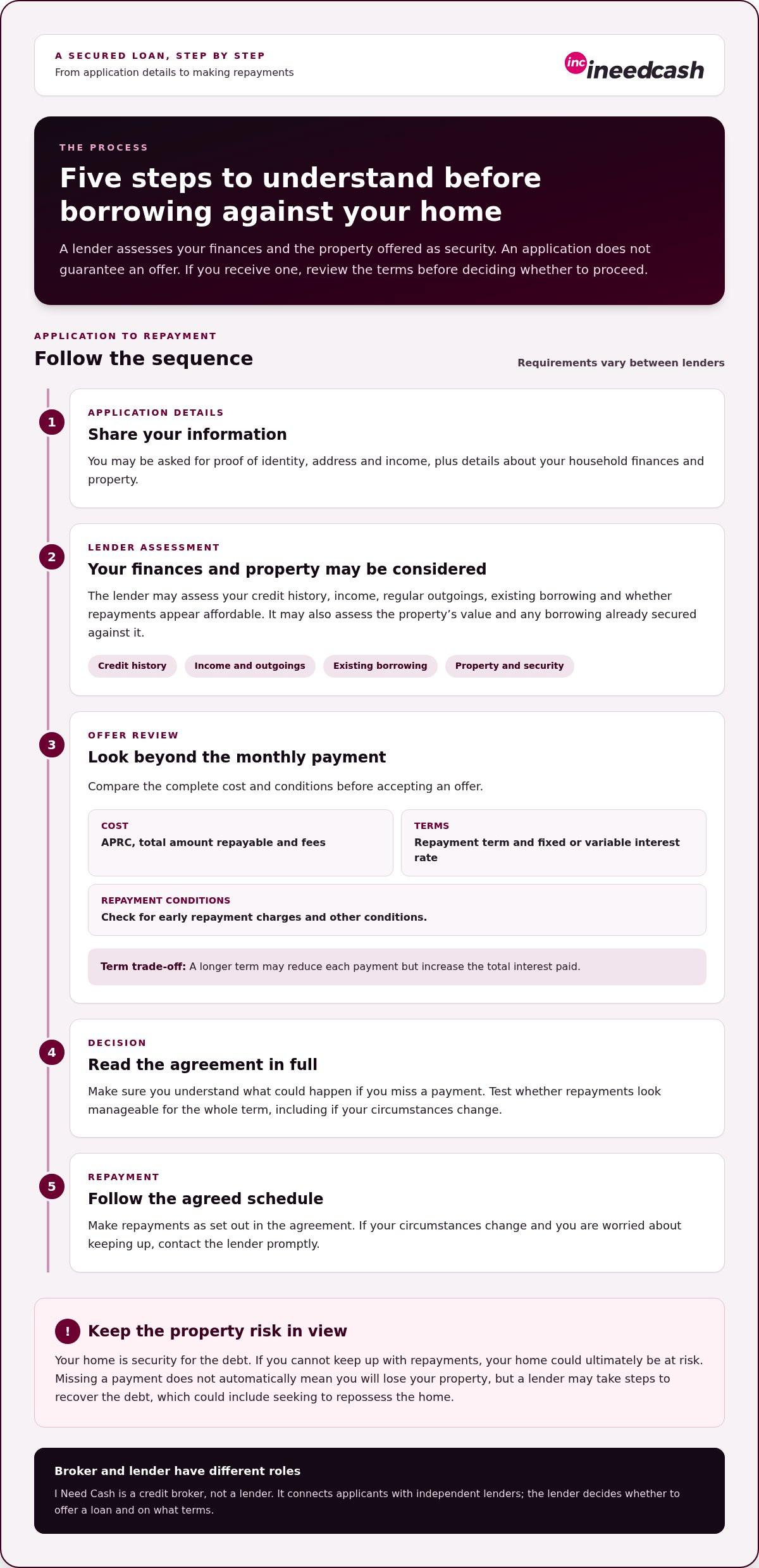
A lender assessing a secured loan considers your finances and the property offered as security. Applying doesn’t guarantee an offer. If you receive one, review the terms carefully before deciding whether to proceed.
- Share your details. You may be asked for proof of identity, address and income, along with information about your household finances and property.
- Wait for the lender’s assessment. The lender may consider your credit history, income, regular outgoings, existing borrowing and whether repayments appear affordable. It may also assess the property’s value and any borrowing already secured against it. Requirements vary between lenders.
- Review any offer carefully. Compare the APRC, total amount repayable, repayment term and fees. Check whether the interest rate is fixed or variable, and look for early repayment charges or other repayment conditions.
- Decide whether to proceed. Read the agreement in full. Make sure you understand what could happen if you miss a payment, and consider whether the repayments look manageable for the whole term.
- Make repayments as agreed. Follow the payment schedule in the agreement. If your circumstances change and you’re worried about keeping up, contact the lender promptly.
What information may a lender assess?
Be prepared to explain your income, regular household outgoings and current borrowing, and to provide details about the property. A lender may ask for documents to support the information you give. There is no single checklist or qualifying threshold, so the requirements depend on the lender and your circumstances.
What should you check before accepting an offer?
Look beyond the monthly payment. A longer term may reduce each payment but increase the total interest paid. Compare the total amount repayable, interest rate, fees and conditions. Then test the repayment against your budget, including whether it would remain manageable if your circumstances changed.
A broker can match an application with independent lenders, but the lender decides whether to offer a loan and on what terms. I Need Cash is a credit broker, not a lender. You can start exploring your options.
Secured loan risks and alternatives: is using your home worth it?
The main risk is that your home could ultimately be at risk if you can’t keep up with repayments. Missing a payment doesn’t automatically mean you’ll lose your property, but the lender may take steps to recover the debt, which could include seeking to repossess the home. Contact the lender promptly if you’re having trouble paying. The UK’s MoneyHelper guide to free debt advice explains where to find support.
How does secured borrowing compare with unsecured borrowing?
| Consideration | Secured borrowing | Unsecured borrowing |
|---|---|---|
| Security | Linked to an asset, commonly your home. | Not secured against your home. |
| Assessment | A lender may assess affordability and the property. | A lender still assesses your circumstances and affordability. |
| If you don’t repay | Your home could be at risk. | Your home isn’t pledged as security, but failing to repay can still have serious consequences. |
The trade-off is that secured borrowing puts your property behind the debt, while unsecured borrowing does not. Both must be repaid, and neither is right for everyone. The FCA’s Consumer Duty says, “A firm must act to deliver good outcomes for retail customers” in its Handbook. This is a regulatory standard, not a promise that a particular loan will suit you.
Could another option fit better?
Start by reviewing your budget and how much you need to borrow. An unsecured personal loan or a conversation about your existing mortgage arrangements may be worth considering. Compare the full cost and terms rather than assuming either option will be cheaper. If you’re already struggling with debt, Citizens Advice debt guidance explains practical next steps.
If you’ve weighed the risks and want to explore a homeowner loan, you can start exploring your options. An application doesn’t guarantee an offer.
How to explore secured loans with I Need Cash
Before exploring secured loans, consider how the repayments would fit your budget and what using your home as security would mean for you. Preparing accurate information about your finances and property can help lenders assess your circumstances. An enquiry does not commit you to accepting an offer.
What to prepare before exploring your options
Gather a clear picture of your finances and property. It may help to have details of:
- Your income and regular household outgoings.
- Existing borrowing and repayments.
- Your property and any mortgage or other borrowing secured against it.
Work out what monthly repayment could fit your budget without making essential bills difficult to manage. Consider whether it would still be affordable if your circumstances changed. A lender will assess affordability and decide whether it can offer borrowing. Owning a home alone does not ensure approval.
What happens when you start an enquiry?
It uses the information you provide to match applicants with independent lenders on its panel. A lender may then assess your circumstances and decide whether it can offer a suitable option, and on what terms. The broker does not make that decision, and an enquiry doesn’t guarantee a match, approval or particular terms.
The service is free to applicants. If you receive an offer, compare the repayment amount, total amount repayable, term and any applicable fees or conditions. Read the lender’s terms in full and proceed only if you understand the agreement and believe the repayments are manageable for the whole term. You can explore your loan options.
There’s no obligation to accept borrowing after making an enquiry. Weigh any offer against your budget and remember that your home may be at risk if repayments become unaffordable. Explore your loan options.
Make your next borrowing decision with care
Secured loans use your home as security. Before moving ahead, check that the repayments fit your budget, understand the total cost and terms, and compare alternatives that don’t put your property behind the debt. If keeping up with repayments could become difficult, take the risk to your home seriously.
I Need Cash is a credit broker, not a direct lender. Its service is free to applicants and matches them with independent lenders, which assess applications and make their own decisions. A match or application doesn’t guarantee approval or particular terms.
If you’ve considered the risks and want to explore a possible option, explore your loan options. Take time to review any offer and proceed only if the repayments feel manageable for your circumstances. A considered decision is a positive next step, whether you choose to borrow or not.
Frequently Asked Questions
What is a secured loan and how does it work?
A secured loan is borrowing backed by an asset, commonly your home. The lender takes security against the property and assesses your finances and the property before deciding whether to offer a loan. If you accept, you repay according to the agreement, which sets out the term, interest and other conditions. Missed repayments can put your home at risk, so check affordability and the full cost before proceeding.
Can I lose my home if I cannot repay a secured loan?
Yes, your home could ultimately be at risk if you can’t keep up with repayments. Missing a payment doesn’t automatically mean you’ll lose your property, but the lender may take steps to enforce its security if the debt remains unpaid. If you’re struggling, contact the lender promptly to explain your situation and discuss what may be possible. Free debt guidance can also help you understand your options.
Can I get a secured loan with bad credit?
Bad credit doesn’t automatically rule out an application, but it doesn’t guarantee acceptance either. Lenders assess each application individually, considering factors such as income, regular outgoings, existing borrowing, credit history and property details. I Need Cash is a credit broker that matches applicants with independent lenders; those lenders make their own decisions. Consider whether repayments are affordable before applying, especially as your home may be at risk.
What is the difference between a secured and unsecured loan?
A secured loan is backed by an asset, often your home; an unsecured loan isn’t secured against your property. Lenders assess affordability for both, though the factors considered can vary. If you don’t repay a secured loan, your home could be at risk. Unsecured borrowing avoids that particular security arrangement, but failing to repay can still have serious financial consequences. Neither option is always cheaper or more suitable.

Article by
Mandy Paige
Social Content Writer and Blogger
Mandy has been writing for various website for a number of years, especially for companies in the consumer finance industry. She started her career guiding customers wanting help when applying for finance at a Loan Brokerage. Speaking to individuals wanting guidance, it lead her to start writing help and guidance on finding the right solution for their needs. Outside of writing, she is a wiz with a pair of scissors as she originally trained as a hairdresser.
Disclaimer
The content of this article/blog was correct to our knowledge on the date/time it was published.