 Skip to content

Homeowner Loans for Bad Credit: A UK Guide for 2026
- Michelle
- Finance
What if a poor credit history doesn’t automatically close the door to borrowing, but putting your home up as security makes the decision far more serious? Some lenders may consider homeowner loans for bad credit, but missed payments or other credit problems can affect their assessment. Approval and suitable terms aren’t guaranteed.
It’s understandable to worry about being turned down, or about what could happen if repayments become unaffordable. Because the loan is secured against your property, falling behind could put your home at risk. This guide explains how homeowner borrowing works, what lenders may consider and what to check before comparing options. You’ll also find practical steps for reviewing your budget and comparing the total cost, not just the monthly payment. A broker such as I Need Cash can connect applicants with a panel of independent lenders, but not every lender will consider every applicant. Compare carefully and weigh up unsecured alternatives before deciding.
Key Takeaways
- Check how lenders assess your credit history. Bad credit may affect their decision, but doesn’t guarantee approval or rejection.
- Understand the consequences of using your home as security before considering homeowner loans for bad credit.
- Review your finances and credit reports, then compare repayment terms and the total cost of borrowing.
- A broker may help you explore potential options from independent lenders. Check how applications and credit searches work before sharing your details.
What are homeowner loans for bad credit, and who might consider one?
A homeowner loan is borrowing secured against a property, which acts as security for the debt. MoneyHelper’s guide to secured loans explains what this means for borrowers. Lenders set their own criteria, so some may consider homeowner loans for bad credit, but owning a home doesn’t guarantee acceptance.
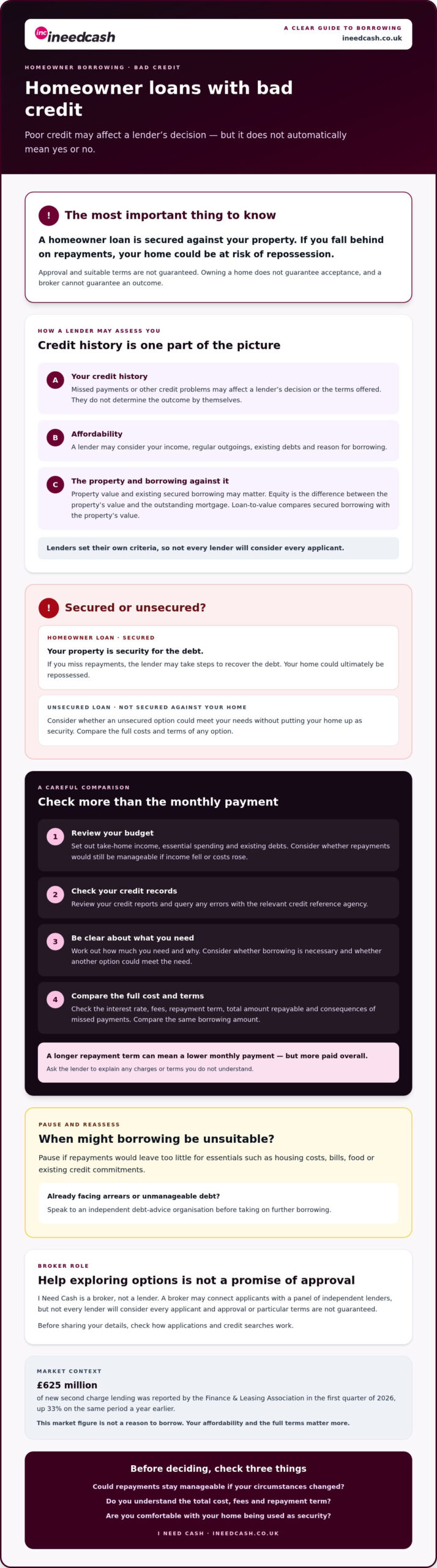
“Bad credit” can refer to concerns in your credit history, such as missed payments. It isn’t an automatic yes or no. A lender assesses the application as a whole, including affordability and property-related factors. These may include the property’s value and any existing borrowing secured against it. If you don’t keep up repayments, your home could be at risk of repossession.
Does bad credit automatically rule out a homeowner loan?
No. Lenders set their own criteria, and a credit score is only one part of the picture. They may consider your income, regular outgoings, existing debts and reason for borrowing when assessing affordability. A past credit problem may affect the decision or terms, but it doesn’t determine the outcome. Homeownership alone won’t make an application eligible, and a broker can’t guarantee acceptance.
How is a homeowner loan different from an unsecured loan?
A homeowner loan is secured against your property; an unsecured loan isn’t secured against your home. That difference matters if you miss repayments. With secured borrowing, your home could ultimately be at risk, so look beyond the monthly payment. Consider whether repayments would remain manageable if your circumstances changed. Compare the full costs and terms, and consider whether an unsecured option might meet your needs without putting your home up as security.
What does securing a bad-credit loan against your home mean?
Your property is security for the borrowing. If you fall behind on repayments, the lender may take steps to recover the debt, and your home could ultimately be repossessed. This risk applies regardless of your credit history.
Warning: securing debt against your home could put it at risk.
Some lenders may consider homeowner loans for bad credit, but using your home as security doesn’t guarantee acceptance or make borrowing suitable. A lender may assess your income, outgoings and existing debts, alongside property factors such as its value and the mortgage already secured against it. The difference between the property’s value and outstanding mortgage is your equity. A lender may also consider the loan-to-value ratio, which compares borrowing secured on the property with its value. Criteria differ, so check the lender’s full terms. The Financial Conduct Authority is the UK’s financial regulator; you can use its website to find information about financial firms and regulation.
When might a homeowner loan be unsuitable?
Pause if repayments would leave too little for essentials such as housing costs, bills, food or existing credit commitments. Check your budget against your take-home income and regular expenses, then consider whether repayments would still be manageable if your income fell or costs rose. If you’re already facing arrears or unmanageable debt, speak to an independent debt-advice organisation before taking on further borrowing.
What should you compare beyond the monthly repayment?
Check the interest rate, any fees, the repayment term and the total amount repayable in the lender’s information. A longer term can reduce the monthly payment but may mean paying more overall. When comparing offers, check that you’re looking at the same borrowing amount and consider how the term changes the total cost. Ask the lender to explain any charges or terms you don’t understand.
If you want to explore potential options, you can start an enquiry about borrowing. I Need Cash is a broker, not a lender; an enquiry doesn’t guarantee approval or particular terms.
How to compare homeowner loans for bad credit responsibly
Use a clear process before making a decision. The Finance & Leasing Association reported £625 million of new second charge lending in the first quarter of 2026, up 33% on the same period a year earlier. That market figure isn’t a reason to borrow. Your own affordability and the full terms matter more.
- Review your finances. Set out your take-home income, essential spending and existing debts. Work out what remains before deciding whether a repayment could realistically fit.
- Check your credit records. Review your reports and query any errors with the relevant credit reference agency.
- Establish your need. Work out how much you need and why. Consider whether borrowing is necessary and whether another option could meet the need.
- Compare terms. Check the interest rate, fees, repayment term, total amount repayable and consequences of missed payments, not just the monthly cost.
- Decide carefully. Proceed only if the repayments look affordable and you understand the commitment and the risk to your home.
MoneyHelper’s guide to secured loans describes a secured loan as “a loan that is secured against an asset, usually your home.” Read its guide to secured loans, and StepChange Debt Charity’s advice on comparing loans responsibly, before weighing up the risks. You can also review the provider’s homeowner loan options; check each lender’s criteria and disclosures.
What information should you prepare before exploring options?
Gather a realistic household budget, details of your income and a list of existing credit commitments. These can help you assess affordability and explain your circumstances. Requirements vary, so check directly with the lender rather than assuming there’s one standard document list.
When should you stop and seek independent help?
Pause if repayments look unaffordable, you’re behind on priority bills, or you’re borrowing to cover an ongoing shortfall. Consider independent guidance from MoneyHelper or a debt-advice charity. If you’ve reviewed the risks and want to explore potential options, start an enquiry. I Need Cash is a credit broker, not a lender, and an enquiry doesn’t guarantee a match or approval.
How I Need Cash can help you explore homeowner loans for bad credit
I Need Cash is a UK credit broker, not a direct lender. It connects applicants with a panel of independent lenders, which may help you explore whether any could consider your circumstances. Lenders set their own criteria, and not every lender will consider every applicant. A broker can’t guarantee a match, approval, a particular rate or loan terms.
The application service is free to applicants. That doesn’t mean any borrowing will be free, or that lender checks have no effect on your credit file. Before sharing information, check what the application involves, including whether and how a credit search may be carried out.
What happens when you explore options through a broker?
You provide information about your circumstances and borrowing needs so potential lender options can be explored. If a lender makes an offer, take time to read its disclosures before accepting. Check the repayment amount, interest rate, fees, term and total amount repayable. For secured borrowing, make sure you understand the consequences of missed repayments and the risk to your home.
What should you confirm before proceeding?
Check that repayments are affordable alongside your household essentials and existing commitments. Review the full terms, not just the monthly figure, and don’t proceed if the commitment could put your home at risk or leave you short of money for priority bills. You can take time to consider the information before deciding whether to take things further.
If you’re ready to explore potential options, explore your options with I Need Cash. An enquiry isn’t a promise of a suitable match or lender approval.
Make your next borrowing decision with care
Some lenders may consider homeowner loans for bad credit, but a poor credit history doesn’t guarantee acceptance or rule it out. Before applying, make sure repayments fit your budget, compare the total amount repayable and other terms, and think carefully about the risk of securing borrowing against your home.
I Need Cash is a credit broker, not a direct lender. It connects applicants with a panel of independent lenders, although not every lender will consider every applicant and no outcome or terms are guaranteed. The business states that it is authorised and regulated by the Financial Conduct Authority. Its application service is free to applicants, but that doesn’t mean borrowing itself is free or that lender checks have no consequences.
If you’ve weighed the risks and want to explore potential options, explore your options. Take your time, review any offer carefully and proceed only if the repayments feel affordable. A clear, considered decision starts with understanding the commitment and its risks.
Frequently Asked Questions
Can I get a homeowner loan with bad credit?
Possibly. Some lenders may consider homeowner loans for bad credit, but each sets its own criteria and approval isn’t guaranteed. They may assess your credit history alongside income, regular outgoings, existing debts and property-related details. Before applying, check whether repayments fit your budget and whether the lender’s terms suit your circumstances. Owning a home doesn’t by itself mean you’ll qualify.
Are homeowner loans for bad credit secured against my property?
Yes. A homeowner loan is secured against your property, which means your home acts as security for the debt. If you miss repayments and don’t resolve the arrears, the lender may take steps that could ultimately lead to repossession. Read the lender’s terms carefully and consider this risk before accepting. Secured borrowing can have more serious consequences for your home than missing payments on an unsecured loan.
Will applying for a homeowner loan affect my credit score?
Applying may affect your credit file, depending on the checks made. A lender or broker may use a soft search to assess eligibility or a hard search as part of a full application; a hard search can be visible to other lenders and may affect your credit score. Ask which search will be used, when it happens and whether your details will be shared before applying. Don’t assume a check has no impact.
What should I compare when considering a homeowner loan with bad credit?
Compare the interest rate, fees, repayment term and total amount repayable, not just the monthly payment. A longer term may reduce each payment but increase the total cost. Check the lender’s disclosures, including what could happen if you miss repayments, as your property is at risk with secured borrowing. Make sure repayments remain affordable alongside essential household costs and existing credit commitments.
Is a broker the lender for a homeowner loan?
No. A broker helps connect applicants with lenders, but doesn’t provide the loan itself. I Need Cash is a UK credit broker, not a direct lender, and connects applicants with a panel of independent lenders. Not every lender will consider every applicant, and a broker can’t guarantee approval or specific terms. If a lender makes an offer, review its terms and disclosures carefully before deciding whether to accept.

Article by
Mandy Paige
Social Content Writer and Blogger
Mandy has been writing for various website for a number of years, especially for companies in the consumer finance industry. She started her career guiding customers wanting help when applying for finance at a Loan Brokerage. Speaking to individuals wanting guidance, it lead her to start writing help and guidance on finding the right solution for their needs. Outside of writing, she is a wiz with a pair of scissors as she originally trained as a hairdresser.
Disclaimer
The content of this article/blog was correct to our knowledge on the date/time it was published.