 Skip to content

Budgeting Loan Alternatives in the UK: What to Check First
- Michelle
- Finance
What if the next step after a refused Budgeting Loan isn’t another loan at all? When an essential cost can’t wait, it’s tempting to look for quick credit. But budgeting loan alternatives may include support you don’t have to repay or a benefit-related option. What’s available depends on your benefits and where in the UK you live.
It’s understandable to feel unsure. A grant, a Budgeting Advance, a council scheme and a commercial loan all work differently, and repayments can add pressure. This guide explains what to check first, without assuming you qualify for support or need to borrow.
We’ll cover support routes across the UK, how to compare borrowing by eligibility, repayments and risk, and where to find impartial advice. If you’re still considering credit, you’ll have a practical way to check whether the repayments fit your budget before taking another step.
Key Takeaways
- Check whether you may qualify for benefit-related or local support before considering commercial borrowing.
- Compare budgeting loan alternatives by eligibility, whether repayments are required and how they could affect your budget.
- Before deciding, confirm the cost and deadline, and whether the expense can wait. Then review the actual repayment terms and missed-payment consequences.
- A broker isn’t the lender and can’t guarantee approval or suitable terms.
Budgeting Loan alternatives: what support should you check first?
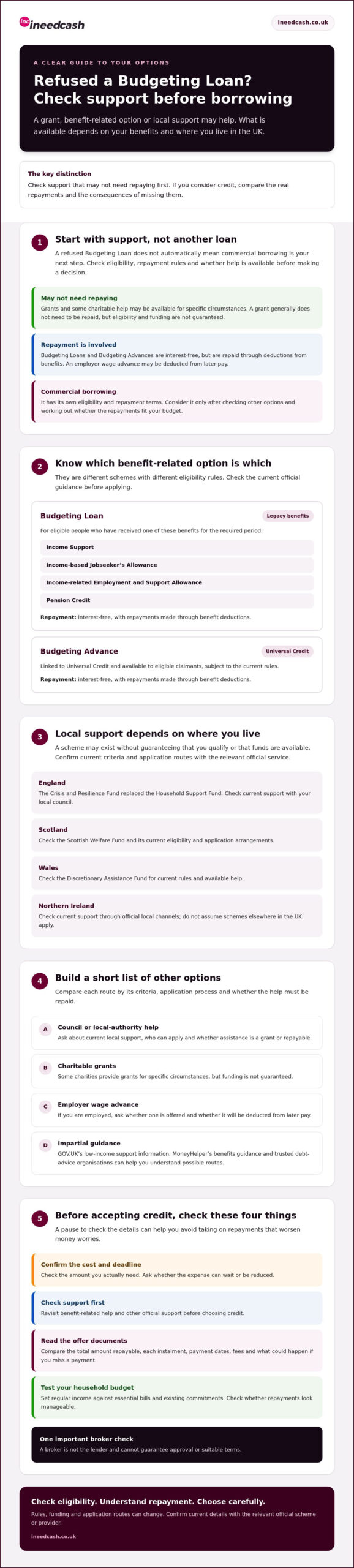
Before taking on commercial credit, check whether support that may not need repaying could help. A Budgeting Loan is a government loan for some people receiving qualifying legacy benefits. Other budgeting loan alternatives may include a grant, a benefit-related advance or charitable help. Commercial borrowing is another possible route, but it has different eligibility rules and repayment terms, so consider it only after checking other options.
Quick distinction: a Budgeting Loan is for eligible people on certain legacy benefits; a Budgeting Advance is for eligible Universal Credit claimants. Both are interest-free and repaid through benefit deductions. Check the current rules before applying. The Budgeting Loan developed from the Social Fund, which provides useful historical context.
Is a Budgeting Loan the same as a Budgeting Advance?
No. GOV.UK says Budgeting Loans are for people who have received Income Support, income-based Jobseeker’s Allowance, income-related Employment and Support Allowance or Pension Credit for the required period. A Budgeting Advance is linked to Universal Credit. Check the official Budgeting Loan eligibility and repayment guidance and Budgeting Advance guidance for current conditions, repayment arrangements and deductions.
Why do alternatives depend on where you live in the UK?
Local support varies across the UK. A scheme may exist without guaranteeing that you’ll qualify or that funds are available. England’s Crisis and Resilience Fund replaced the Household Support Fund on 1 April 2026. Scotland has the Scottish Welfare Fund, while Wales has the Discretionary Assistance Fund. Check the relevant official scheme or local authority for current eligibility, how to apply and whether help is a grant or must be repaid. In Northern Ireland, check current support through official local channels rather than assuming schemes elsewhere apply.
Consider borrowing only if support options don’t fit and the repayments look manageable. If you compare a commercial option, read its terms carefully. For example, payday loan information should not replace checking grants and benefit support first.
Which UK support options could help before you borrow?
Before taking on repayments, check whether a benefit-related advance, local-authority help, charitable grant or employer support could meet the need. Eligibility, funding and repayment arrangements vary, so confirm the details with the provider. GOV.UK’s financial support if you’re on a low income page is a useful starting point, but it doesn’t guarantee you’ll qualify.
Could a grant or council support be better than another loan?
A grant generally doesn’t need to be repaid, so it may be worth checking before borrowing. Eligibility and available funding aren’t universal, though. In England, ask your council about current local support. A Swift Money article published in April 2026 reported that the Crisis and Resilience Fund had replaced the Household Support Fund. Check current rules with your council, and look up official support separately in Wales, Scotland and Northern Ireland. Schemes and application routes differ across the UK.
What other non-commercial help is worth checking?
If you’re employed, ask whether your employer offers a wage advance and whether it will be deducted from later pay. Charities may provide grants for specific circumstances, while trusted debt-advice organisations can help you understand your options. Neither is guaranteed to provide funding. MoneyHelper’s benefits guidance can help you find relevant information. Check each provider’s current criteria and terms before relying on support.
Make a short list of possible routes. For each one, note the eligibility requirements, how to apply and whether the help must be repaid. This makes it easier to compare support before considering credit.
How to compare budgeting loan alternatives without worsening money worries
Pause before accepting an offer. Work through this checklist to decide whether the expense is urgent and whether repayments could fit your budget:
- Confirm the cost and deadline. Check the amount you actually need. Ask whether the expense can wait or be reduced.
- Check support first. Revisit benefit-related help and the official other help you can get before choosing credit.
- Read the offer documents. Compare the total amount repayable, each instalment, payment dates, fees and what could happen if you miss a payment.
- Test your household budget. Set regular income against essential bills, existing commitments and the proposed repayment. Check what remains after those costs.
APR helps you compare borrowing costs, but it can’t tell you whether a particular repayment is manageable for your household. The FCA’s guidance on borrowing money can help you understand what to consider. Affordability assessments and offered terms vary by lender and applicant, so read the actual agreement and ask the lender about anything unclear.
What should you check before accepting any credit?
Use your real budget, not an optimistic estimate. Don’t borrow more than the cost requires, and don’t treat approval as proof that repayments will be comfortable. Before agreeing, check the payment dates and what could happen if you miss a payment. Make sure you understand how each instalment fits alongside rent or mortgage payments, bills, food and other commitments.
When should you pause and seek debt advice?
If you’re already struggling with repayments or borrowing repeatedly to cover everyday costs, pause and speak to an impartial debt-advice organisation before taking on more credit. If an application asks for information about your finances, make sure you understand what’s requested and how it’s used. I Need Cash is a credit broker, not a lender, and lender decisions and terms vary. If you’ve checked support and decide to explore an application, you can start a loan enquiry, but only proceed if the repayments appear manageable.
When could a regulated broker be one budgeting loan alternative?
Commercial borrowing is a later option, not the automatic next step. Consider it only after checking relevant support and reviewing your budget. If repayments would leave you short for essentials, pause. A loan found through a broker may still be unsuitable for your circumstances, even if it’s one of the budgeting loan alternatives available to explore.
What does a credit broker do, and what does it not do?
A credit broker connects applicants with lenders; it doesn’t provide the loan itself. I Need Cash is a credit broker, not a lender, and connects applicants with independent lenders. Each lender sets its own criteria, checks eligibility and makes its own decision. Applying doesn’t guarantee an offer, approval or suitable terms.
Before proceeding, check the broker’s current entry on the FCA Register and read its explanation of its role. Review any lender’s offer documents carefully, including the total repayment, instalments, payment dates and consequences of missed payments. Don’t treat approval as proof that the borrowing is affordable.
How to take a careful next step
Confirm the cost and deadline, check support options, then test any proposed repayment against your household budget. Ask questions if a term is unclear. If repayments don’t seem manageable, or you’re already struggling with existing commitments, seek impartial debt advice rather than applying for more credit.
If you’re comparing payday credit, review its repayment terms carefully and use the payday loan information as a product comparison, not an endorsement. You don’t need to apply unless you’ve considered the risks and are comfortable with the terms. If you decide to explore an application, explore your options.
Choose your next step with care
The first option to check isn’t always another loan. Find out whether benefit-related help, a grant or local support could apply. Then compare any borrowing by its full repayment terms and what your household budget can manage. These checks can help you choose among budgeting loan alternatives without rushing into extra debt.
I Need Cash is a credit broker, not a lender. It connects applicants with a panel of independent lenders, but approval and terms depend on the lender and your circumstances. Before applying, check the broker’s current FCA Register entry and confirm whether applicants are charged a fee. Only proceed if the repayments appear affordable, and read the offer carefully before agreeing.
If you’ve checked support and decided that exploring borrowing may suit your situation, explore your options. Take time to understand the choices and choose a next step that feels manageable.
Frequently Asked Questions
Is a Budgeting Advance the same as a Budgeting Loan?
No. A Budgeting Advance and a Budgeting Loan are separate forms of government support with different eligibility rules and benefit contexts. If you receive Universal Credit, check whether a Budgeting Advance may apply rather than assuming you can get a Budgeting Loan. Before applying, use GOV.UK to confirm current eligibility, repayment arrangements and application steps, as rules and guidance can change.
Can I get help with an essential cost without taking out a loan?
Possibly. Depending on your circumstances, you could check benefit-related support, a grant, council assistance or charitable help before borrowing. Contact your local authority to ask what support is currently available, then check the scheme’s eligibility and repayment conditions. These budgeting loan alternatives aren’t available to everyone, so confirm details directly with the official provider before relying on support for an urgent bill.
Are grants a better alternative to a Budgeting Loan?
A grant may be worth checking first because it usually doesn’t need to be repaid. But eligibility rules, funding limits and availability vary, and applying doesn’t guarantee you’ll receive help. Check the current official support route for your UK nation and confirm the conditions with the provider. If no grant applies, compare any borrowing options by their repayment terms and affordability.
What should I do if I cannot afford my existing repayments?
Pause before taking on more credit and contact a free, impartial debt-advice organisation to discuss your situation. Review essential spending and, if a bill is urgent, contact the organisation you owe to ask what support may be available. Don’t assume another loan will fix ongoing repayment problems. A debt adviser can help you understand possible next steps based on your circumstances.
Does using a credit broker guarantee that I will get a loan?
No. A credit broker can introduce you to lenders, but each lender decides whether to offer credit and on what terms. I Need Cash is a credit broker, not a lender, and connects applicants with a panel of independent lenders. Approval isn’t guaranteed. Before applying, assess affordability after essential costs and existing commitments, read the information provided and check the broker’s current details on the FCA Register.

Article by
Mandy Paige
Social Content Writer and Blogger
Mandy has been writing for various website for a number of years, especially for companies in the consumer finance industry. She started her career guiding customers wanting help when applying for finance at a Loan Brokerage. Speaking to individuals wanting guidance, it lead her to start writing help and guidance on finding the right solution for their needs. Outside of writing, she is a wiz with a pair of scissors as she originally trained as a hairdresser.
Disclaimer
The content of this article/blog was correct to our knowledge on the date/time it was published.