 Skip to content

Homeowner Loans UK: How Secured Borrowing Works in 2026
- Michelle
- Finance
Could borrowing against your home meet a pressing need, or put the security you value at risk? When comparing homeowner loans uk with other borrowing, weigh the purpose, full cost and property risk together. A secured homeowner loan uses your property as security. It is different from an unsecured personal loan and does not replace your mortgage. If repayments become unaffordable, your home could be at risk.
Before applying, get clear on how homeowner loans work, how they differ from mortgages and personal loans, and what affordability checks and credit-file searches may mean. Compare representative APRs, fees, repayment terms and the total amount repayable, rather than judging an offer by its rate or monthly payment alone. I Need Cash is a UK credit broker that connects applicants with independent lenders. An enquiry can help you explore options, but it does not guarantee approval or particular terms.
Key Takeaways
- Understand how homeowner loans uk use your property as security, and why they are different from a first mortgage.
- Compare repayment terms and the total amount repayable, not just the monthly payment.
- Use a practical checklist to weigh your borrowing purpose, budget, existing commitments, property risk and alternatives.
- Learn what happens when you enquire through a broker, and why an enquiry does not guarantee a lender’s approval or particular terms.
What are homeowner loans in the UK and how do they work?
Homeowner loans are loans secured against a property you own. The property acts as security for the borrowing, so if you do not keep up with repayments, your home could be at risk. A homeowner loan is generally separate from a first mortgage rather than replacing it. The arrangement, repayment terms and lender’s rights depend on the loan agreement.
How is a homeowner loan different from a mortgage?
A first mortgage is usually the main loan used to buy a home. A homeowner loan can be additional borrowing secured against a property, including one that already has a mortgage. Some homeowner loans are structured as second-charge mortgages. MoneyHelper’s guide to second-charge mortgages explains how this type of borrowing differs from a first mortgage. The exact structure and terms depend on the lender and agreement.
What does it mean to secure borrowing against your home?
In plain terms, your home backs the loan. For example, if you borrow towards a renovation, the lender may take security over your property under the agreement. The FCA’s mortgage guidance uses the warning: “Your home may be repossessed if you do not keep up repayments on your mortgage.” This highlights the seriousness of secured borrowing. Read the specific terms and consequences in any loan offer.
People may consider homeowner loans for home improvements, a large planned expense or consolidating existing debts. These are examples, not recommendations, and a purpose that suits one person may not suit another. Explore homeowner loan options with the property risk in mind. For more on mortgage responsibilities, see the FCA’s guide to mortgages.
Homeowner loans versus unsecured loans: understand the trade-offs
A homeowner loan is secured against your property; an unsecured personal loan is not secured against a specific asset. That affects the consequences of missed repayments, but does not make secured borrowing automatically cheaper, easier to obtain or suitable for you. Your home could be at risk if you fall behind on a secured loan. For context, the Bank of England kept Bank Rate at 3.75% in September 2026, but that figure is not the APR for either type of borrowing. Compare the actual offer terms. Citizens Advice explains the distinction in its guide to mortgages and secured loans.
When might secured borrowing be worth exploring?
It may be one option to assess for a substantial planned expense or when comparing ways to borrow. That does not mean securing the debt is suitable, even if an instalment looks manageable. Consider how a drop in income or rise in household costs could affect your repayments. Any potential flexibility must be weighed against the added consequence: your home secures the borrowing.
What should you compare before choosing?
Use lender disclosures to compare the representative APR, fees, repayment term, monthly instalments and total amount repayable. A lower monthly payment may reflect a longer term, so check whether the overall cost is higher. For a useful comparison, look at offers for the same borrowing amount and repayment period where possible.
Test the instalment against your household budget, including regular bills, existing commitments and possible changes in expenses. Do not rely on an ideal month or assume a small payment will always feel manageable. The enquiry page is one way to explore options. An enquiry does not guarantee approval or particular terms.
How to assess homeowner-loan affordability, eligibility and risk
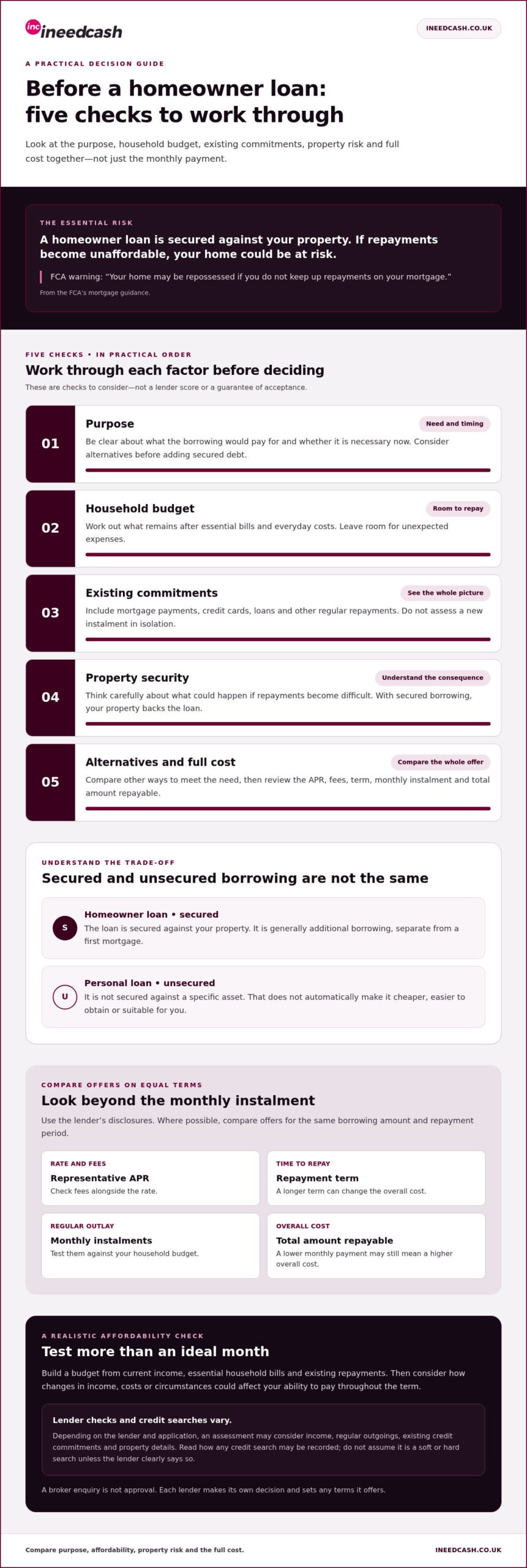
Before considering homeowner loans uk, pause and test the need, the repayments and the risk to your property. This checklist can help you make a grounded decision, but it cannot predict whether a lender will accept an application.
- 1. Purpose: Be clear about what the borrowing would pay for and whether it is necessary now. Consider alternatives before adding secured debt.
- 2. Household budget: Work out what remains after essential bills and everyday costs. Leave room for unexpected expenses.
- 3. Existing commitments: Include mortgage payments, credit cards, loans and other regular repayments. Do not assess a new instalment in isolation.
- 4. Property security: Think carefully about the consequences if repayments become difficult. Securing borrowing against your home puts the property at risk.
- 5. Alternatives and full cost: Compare other ways to meet the need, then review the APR, fees, term, monthly instalment and total amount repayable in the lender’s disclosures.
What information may lenders assess?
Depending on the lender and application, an assessment may consider your income, regular outgoings, existing credit commitments and details about the property. Criteria and information requested vary, so none of these factors on its own guarantees eligibility or acceptance.
Credit checks also depend on the lender and application process. Before proceeding, read the explanation of any search and how it may be recorded. Do not assume it is a soft or hard search unless the lender clearly says so.
How can you check whether repayments look manageable?
Build a realistic budget using your current income, essential household bills and existing repayments. Then consider how a change in income, costs or circumstances could affect your ability to pay throughout the term. The enquiry form lets you explore borrowing options. It is not approval: a lender decides whether to offer borrowing and on what terms.
Applying through a homeowner-loan broker: what happens next?
If you are exploring homeowner loans uk, a broker can help you search for possible options. I Need Cash is a credit broker, not a lender. It connects applicants with a panel of independent, regulated UK lenders. An enquiry is not approval: each lender makes its own decision and sets any terms it offers.
What happens after you make an enquiry?
You submit details about your circumstances and borrowing needs. These can be used to explore possible options with lenders on the panel, but a potential match is not a loan offer or a promise of acceptance. If a lender makes an offer, take time to review its agreement before deciding. Check the repayment schedule, APR, fees, total amount repayable and the consequences of missed payments. Proceed only if you understand the terms and believe the repayments are manageable.
How can you approach an application with confidence?
Have accurate information about your income, household spending and existing borrowing to hand. This helps you give a clear picture of your finances. If an enquiry involves sharing financial information, read what you are agreeing to and how it may be used.
There is no need to feel judged for asking about your options. Take the time you need, compare the full terms and keep the decision in your hands. An enquiry does not oblige you to accept an offer, and it does not guarantee that a lender will approve borrowing or offer particular terms.
You can make an enquiry when you are ready to explore the process.
Make your next step an informed one
Choosing between homeowner loans uk and unsecured borrowing means looking beyond the monthly payment. A homeowner loan is secured against your property, so weigh that risk alongside the purpose of borrowing and whether repayments are manageable over the full term.
Before deciding, compare the APR, fees, repayment period and total amount repayable. Check the figures against your household budget, existing commitments and possible changes in your circumstances. A lower instalment can mean paying over a longer period, not necessarily paying less overall.
I Need Cash is a credit broker, not a direct lender. It connects applicants with a panel of independent, regulated UK lenders and is authorised and regulated by the Financial Conduct Authority. An enquiry can help you explore options, but it does not guarantee approval or particular terms. Any decision to proceed is yours.
If you are ready to explore a possible route, start your homeowner-loan enquiry with I Need Cash. Take your time, review any offer carefully and choose the next step that feels right for your circumstances.
Frequently Asked Questions
What is a homeowner loan in the UK?
A homeowner loan is borrowing secured against a property you own. The lender takes security over the home under the loan agreement, so missed repayments can have serious consequences, including putting your property at risk. It is generally separate from a first mortgage rather than a replacement for it. The specific structure, repayment term and cost depend on the lender and agreement.
Can I get a homeowner loan if I already have a mortgage?
It may be possible to apply for a homeowner loan while you have a mortgage, but having one does not guarantee acceptance. The lender assesses your circumstances and its own criteria, which may include your income, existing repayments and property details. A homeowner loan can be secured against a property with an existing mortgage, but the terms and arrangement vary. Consider the added property risk before applying.
Will a homeowner loan affect my credit score?
It may, but the effect depends on the lender’s checks and how you manage repayments. An application may involve a credit search, so check what type of search will be made and how it may appear on your credit file before proceeding. Late or missed payments can harm your credit record. Do not assume an enquiry has no impact.
What can I use a homeowner loan for?
Possible purposes include home improvements, a large planned expense or consolidating existing debts, but these are examples, not recommendations. A purpose that suits one person may not suit another, particularly because the borrowing is secured against a home. Before applying, consider whether the expense is necessary, whether alternatives are available and whether you can afford the repayments over the full term.
What happens if I cannot repay a homeowner loan?
If you are worried you will miss a payment, contact the lender as soon as possible to discuss your circumstances and the options available under your agreement. Falling behind can lead to arrears and further consequences. Because the loan is secured against your property, continued repayment problems could ultimately put your home at risk. Do not ignore the issue. Review your budget and seek independent debt advice if you need support.

Article by
Mandy Paige
Social Content Writer and Blogger
Mandy has been writing for various website for a number of years, especially for companies in the consumer finance industry. She started her career guiding customers wanting help when applying for finance at a Loan Brokerage. Speaking to individuals wanting guidance, it lead her to start writing help and guidance on finding the right solution for their needs. Outside of writing, she is a wiz with a pair of scissors as she originally trained as a hairdresser.
Disclaimer
The content of this article/blog was correct to our knowledge on the date/time it was published.