 Skip to content

Secured Debt Consolidation Loans UK: How to Weigh Up Your Options
- Michelle
- Finance
Could combining several debts into one repayment make life easier, but leave your home carrying more risk? If you’re considering secured debt consolidation loans uk, it’s understandable to focus on the possibility of a lower monthly payment. But that figure alone won’t show whether the borrowing is affordable or what it could cost over the full term.
It’s important to weigh up both convenience and risk. Secured consolidation uses your property as security, so falling behind on repayments could put your home at risk. This guide explains how it works, what to compare with unsecured borrowing and other ways to manage debt, and which costs and terms to review before deciding. You’ll also see why extending a loan term can reduce monthly payments while increasing the total interest paid, and what to consider about affordability and clearing old credit balances. The aim is to help you make a considered decision, not rush into borrowing.
Key Takeaways
- See how secured debt consolidation loans uk can bring several debts into one new borrowing agreement, and why your home becomes part of the risk.
- Compare secured borrowing, unsecured consolidation and keeping existing repayments by looking beyond the monthly amount to total cost and missed payment consequences.
- Build a clear picture of affordability by listing your debts, current payments, income and essential outgoings before weighing up a new agreement.
- Understand I Need Cash’s role as a credit broker and why any lending decision and terms depend on a lender’s assessment.
How do UK secured debt consolidation loans work?
Secured debt consolidation loans uk are a form of borrowing backed by an asset, most commonly a homeowner’s property. If a lender approves the application, the loan funds may be used to repay several existing balances, such as credit cards or personal loans, leaving one new borrowing agreement to manage. The debt hasn’t disappeared; it has moved into a different arrangement. MoneyHelper’s guide to debt consolidation explains the general approach. The key difference here is that the borrowing is secured against property.
In the UK, this borrowing may be described as a homeowner loan. Where it is secured against a home that already has a mortgage, it may be called a second charge mortgage. By contrast, an unsecured personal loan isn’t secured against your home or another asset in this way.
What does it mean to secure borrowing against your home?
The property acts as security for the lender. If you don’t keep up with repayments, missed payments can put your home at risk. If the loan remains unpaid, this could ultimately lead to repossession. This makes secured borrowing fundamentally different from an unsecured debt, where your home isn’t pledged as security. Consider this consequence carefully before using your property to reorganise other borrowing.
Does one new repayment mean the debt has become cheaper?
Not necessarily. One payment can make due dates easier to manage, and a lower monthly repayment may feel more affordable. But it doesn’t prove the borrowing will cost less overall. A longer repayment term can mean paying interest for longer, while interest and any applicable fees also affect the total repayable.
Before comparing options, set the proposed agreement beside your current debts. For each option, check the monthly payment, the full amount repayable over the term, how long you’ll be paying and any fees. Also check whether there are costs for settling your existing debts. A smaller monthly figure can come with a higher overall cost, so consider both affordability now and the total commitment.
Is a secured debt consolidation loan worth the risk? Compare the trade-offs
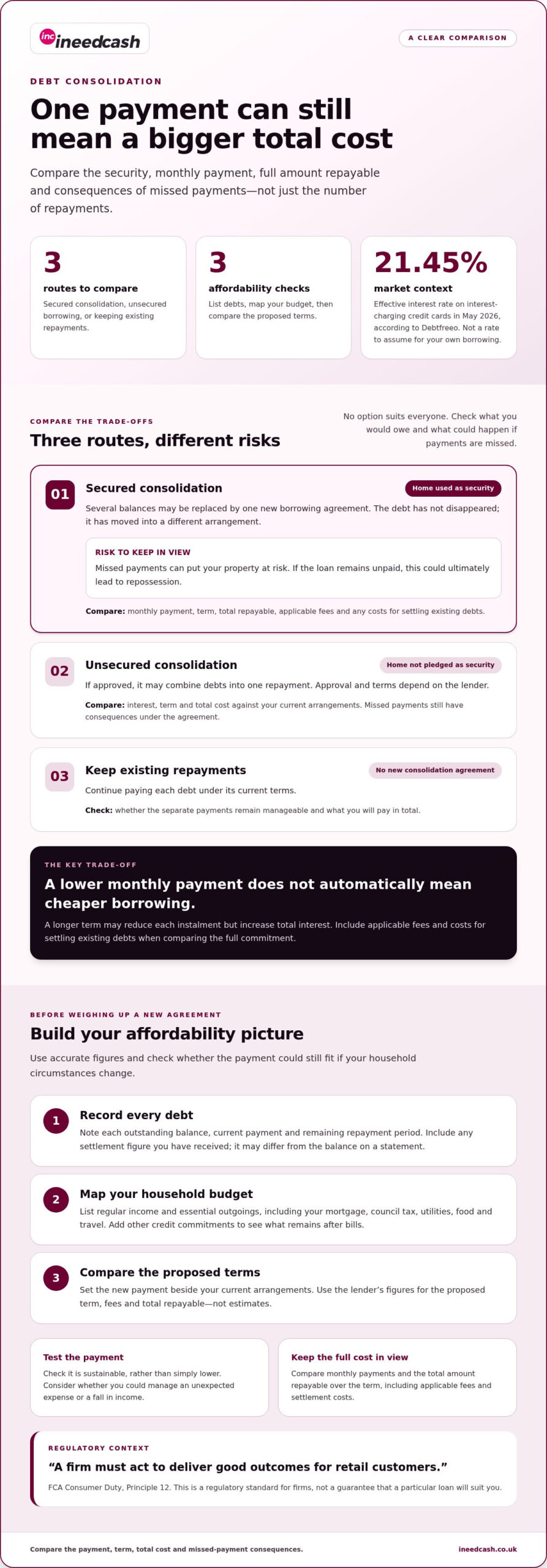
There’s no option that suits everyone. Compare the security, payment structure, overall cost and consequences of missed payments before deciding which route fits your circumstances.
Compare the trade-offs
Secured consolidation: Your home is used as security. Several balances may be replaced by one new repayment, but missed payments can put your property at risk. Compare the total repayable, including applicable fees and any costs for settling existing debts.
Unsecured consolidation: The borrowing isn’t secured against your home. If approved, it may combine debts into one repayment. Compare its interest, term and total cost with your current arrangements. Missed payments still have consequences under the agreement.
Keep existing repayments: You continue paying each debt under its current terms, without a new consolidation agreement. Check whether the separate payments remain manageable and what you’ll pay in total.
A lower monthly payment doesn’t automatically mean cheaper borrowing. A longer term may reduce each instalment but increase total interest. Include applicable loan fees and costs for settling existing debts in your comparison. The effective interest rate on interest-charging credit cards was 21.45% in May 2026, according to Debtfreeo. This is market context, not a rate to assume applies to your own borrowing.
The FCA’s Consumer Duty, Principle 12, states: “A firm must act to deliver good outcomes for retail customers.” This is a regulatory standard for firms, not a guarantee that a particular loan will suit you. StepChange Debt Charity’s guide to secured debt consolidation also discusses risks and alternatives.
When might another debt option be more appropriate?
If your current repayments are manageable, keeping them may avoid securing new borrowing against your home. Unsecured borrowing is another option to compare, although approval and terms depend on the lender. If you’re struggling with debt, seek independent debt advice rather than treating borrowing as a substitute for that support.
When you’re ready to compare borrowing options, you can explore your options. An application doesn’t guarantee an offer.
How to assess affordability before consolidating debts against your home
Before considering secured debt consolidation loans uk, build a realistic picture of your finances. Start with current figures, then consider whether repayments could still fit if household circumstances change. Use accurate information rather than best case assumptions.
Which figures should you compare before making a decision?
Gather the details for each debt, then map your household budget:
- Record your debts. Note each outstanding balance, current payment and remaining repayment period. Include any settlement figure you’ve received, which may differ from the balance on a statement.
- Map your budget. List regular income and essential outgoings such as your mortgage, council tax, utilities, food and travel. Include other credit commitments to see what remains after bills.
- Compare the proposed terms. Set the new payment beside your current arrangements. Use the lender’s figures to compare the proposed term, fees and total repayable, rather than relying on estimates.
Check whether the new payment is sustainable, rather than simply lower. Keep the property risk in view: consider whether you could manage if an unexpected expense arose or your income fell. Your budget should work beyond an ideal month.
What should you consider if your income changes?
Think through foreseeable changes, such as reduced working hours, a shift in household income or higher essential costs. Would the repayment still fit after those changes? Avoid relying on uncertain future income to justify borrowing secured against your home.
Prepare accurate details of income, spending and debts so you can make an informed assessment. This information may also be needed during an application, but it doesn’t guarantee eligibility or approval. If your figures leave little room for unexpected costs, pause and consider whether a secured commitment is sustainable.
Once you’ve reviewed your budget and the lender’s figures, you can explore your borrowing options.
How to explore secured debt consolidation loans with a UK credit broker
A credit broker helps connect applicants with lenders; it doesn’t make the lending decision. I Need Cash is a UK credit broker, not a lender, and connects applicants with a panel of regulated lenders. For secured debt consolidation loans uk, the lender assesses your circumstances and decides whether to offer borrowing and on what terms. An application doesn’t guarantee approval.
The process starts with sharing information about your finances and property. If lender options are presented, compare them with your existing debts and consider whether the repayments and property risk are acceptable. Take time to review the agreement before deciding whether to proceed. You’re in control of that decision.
What information may be useful when exploring homeowner borrowing?
Having relevant details to hand can make it easier to provide a clear picture of your situation. These may include:
- Balances and payments for the debts you’re considering consolidating.
- Income, regular household commitments and other borrowing.
- Information about your property and any existing borrowing secured against it.
Information requirements vary by lender and application, so provide accurate details and respond to requests for further information. This helps inform an assessment but doesn’t guarantee eligibility or an offer.
What should you read before accepting an offer?
Read the lender’s terms carefully before agreeing. Check the interest rate, any fees, the repayment period and total amount repayable. Make sure you understand when payments are due and the consequences of missing them, particularly because the borrowing is secured against your home. Compare the terms with your current arrangements, and don’t feel pressured to accept before you understand the commitment. If anything is unclear, seek independent advice.
If you’ve considered the risks and want to explore the next step, you can start an application. Any decision and terms will depend on the lender’s assessment of your individual circumstances.
Make your next step a considered one
Use your figures and the lender’s written terms to decide what feels sustainable for your household, not just what fits this month. If you’re still uncertain, pause and seek independent guidance before making a commitment secured against your home. Taking time to decide is a practical step, not a setback.
I Need Cash is an FCA-authorised and regulated credit broker that connects applicants with a panel of regulated UK lenders rather than lending directly. Any lending decision and terms depend on the lender’s assessment of your individual circumstances.
If you’ve reviewed your position and want to explore secured debt consolidation loans uk, take the next step with an application. There’s no promise of an offer or approval, so proceed only if the terms work for you.
Frequently Asked Questions
Can I consolidate unsecured debts with a secured loan?
Yes, a lender may approve a secured loan to repay eligible unsecured debts, such as credit card or personal loan balances. The lender’s decision and the loan terms depend on your circumstances. If debts are cleared this way, they’re replaced by borrowing secured against your home. Check which balances will be repaid and whether you need to close or manage any accounts afterwards.
Will applying for a secured debt consolidation loan affect my credit file?
It may, depending on the credit checks involved. Before submitting an application, find out whether the search will be recorded as a soft or hard check. A hard search can appear on your credit file and may affect your credit score; several applications in a short period could also be a concern to lenders. Check your credit report for accuracy before applying.
Can a secured debt consolidation loan reduce my monthly payments but cost more overall?
Yes. A longer repayment term can spread the borrowing over more time, lowering each instalment while increasing the interest paid across the agreement. Compare the total payable over the proposed term with the remaining payments on your current debts. Include any fees shown in the lender’s offer. A smaller monthly payment alone doesn’t establish that the loan is cheaper.
What happens if I miss repayments on a loan secured against my home?
Missing repayments can lead to arrears, extra charges under the agreement and harm to your credit record. Because the loan is secured against your home, continued non-payment could ultimately put your property at risk. If you think you’ll miss a payment, contact the lender promptly to discuss your situation and possible next steps. Don’t wait for arrears to build before seeking help.
Can I repay a secured debt consolidation loan early?
Possibly, but the agreement may set conditions or include an early repayment charge. Before paying extra or clearing the loan, ask the lender for a settlement figure and check how it’s calculated, whether charges apply and how long the figure remains valid. Compare the cost of early repayment with continuing as agreed, and make sure the payment won’t leave you short for essential bills.

Article by
Mandy Paige
Social Content Writer and Blogger
Mandy has been writing for various website for a number of years, especially for companies in the consumer finance industry. She started her career guiding customers wanting help when applying for finance at a Loan Brokerage. Speaking to individuals wanting guidance, it lead her to start writing help and guidance on finding the right solution for their needs. Outside of writing, she is a wiz with a pair of scissors as she originally trained as a hairdresser.
Disclaimer
The content of this article/blog was correct to our knowledge on the date/time it was published.