 Skip to content

Home improvement loans with bad credit: UK options explained
- Michelle
- Finance
A poor credit history doesn’t automatically rule out borrowing for renovations, but a low monthly payment can come with a higher overall cost or greater risk. The home improvement loans bad credit applicants can explore vary, and approval isn’t guaranteed.
It’s understandable to worry about rejection, affordability or putting your home at risk. A 2026 report by Evolution Money found that 67% of UK homeowners had delayed home improvement projects because of affordability. Borrowing still needs careful thought. This guide compares unsecured personal loans with borrowing secured against your property, and explains what to prepare before weighing up the options. You’ll also learn how to compare repayment costs and what to consider before applying. I Need Cash is a credit broker, not a lender, so any decision and terms depend on the lender’s assessment of your circumstances.
Key Takeaways
- Home improvement loans bad credit applicants may consider depend on the project, their circumstances and a lender’s assessment.
- Compare unsecured borrowing with homeowner borrowing, including the risk to your property if you miss secured repayments.
- Before comparing options, define the work, set a realistic repayment budget and check your credit-file details.
- Compare the total repayable, monthly payments, loan duration, fees and missed-payment consequences to assess affordability.
Can you get a home improvement loan with bad credit? Start with the project
Yes, a poor credit history doesn’t mean every lender will decline your application. A home improvement loan is borrowing intended to pay for work on a property. The options available depend on the lender and your circumstances. Approval depends on the lender’s criteria, your affordability and your individual circumstances.
Before considering home improvement loans bad credit options, decide which work needs doing and what can wait. Separate essential repairs from optional upgrades, then estimate the amount needed for the planned work. This helps you avoid borrowing extra for work that isn’t urgent.
What counts as a home improvement project?
Projects can range from repairing a leaking roof or replacing unsafe wiring to renovating a kitchen or building an extension. Improvements may make a home better suited to your needs, but don’t assume they’ll increase its value or recover their cost.
Write down the work you’re considering, identify what’s essential and note what could be postponed. Use estimates for the work to guide the amount you may need to borrow. A clear scope makes it easier to spot optional extras and avoid borrowing more than the project requires.
Does a poor credit history automatically rule you out?
No. Missed payments and other issues on your credit file can affect how an application is assessed, but lenders have different criteria and outcomes vary. A credit-file issue is one part of an assessment, not a guarantee of decline or acceptance. Check your records so you understand what a lender may consider.
If you’re looking at home improvement loans bad credit applicants may be considered for, start with the amount needed and whether repayments could fit your budget. Lenders assess applications individually, so a past credit problem doesn’t determine the outcome by itself. Borrowing is only worth considering if you can manage the repayments alongside your other commitments.
Secured or unsecured home improvement loans: understand the trade-offs
The main difference is whether your property is used as security. Neither option is automatically the cheapest or most suitable, particularly if you have a poor credit history. Compare the full repayment cost and consider what could happen if you can’t keep up with payments.
| Unsecured personal borrowing | Secured homeowner borrowing |
|---|---|
| Your home isn’t used as security for the loan. Approval and terms still depend on the lender’s assessment of your circumstances and affordability. | Your property is used as security. This may provide another route to explore, but it doesn’t guarantee approval or favourable terms. |
| Check whether the repayments fit your budget and compare the total amount repayable, not just the monthly payment. | Missed repayments can put your home at risk. Consider this consequence carefully before applying. |
What does using your home as security mean?
With secured borrowing, the property backs the loan. If you fall behind, the lender may take steps to recover what’s owed, and ultimately your home could be at risk. Read the agreement carefully to understand your repayment obligations and what may happen if you can’t meet them. Using your property as security doesn’t guarantee acceptance or better terms.
Explore homeowner loan options as one secured route, and weigh the risk to your property alongside any potential benefits.
When might an unsecured loan be worth comparing?
If you want to avoid securing borrowing against your home, an unsecured personal loan may be worth comparing. You’ll still need to repay it, and a poor credit history can affect eligibility and terms. Compare the total amount repayable, monthly commitment, fees and consequences of missed payments across both routes.
The right fit for home improvement loans bad credit applicants depends on the project and the repayments they can manage, not simply on whether a loan is secured. I Need Cash is a credit broker, not a lender. Its application process helps applicants explore options from independent lenders, but approval and terms aren’t guaranteed.
How to compare bad-credit home improvement borrowing responsibly
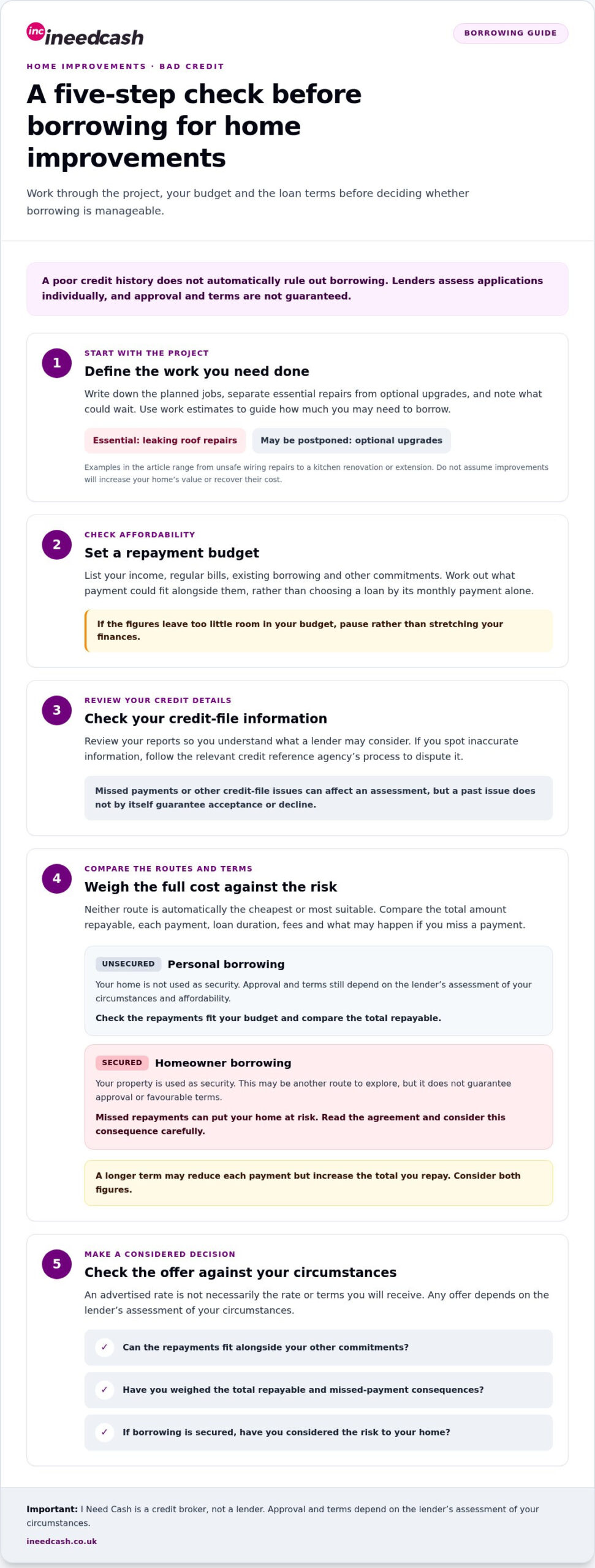
Compare options in stages, using the project and your budget to guide each decision:
- Scope the work. Separate essential jobs from upgrades and base your borrowing estimate on the work you plan to do.
- Set a repayment budget. List your income, regular bills, existing borrowing and other commitments to work out what payment could fit.
- Check your credit-file details. Review your reports and follow the relevant credit reference agency’s process to correct inaccuracies.
- Compare the terms. Check the total repayable, each payment, the loan duration, fees and what may happen if you miss a payment.
- Decide carefully. If the figures leave too little room in your budget, pause rather than stretching your finances.
An advertised rate isn’t necessarily the rate or terms you’ll receive; any offer depends on the lender’s assessment. A longer term may reduce each payment but increase the total you repay, so consider both figures.
What should you check before applying?
MoneyHelper explains how to check your credit report. Review the information held by credit reference agencies and use their process to dispute errors. You can also consult the FCA’s consumer credit guidance when considering borrowing. Matt Tristram, co-founder of Loans Warehouse, told The Intermediary in July 2026: “The latest housing figures suggest many homeowners are pressing pause on moving, but they’re certainly not pressing pause on improving their homes.” That observation doesn’t replace the need to assess your own budget.
How can you avoid taking on unaffordable repayments?
Stress-test your budget against regular bills and unexpected expenses before committing. Don’t assume a payment is manageable just because it fits in an ordinary month. If you’re considering open banking as part of comparing options, understand how the approach works and remember that it doesn’t guarantee eligibility or approval.
You can explore possible borrowing options through I Need Cash, a credit broker, not a lender. Lender decisions and terms depend on individual assessment.
Explore home improvement loan options with I Need Cash
If you’ve weighed up the project, repayments and risks, a broker offers another way to explore borrowing. I Need Cash is a UK credit broker, not a direct lender. It connects applicants with independent lenders, and its service to applicants is free. Exploring options doesn’t mean you’ll be approved or receive a particular loan offer.
What happens when you explore options through a broker?
You provide relevant details about your circumstances and borrowing needs. The broker can use these details to match your application with lenders on its panel. Each lender makes its own decision, based on its criteria and affordability assessment. Any offer or terms depend on your individual application.
This distinction matters when considering home improvement loans bad credit. A broker can help you explore possible routes, but can’t promise a lender will accept your application. If you receive an offer, read the terms carefully and compare the repayments and total amount repayable with your budget before deciding.
What should you decide before taking the next step?
Make sure you can clearly explain the work you want to fund and the amount you need. Set a monthly repayment limit that leaves room for regular bills and unexpected expenses. If an option uses your home as security, consider carefully whether you’re comfortable with the risk if repayments become difficult.
An enquiry is a way to explore, not a commitment to accept an offer. Review any potential terms and decide whether they fit your circumstances before proceeding.
Choose a next step that fits your plans
Your renovation plan can change, so reassess it before taking on repayments. If the work can wait, saving towards it or completing it in stages may give you more flexibility. If borrowing remains part of your plan, use your written scope and monthly budget as guides, and take time to consider any offer before committing.
Exploring home improvement loans bad credit options can be a starting point, not a decision you need to make today. Focus on finding terms that fit your circumstances and on understanding the risks, especially if your home would be used as security.
I Need Cash is a credit broker, not a direct lender, and its service to applicants is free. Lender decisions and terms depend on individual assessment. If you’re ready to explore, explore your loan options and review any potential terms carefully before deciding.
Frequently Asked Questions
Can I get a home improvement loan with bad credit?
Yes, a poor credit history doesn’t automatically prevent you from borrowing, but approval isn’t guaranteed. Lenders may consider your income, existing credit commitments and how you’ve managed borrowing, as well as the credit-file issue itself. When comparing home improvement loans bad credit applicants may be considered for, check that repayments fit your budget, including if your circumstances change.
Can I get a secured home improvement loan with bad credit?
Possibly. Some lenders may consider secured applications from people with a poor credit history, but each lender sets its own criteria and assesses affordability. Being a homeowner or offering property as security doesn’t ensure acceptance. Before exploring this route, consider whether you could maintain repayments if your income fell or an essential household expense increased. Your property is involved, so missed repayments can put it at risk.
Is an unsecured loan better than a secured loan for home improvements?
Not automatically. An unsecured loan doesn’t use your property as security, while a secured loan does, so the consequences of missed payments differ. Compare options only if they fit your circumstances, and weigh the payment amount against the full repayment cost and loan duration. For example, a lower monthly payment could still mean paying more overall if the borrowing runs for longer.
Will applying for a home improvement loan affect my credit score?
It depends on the type of credit check. An eligibility checker using a soft search can show whether you may fit a lender’s criteria without affecting your score. A formal application may involve a hard search, which can appear on your credit file. Check which search will be used before proceeding, and avoid making several full applications close together.
What can I use a home improvement loan for?
A home improvement loan is intended to fund work on a property. Depending on the lender’s terms, this might include bathroom repairs, damp treatment or loft insulation. Check that the work you plan to fund fits the loan’s stated purpose, and keep quotes or invoices to track spending. Borrowing for home improvements doesn’t guarantee the work will increase your property’s value.

Article by
Mandy Paige
Social Content Writer and Blogger
Mandy has been writing for various website for a number of years, especially for companies in the consumer finance industry. She started her career guiding customers wanting help when applying for finance at a Loan Brokerage. Speaking to individuals wanting guidance, it lead her to start writing help and guidance on finding the right solution for their needs. Outside of writing, she is a wiz with a pair of scissors as she originally trained as a hairdresser.
Disclaimer
The content of this article/blog was correct to our knowledge on the date/time it was published.