 Skip to content
Second Charge Loans UK: How They Work and What They Cost
- Michelle
- Finance
A second charge loan lets you borrow against your home while keeping your existing mortgage. In the UK, the second charge ranks behind the first mortgage, so the first lender is paid first if the property is sold. You’ll have two separate loans and monthly payments to manage.
Borrowing against your home is a significant decision, particularly when you’re weighing the cost against the risk. Understanding how the charges work helps you assess the commitment before deciding whether it suits your circumstances.
This guide explains how lenders assess your property’s equity, how repayment priority works and what can affect the overall cost. It also covers potential advantages and compares second charge loans with remortgaging and unsecured personal loans, so you can weigh the trade-offs.
Key Takeaways
- Work out how combined borrowing compares with your property’s value to understand the equity available and the lender’s likely assessment.
- Compare a second charge with remortgaging or a further advance, including the effect each could have on your existing mortgage rate and overall borrowing costs.
- Understand how registered charges set repayment priority, and why that order matters if the property is sold or you later remortgage.
- Weigh the risk of securing extra borrowing against your home against alternatives that may not use your property as security.
How do second charge mortgages work?
A second charge mortgage is borrowing secured against a property that already has a first mortgage. Its purpose, the property valuation and the lender’s priority shape how the loan works.
What a second charge loan is and how it works
The new loan is separate from the homeowner’s existing mortgage, so the borrower makes payments on both. The second lender’s charge is registered alongside the first at HM Land Registry. Second charge mortgages are regulated by the Financial Conduct Authority in the same way as first charge mortgages. The FCA’s mortgage warning says, “Your home may be repossessed if you do not keep up repayments on your mortgage,” a risk that also applies to secured borrowing. Find authorised lenders and brokers through the FCA Financial Services Register.
Combined loan-to-value calculations
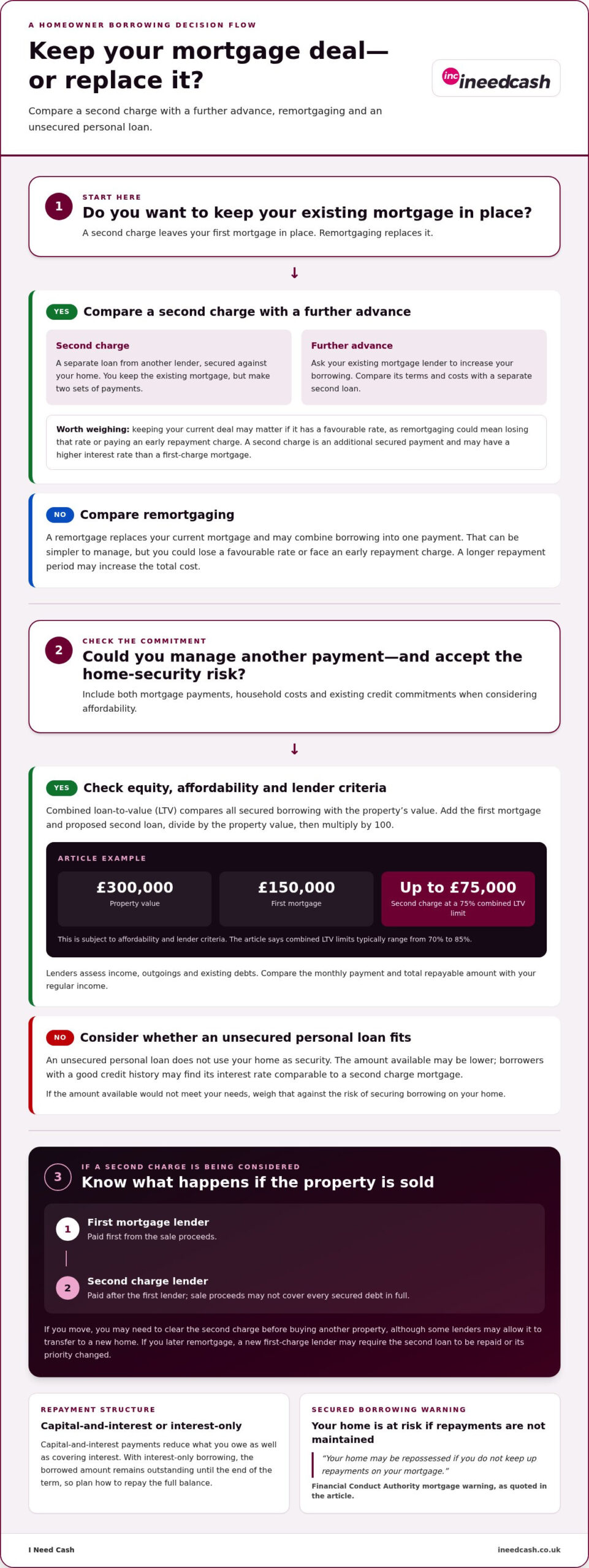
Combined loan-to-value (LTV) compares all secured borrowing with the property’s valuation: add the first mortgage and proposed second loan, divide by the property value, then multiply by 100. For example, a £300,000 home with a £150,000 first mortgage and a 75% combined LTV limit could support a second charge of up to £75,000, subject to affordability and lender criteria. Limits typically range from 70% to 85%. A developer example uses land and future properties valued at £45 million as security for a £31.5 million first loan, leaving £13.5 million equity and seeking a £2 million second loan for short-term costs while planning 10 homes.
Selling a property and repaying the loan
Selling a property secured by a second charge loan can affect how the loan is repaid. The first mortgage is paid before the second lender, which affects how much remains for you. If you move, you may need to clear the second charge before buying another property, although some lenders may allow it to transfer to a new home.
Restrictions on the use of loan funds
A second charge mortgage can fund many lawful purposes, but lenders may set restrictions on how you use the money. State your intended purpose in the application and check that it fits the loan terms. Short-term bridging finance may cover temporary costs, with repayment planned through a sale, refinancing or another evidenced source. The property itself is not a repayment plan. With interest-only borrowing, you must repay the full amount borrowed at the end of the term.
What Are the Advantages of a Second Charge Loan?
A second charge loan lets you raise money without replacing your existing mortgage. This may matter if your current deal has a favourable rate, since remortgaging could mean losing that rate or paying an early repayment charge. Keeping the first mortgage in place separates the new borrowing from your original deal. The trade-off is an additional secured payment, potentially at a higher interest rate than a first-charge mortgage.
A further advance is another option: you ask your existing mortgage lender to increase your borrowing. A second charge is a separate loan from another lender, with its own application and repayments. Compare both options with remortgaging, which replaces your current mortgage and may combine your borrowing into one payment. One payment can be simpler to manage, but a longer repayment period may increase the total cost.
Consider your purpose and the amount you need before choosing a route. An unsecured personal loan doesn’t use your home as security, and borrowers with a good credit history may find its interest rate comparable to that of a second charge mortgage. However, the amount available may be lower. A second charge loan may suit someone who needs to borrow more, but the property is at risk if repayments aren’t maintained.
Capital raising through a remortgage can be complicated if a second charge is already registered. The new first-charge lender may require the second loan to be repaid or its priority changed through subordination. That can affect whether the remortgage proceeds as planned. A broker can help compare the application routes, while lenders assess income, outgoings and existing debts. To explore borrowing options against your circumstances, get started with a loan enquiry.
Priority and repayment order for first and second charges
Registered charges determine repayment priority, while your loan agreement sets the repayment terms. You may be able to repay early, subject to the agreement and any early repayment charge it specifies.
Priority of first and second charges
Priority establishes which charge lender is paid first if secured property is sold. In England and Wales, registered charges generally rank in the order shown on the property register, unless an agreement or register entry changes that order. Section 48 of the Land Registration Act 2002 says registered charges on the same estate rank in the order shown in the register, according to UK Government, legislation.gov.uk. The first lender is therefore usually repaid before the second. This matters because sale proceeds may not cover every secured debt in full.
Affordability and repayment pressure
Before approving a second secured loan, lenders assess your income, outgoings and other debts. Comparing your debt with your income helps show how much you already spend on borrowing and whether another monthly payment is manageable. Include both mortgage payments, household costs and existing credit commitments in your budget. Interest rates also affect the total cost: a higher rate can make the loan more expensive, even if the initial monthly payment seems affordable. Compare the payment and total repayable amount with your regular income.
Repayment structures and exit strategies
A second charge mortgage may use capital-and-interest or interest-only repayments. With capital and interest, each payment covers interest and reduces the amount you owe. With interest-only payments, the borrowed amount remains outstanding until the end of the term, so plan how you’ll repay that final balance. For bridging finance, possible repayment sources include selling the property, refinancing, selling another asset or using another clearly evidenced source. A sale or refinancing plan should account for costs, timing and the first charge lender’s priority. The property itself does not repay the loan.
How does it compare with other borrowing options?
Compare each borrowing route with your goal, repayment capacity and willingness to put your home at risk. MoneyHelper’s UK consumer guidance on remortgaging and releasing equity provides a useful point of comparison when deciding whether to replace your mortgage or keep the borrowing separate.
Risks of property-secured borrowing
Your home is at risk if you don’t maintain repayments on a second charge loan. An unsecured personal loan doesn’t use your property as security. Consider how you’d manage if your income fell or household costs rose, and include all existing credit commitments in your budget. A lower monthly payment may still mean a higher overall cost if you repay over a longer period.
Interest, fees and total borrowing costs
Second charge loans generally have higher interest rates than first-charge mortgages because the second lender takes on greater risk. Valuation, arrangement and legal fees may also apply. Compare the interest rate, fees, monthly instalments and total repayable amount instead of judging a deal by its headline payment. If the rate is variable, consider whether your budget could absorb higher instalments during the loan term.
Home equity and borrowing limits
Equity is the property’s value minus borrowing already secured against it. For example, a £500,000 property with a £250,000 first mortgage and a £100,000 second charge has £350,000 in total secured borrowing, giving a combined loan-to-value ratio of 70%. Lenders assess the valuation, existing debt and affordability when deciding how much they may lend. A good credit history may help with an unsecured personal loan, though the available amount can be lower than property-secured borrowing.
Before applying, compare the full cost and the security involved for each route. This gives you a clearer basis for choosing the borrowing option that fits your needs.
I Need Cash: Homeowner Loans
I Need Cash helps you explore homeowner loan options by matching applications with products from independent lenders. It is a credit broker, not a lender, and helps you consider borrowing routes suited to your circumstances.
Consider I Need Cash when you’re weighing a homeowner loan against other borrowing and want to explore options that may suit your needs. These include personal loans, short-term loans and bad credit loans. A homeowner loan is secured against your property, so consider its repayments alongside your existing mortgage and household outgoings before proceeding.
Share your borrowing needs and circumstances with I Need Cash to explore a suitable route. Visit ineedcash.co.uk to get started.
Make your next borrowing decision with care
Before choosing between second charge loans in the UK and other options, write down what you need the borrowing to achieve. Then consider how the commitment fits with future plans, such as changing jobs, moving home or managing an unexpected drop in household income. A clear purpose and realistic budget can help you identify the questions that matter most.
There’s no need to rush a decision made under financial pressure. Take time to compare the full repayment commitment and the effect of securing borrowing against your home. If you’d like support exploring possible options, contact I Need Cash to discuss your options.
Choose an option that feels manageable for your circumstances, and move forward with a clear plan.
Frequently Asked Questions
What Are Second Charge Loans?
Second charge loans are a form of homeowner borrowing that adds a separate loan alongside an existing mortgage. A further advance, by contrast, increases borrowing through your current mortgage lender. When comparing offers, look at each agreement’s interest rate, repayment method, fees and total amount repayable rather than treating the options as interchangeable.
What Does a Second Charge on a Property Mean?
It means the loan agreement names a property as security for the debt. Check the documents to see which property is named and what conditions apply. The charge relates to that specified property, not automatically to every possession you own. This helps clarify exactly what the lender’s security covers before you agree to borrow.
Does the existing lender need to consent?
Generally, yes. Consent from your current mortgage lender is part of arranging a second charge, so consider it early rather than leaving it until the last minute. Prepare details of the proposed loan and your reason for borrowing when discussing the request. This can help clarify your existing lender’s position before you proceed with a separate application.
How does the loan work?
The lender reviews your application and sets out the borrowing terms in an offer. Read the agreement for the interest-rate type, repayment schedule, fees and early repayment conditions. For example, an interest-only arrangement requires a plan to repay the borrowed capital at the end of the term. A capital-and-interest schedule instead includes repayment of the balance over the agreed period.
What are the risks?
Taking on another loan increases the amount you need to manage from your household income. If the rate is variable, payments may change, so consider whether your budget could cope with higher costs. Consolidating other debts into borrowing secured on your home also changes the nature of that debt. Compare the new agreement’s full repayment terms with your existing commitments before proceeding.
What assets can be charged?
A second charge mortgage uses a property as security, usually the home connected with the mortgage application. It doesn’t automatically include a car, savings or household belongings in the charge. Check the security description in the loan documents to know precisely which property is involved. Other forms of borrowing may use different security arrangements, but they don’t automatically create a charge on your home.

Article by
Mandy Paige
Social Content Writer and Blogger
Mandy has been writing for various website for a number of years, especially for companies in the consumer finance industry. She started her career guiding customers wanting help when applying for finance at a Loan Brokerage. Speaking to individuals wanting guidance, it lead her to start writing help and guidance on finding the right solution for their needs. Outside of writing, she is a wiz with a pair of scissors as she originally trained as a hairdresser.
Disclaimer
The content of this article/blog was correct to our knowledge on the date/time it was published.