 Skip to content

Car Loan Finance Comparison: Find Your Best UK Rates
- Michelle
- Finance
A car loan is typically an unsecured personal loan used to buy a car, and you own the vehicle from the start. A car loan finance comparison helps you weigh the amount borrowed, interest and fees against the total you’ll repay and the balance still outstanding. Unlike hire purchase, you don’t have to wait until the final payment to own the car.
It’s easy to focus on the monthly payment when you’re trying to keep a car affordable. But that figure alone doesn’t show the full cost or what happens to the car when the agreement ends. This guide compares personal loans with PCP, hire purchase and leasing, explains what APR and total repayment reveal, and shows why the outstanding balance matters if you might sell the car before clearing the loan. Use these points to compare your options and decide which type of finance fits your plans.
Key Takeaways
- Compare the total repayable and how the car’s ownership changes under a personal loan, PCP, hire purchase or leasing.
- Match the amount you borrow to the car you need, then compare how lenders’ borrowing limits and terms affect repayments.
- Use representative APRs as a comparison point, and look beyond the monthly payment to the overall cost and remaining balance.
- See how I Need Cash’s personal loan options may fit if you’re considering borrowing beyond car finance agreements.
Personal loans compared with PCP, HP and leasing
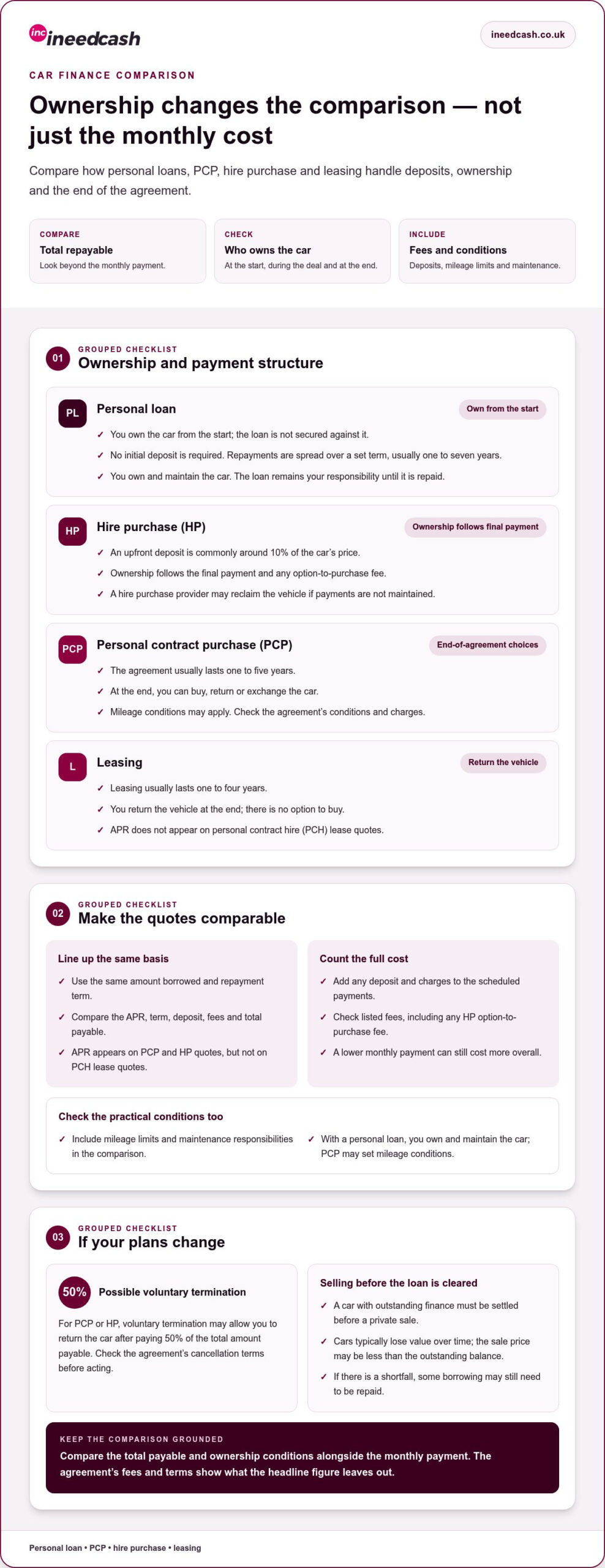
A personal loan, PCP, hire purchase (HP) and leasing differ in ownership, upfront payments and what happens at the end of the agreement. Compare the total payable and those conditions, not just the monthly payment.
Loan terms, rates and borrowing amounts
A personal loan spreads repayments over a set term, usually one to seven years, and doesn’t require an initial deposit. These bands help frame comparisons, but the APR shown in an individual offer matters most.
Comparing quotes, fees and total payable
Compare quotes using the same amount borrowed and repayment term, then add any deposit and charges to the scheduled payments. This shows the total amount payable and helps reveal when a low monthly payment costs more overall. Check the agreement for fees and conditions. With HP, an option-to-purchase fee may apply before ownership transfers.
With a personal loan, you own the car from the start. HP commonly involves an upfront deposit of around 10% of the car’s price, and ownership follows the final payment and option-to-purchase fee. PCP usually lasts one to five years; at the end, you can buy, return or exchange the car. Leasing usually lasts one to four years, then you return the vehicle, with no option to buy.
To compare personal loans with dealer finance, line up the APR, term, deposit, fees and total payable. APR appears on PCP and HP quotes, but not on personal contract hire (PCH) leases. For a car loan finance comparison, also include mileage limits and maintenance responsibilities in each agreement. PCP may set mileage conditions, while with a loan, you own and maintain the car.
For PCP or HP, voluntary termination may allow you to return the car after paying 50% of the total amount payable. Check the agreement’s cancellation terms before acting. To find FCA-authorised finance firms, use the FCA Register; for suspected mis-selling, raise a complaint with the lender and follow the available complaint process.
For charges, check the agreement for any deposit, option-to-purchase fee and other listed fees before signing. A car with outstanding finance must be settled before private sale. A hire purchase provider may reclaim the vehicle if payments aren’t maintained. Car finance information can help you compare the options alongside personal borrowing.
Typical car loan borrowing amounts
These are market ranges, not a promise of what every applicant can borrow. Start with the amount needed to buy the car, then compare it with a repayment that fits your budget.
Set a borrowing amount around the purchase
Start with the car’s price and any contribution you can make from savings. Borrowing only what you need avoids taking on extra debt to fund a larger purchase. If your savings cover part of the price, for example, base your application on the remaining amount, not the full price.
Car ownership brings costs beyond the purchase price. Insurance, road tax, fuel, MOTs, maintenance, repairs and parking all affect your budget. Include these expenses alongside the proposed loan payment before deciding how much you can afford to borrow.
Understand what shapes the offer
A lender assesses your credit information and financial details to decide whether to lend and on what terms. Applicants with a bad credit score may face higher rates, a larger deposit or stricter conditions. The amount offered may differ from what you initially hoped to borrow.
Compare the proposed monthly payments across the full repayment period. A longer term can spread the payments, but it also means carrying the debt for longer. Check that repayments remain manageable alongside routine motoring costs and other commitments.
Keep the outstanding balance in view
Cars typically lose value over time. If you sell before clearing the loan, the sale price may be less than the outstanding balance, leaving some borrowing to repay. Consider how long you expect to keep the car and whether your plans might change during the loan term.
Use the amount required, monthly affordability and likely ownership period to frame your decision. If you’re considering borrowing and want to explore available options, review your borrowing options before committing to a finance deal.
What a car loan is and how it works
A UK car loan is typically an unsecured personal loan used to fund a vehicle purchase. “Unsecured” means the loan isn’t secured against the car. You borrow an agreed amount and repay it with interest and any fees under the loan agreement. The car is yours from the start, rather than becoming yours after the final instalment.
What happens during an application
You choose how much to borrow and provide financial details. The lender checks your credit information to decide whether to lend. Its offer sets out the loan amount, interest rate, repayment period and scheduled payments. Review them together: a manageable monthly payment can still mean paying more interest over a longer term.
How repayments affect the balance
Repayments reduce the amount owed over time, while interest contributes to the total cost. Paying off a UK car loan early may help you save on interest. Check the lender’s settlement terms before changing your payment plan. Keep a record of payments and the remaining balance to track how the debt changes.
What ownership means if you sell
Unlike PCP or hire purchase, a personal loan doesn’t tie ownership to a final car-finance payment. You can keep or sell the vehicle, but the loan remains your responsibility until it’s repaid. Since cars typically lose value over time, selling before clearing the loan may not cover the outstanding balance. Consider this if you expect to change cars before the borrowing period ends.
Review the offer before accepting
Before accepting, check the amount borrowed, interest, fees and repayment schedule. Compare the annual percentage rate with the total repayable instead of judging the offer by one monthly figure. The lender’s final quote is based on a credit check and your financial details, so assess the terms and commitment in the offer.
What are typical APR rates for car finance in the UK in 2026?
Representative APRs provide a comparison point, but the rate offered depends on the borrowing and the lender’s assessment. Consider the rate alongside the agreement’s term and total payable.
What advertised APR tells you
A representative APR is an advertised borrowing rate, not a personal offer. Compare like with like by using the same loan amount and repayment period for each quote. Then check whether the displayed APR applies to the type of finance you’re considering. A monthly payment alone can hide differences in the total cost.
For background on how car finance works, MoneyHelper’s car finance guide explains the main agreement types. Use it to understand what a quote covers before comparing its cost with another option.
Why your offered rate may differ
A lender bases its quote on a credit check and your financial details. An online estimate doesn’t reflect your income, employment or creditworthiness, so the rate may change after assessment. Compare the final offer, not just an initial illustration, and review the repayment schedule to understand the full commitment.
Check the firm’s authorisation through the Financial Conduct Authority Register. This helps you identify whether a finance firm appears on the regulator’s register before you proceed.
Market reporting and rate context
Rates are only one part of the decision. Autotrader reports that “car finance commissions have been under investigation for the past year”. It’s sensible to understand how a quote is structured, including any commission information provided with the offer.
Keep a written record of the quoted APR, total payable and any fees. Compare these details across finance types rather than assuming offers with similar monthly payments cost the same. A clear comparison helps you judge the overall commitment and choose terms that fit your budget.
I Need Cash: Homeowner Loans
I Need Cash is a UK credit broker that matches consumers with financial products through independent lenders. If you’re weighing car finance against broader borrowing, its Homeowner Loans and Personal Loans may be relevant options to consider alongside your comparison.
The right route depends on what you need to fund and the repayments you can manage. Compare each agreement’s total cost, term and conditions, and remember that a homeowner loan is a separate borrowing option, not PCP or hire purchase. I Need Cash also offers Short Term Loans and Bad Credit Loans for people considering those types of borrowing.
For a clearer view of borrowing options, visit ineedcash.co.uk.
Make your next move with confidence
Before choosing finance, think about how long you expect to keep the car and how much flexibility you may need if your plans change. A car loan finance comparison should help you choose a commitment that fits your budget alongside ownership costs such as insurance, road tax, fuel, MOTs and repairs. Leave room for these expenses instead of using your full monthly budget on repayments.
Decide what matters most: owning the car immediately, keeping payments predictable or having options at the agreement’s end. Write down your priorities and use them to assess each offer’s total cost and conditions. If you’re considering borrowing beyond a car finance agreement, compare that option with your needs and repayment capacity.
For support exploring borrowing options, contact I Need Cash to discuss your options. Take the next step at your pace and choose the route that feels right for your circumstances.
Frequently Asked Questions
What is a car loan?
A car loan is borrowing used to pay for a vehicle, usually through an unsecured personal loan. For example, you could borrow the purchase amount and repay it on an agreed schedule while owning the car, rather than using a finance agreement that ties ownership to its final payment. Check that the loan’s permitted use and repayment terms fit the vehicle you plan to buy.
Will a car loan provider check my credit score?
Yes. A lender checks your credit information and financial details when assessing an application. This helps it decide whether to lend and what terms to offer. An initial eligibility search may be a soft search that doesn’t affect your credit score; a full credit check may follow for some loan types. Read the application information to understand which search applies at each stage.
Are there other ways to finance a car?
Yes. You can consider PCP, hire purchase, leasing or a personal loan, depending on whether you want to own a car or use one for a set period. Leasing, for example, suits someone who plans to return the vehicle, while a personal loan gives you ownership from the outset. Compare the agreement’s end conditions and total commitment with how long you expect to keep the car.
How do car loans work?
You apply to borrow an amount, and the lender assesses your credit information and financial circumstances. If approved, the offer sets out the repayment schedule and borrowing terms. You then make the agreed payments, covering the amount borrowed, interest and any fees. Keep the agreement handy and review your balance if you plan to sell the car or repay the loan early.
Are the monthly prices guaranteed?
No. An estimate doesn’t guarantee a monthly payment. It may not reflect your income, employment or creditworthiness, and the lender’s assessment can change the final quote. Before accepting, compare the formal offer with the estimate, including the payment amount, term and total repayable. Use the agreement’s figures to judge affordability if any details differ.
What types of car finance are available in the UK, including PCP, HP and personal loans?
Common options include personal loans, personal contract purchase (PCP), hire purchase (HP) and personal contract hire (PCH) leasing. PCP gives you choices at the end, including returning or buying the car. With HP, ownership follows the required final payment and fee. A personal loan means you own the vehicle from the start, while leasing involves returning it under the agreement.

Article by
Mandy Paige
Social Content Writer and Blogger
Mandy has been writing for various website for a number of years, especially for companies in the consumer finance industry. She started her career guiding customers wanting help when applying for finance at a Loan Brokerage. Speaking to individuals wanting guidance, it lead her to start writing help and guidance on finding the right solution for their needs. Outside of writing, she is a wiz with a pair of scissors as she originally trained as a hairdresser.
Disclaimer
The content of this article/blog was correct to our knowledge on the date/time it was published.