 Skip to content

Car Loans UK: Find the Best Way to Finance Your Vehicle
- Michelle
- Finance
An early repayment can change what you owe, not just when you finish paying. With a car loan in the UK, the settlement figure typically includes your outstanding finance minus future interest you won’t need to pay. The amount and timing of your repayments still matter, so it’s worth understanding the terms before you commit or settle early.
It’s natural to focus on the monthly payment, but a lower payment over a longer term can mean paying more interest overall. This guide explains what affects car finance costs, how to choose a loan amount and term that fit your budget, and what to look for before paying a loan back early. You’ll also learn how different finance arrangements work, so you can compare your options with more confidence.
Key Takeaways
- Before repaying early, get a settlement figure and compare it with your remaining payments; it typically deducts future interest you won’t need to pay.
- Compare APR, monthly repayments and total borrowing costs, not just the headline rate.
- Use a calculator to explore how the amount borrowed, deposit and repayment term affect your budget.
- Choose a loan amount and term that fit your finances, remembering that longer terms can lower monthly repayments but increase the interest paid overall.
Can I pay my loan back early?
Ask your lender for an early settlement figure before clearing car finance. It usually accounts for future interest you would no longer need to pay. Compare the figure with your remaining payments, then check your agreement for any early repayment charge. Before paying, confirm the final amount and payment instructions, as settling early changes the payment schedule.
Eligibility and credit checks
There’s no universal minimum credit score for car finance in the UK. Lenders assess your income, employment, creditworthiness and existing commitments to decide whether repayments are affordable. A full application involves a hard credit check by the lender. Provide accurate details and avoid making repeated applications without considering the checks involved. Bad credit may mean higher rates, a larger deposit or stricter terms.
Finance types and providers
Personal loans, Hire Purchase (HP) and Personal Contract Purchase (PCP) are common options. A car bought with a personal loan belongs to you from day one. With HP, ownership transfers at the end of the agreement after you pay the option-to-purchase fee. PCP may let you return the car, pay the balloon payment to own it, or put positive equity towards another deal.
A bank car loan is generally a personal loan, while a dealer can arrange PCP or HP through a lender. UK dealerships act as credit brokers and usually earn commission when customers sign finance agreements. Compare the annual percentage rate, total payable and agreement terms, rather than choosing on the monthly payment alone.
Fees, cashback and voluntary termination
Check the agreement for deposits, applicable fees and any early repayment charge. If a cashback offer applies, read its eligibility and payment terms, including which agreement qualifies and how the money is paid. Under PCP or HP, voluntary termination may let you return the car after paying 50% of the total amount payable. Check your payments against that figure before acting.
How much does car finance cost?
The total cost depends on the amount borrowed, repayment term, interest rate and any applicable fees. Compare the full borrowing cost as well as the monthly payment.
APR and interest rates
APR helps you compare the cost of borrowing across finance quotes, while the interest rate affects how much interest builds up. A representative APR is the APR offered to at least 51% of a lender’s customers, but your own quote may differ. APR applies to PCP, HP and Conditional Sale quotes, but not Personal Contract Hire leases. Check which rate and agreement type each quote uses.
Total borrowing costs
Look beyond the monthly payment. Compare the loan amount, total repayable, interest and applicable fees in each quote. A car finance estimate can show potential monthly payments and total interest, but it isn’t tailored to your circumstances. Use it to explore options, then compare it with a lender’s quote, which can set out the amount borrowed, interest rate, monthly payment and applicable fees.
Costs to budget for
Buying a car can bring costs beyond finance payments. Include insurance, vehicle tax and likely expenses such as servicing or new tyres in your budget. A car loan can also cover buying-related costs such as tax, servicing or tyres, but borrowing more increases the amount you repay. A deposit may reduce the sum financed; at least 10% of the total loan may be considered a good deposit.
Factors affecting finance costs
Lenders set approval and offered terms according to your circumstances, including income, employment and creditworthiness. The vehicle, deposit, amount borrowed and repayment term also shape the quote. Lloyds Bank says longer terms can reduce monthly repayments but increase the interest paid overall. Use a calculator to compare the effect of changing the term, then explore your borrowing options with those costs in mind.
Car finance calculator inputs
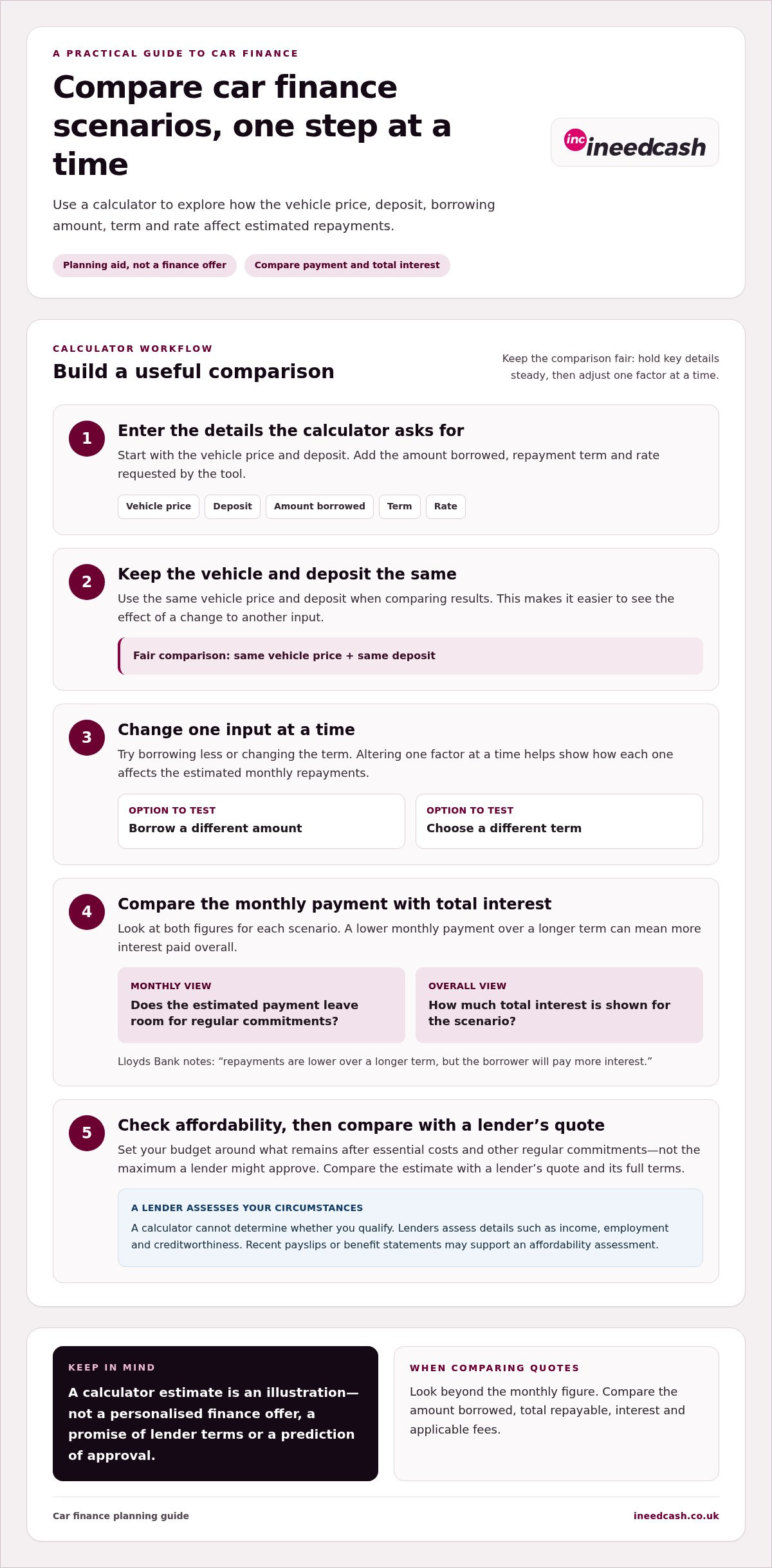
Use a calculator to compare realistic borrowing scenarios before deciding what to apply for. Enter the vehicle price, deposit, amount borrowed, term and rate requested by the tool. Keep the vehicle and deposit the same when comparing results, then change one input at a time. This helps show how each factor affects the estimated monthly repayments.
Test your budget
Try borrowing less or changing the term, then compare the estimated monthly payment and total interest. Treat each result as an illustration, not a personalised finance offer. A calculator can help you identify payments that leave too little room for other regular commitments. Set your budget based on what remains after essential costs, rather than the maximum a lender might approve.
Credit and applications
A calculator can’t determine whether you qualify. Lenders assess applications using details such as income, employment and creditworthiness. Recent payslips or benefit statements may support an affordability assessment. Your credit history can affect the terms offered, so use estimates to plan, not to predict approval or your actual rate.
Risks and broker commission
Repayments that strain your budget can increase the risk of missed payments. If you’re concerned about affordability, reconsider the amount before applying and read the agreement carefully. Dealers act as credit brokers and usually earn commission from lenders when customers sign finance agreements. Compare the full terms, not just the calculator’s monthly figure.
What longer terms can mean
Lloyds Bank notes that “repayments are lower over a longer term, but the borrower will pay more interest.” Keep this in mind when comparing scenarios, and weigh the payment against the total borrowing cost. An estimate is a planning aid, not a promise of the terms a lender will offer.
Choosing loan amounts and terms
Set your borrowing limit before choosing a vehicle. New cars in the UK can cost tens of thousands of pounds, so begin with a price that fits your budget. Include your deposit and likely purchase costs, then work out how much you actually need to borrow. Don’t let an available offer set your spending limit.
Choose an amount that fits your budget
Work backwards from your regular finances. Decide what monthly payment you can manage after household bills and other commitments, then compare vehicles and borrowing amounts with that limit. Leave room for changes, such as higher household costs. If a payment only works when nothing changes, consider borrowing less or choosing a lower-priced car.
Balance the term and repayments
A longer agreement spreads repayments over more months and can reduce each payment, but may increase the total interest. A shorter term means repaying the balance sooner, giving interest less time to accrue. Compare the total payable as well as the monthly figure. Choose a term that fits your budget without overlooking the overall cost.
Match the agreement to your driving
For PCP, check that the annual mileage allowance matches how you use the vehicle. Exceeding it can lead to an excess mileage charge, usually calculated in pence per mile. Estimate your regular driving before accepting the agreement, including routine journeys and possible changes during the term. A low payment is less useful if the agreement doesn’t suit your mileage.
Compare the amount, term and agreement together, then decide whether the repayments remain manageable. To explore borrowing options for your circumstances, get started with an application.
I Need Cash: Homeowner Loans
I Need Cash can help you explore borrowing options when comparing ways to fund a vehicle. As a credit broker, it matches consumers with independent lenders rather than lending directly. Homeowner Loans may be relevant if you own a home and want to consider that type of borrowing; Personal Loans are another option. The right route depends on your circumstances and the total cost, repayment schedule and terms.
Use the figures from your car finance comparison to decide whether a separate borrowing option makes sense. Consider the full repayments alongside your existing commitments, not just the monthly amount. I Need Cash also offers Short Term Loans and Bad Credit Loans for other borrowing needs. Review the options and terms before deciding whether to apply.
Visit ineedcash.co.uk to explore your options.
Make your next move with confidence
Before committing to a car loan in the UK, give yourself time to decide on your terms. Consider how the commitment would fit if your household budget changed or the car no longer suited your needs. A suitable choice is one you can live with beyond the excitement of driving away.
Write down what matters most: keeping flexibility, owning the vehicle outright, or knowing what happens at the end of the agreement. Use those priorities to guide your next steps. If you’re still weighing your options, I Need Cash can help you explore available borrowing routes. The right outcome depends on your circumstances, so take time to understand the terms before choosing.
Contact I Need Cash to discuss your options, and take the next step at a pace that feels right for you.
Frequently Asked Questions
How much can I borrow with car finance?
The amount you can borrow for a car loan in the UK depends on your income, employment, creditworthiness and the finance requested. There’s no single borrowing limit for every applicant. Before applying, work out what you can afford from your regular income and commitments. Set your borrowing target around that figure, not the vehicle’s maximum price.
Is a credit check done during my loan application?
Yes. A full car finance application involves a hard credit check by the lender. This differs from using a calculator, which provides an estimate without assessing your application. Before submitting, check that your requested amount and details are accurate. When comparing options, avoid sending multiple full applications without considering that each lender may carry out its own check.
What do I need to apply for car finance?
Prepare accurate details about your income, employment and regular financial commitments. A lender may also ask for recent payslips or benefit statements to assess affordability. Have these documents ready before applying, and make sure the figures you enter reflect your current circumstances. Missing or inconsistent information can make it harder to assess your application correctly.
What information is needed for a financing decision?
Lenders assess details such as your income, employment and creditworthiness alongside the amount requested. They use this information to judge affordability and decide whether to offer finance, and on what terms. For example, a requested repayment that doesn’t fit your income may affect the decision. Give complete, accurate information so the assessment reflects your circumstances.
What are typical UK car loan interest rates and APRs in 2026?
There isn’t one APR that applies to every UK borrower in 2026; rates depend on the lender, finance type and applicant’s circumstances. I Need Cash advertises car loans from a representative 8.9% APR. That is the company’s advertised starting representative APR, not a market-wide typical rate or a guarantee of the rate offered to you. Compare your own quote and total repayable.
How much can you borrow for a car loan in the UK, and over what terms?
There’s no single amount available to every applicant. The lender’s decision depends on affordability and the borrowing requested. Car finance terms typically run from one to five years. Compare repayments across suitable terms, then consider the total cost over the agreement. A longer term can reduce payments while increasing the total interest.

Article by
Mandy Paige
Social Content Writer and Blogger
Mandy has been writing for various website for a number of years, especially for companies in the consumer finance industry. She started her career guiding customers wanting help when applying for finance at a Loan Brokerage. Speaking to individuals wanting guidance, it lead her to start writing help and guidance on finding the right solution for their needs. Outside of writing, she is a wiz with a pair of scissors as she originally trained as a hairdresser.
Disclaimer
The content of this article/blog was correct to our knowledge on the date/time it was published.