 Skip to content

Cheap Car Loans: How to Secure the Best Rates in the UK
- Michelle
- Finance
A cheap car loan isn’t the only way to pay for a car. With a personal car loan, you typically own the vehicle from the start and repay the amount borrowed, plus interest and any fees, in monthly instalments. Hire purchase and personal contract purchase are other options, each with different ownership rules and choices at the end of the agreement.
Comparing borrowing options can feel daunting when you’re also trying to find a car that fits your budget. Look beyond the monthly payment: compare the total repayable, ownership terms, flexibility and any costs or rules for settling early.
This guide explains how car loans compare with car finance, how repayments and interest rebates work, and what lenders may ask for when you apply. You’ll also find practical ways to compare offers and judge whether the repayments fit alongside the rest of your motoring costs.
Key Takeaways
- Compare a personal loan with hire purchase or PCP by looking at ownership, flexibility and the total amount repayable, not just the monthly payment.
- Understand how borrowing, interest and early repayment can affect what you pay, then build motoring costs into your budget.
- Lenders use credit information to assess applications. Your income, existing commitments and credit history can influence the terms you’re offered.
- If you’re exploring borrowing options, I Need Cash can help you consider personal, homeowner or bad credit loans through its broker service.
What is the difference between a car loan and car finance?
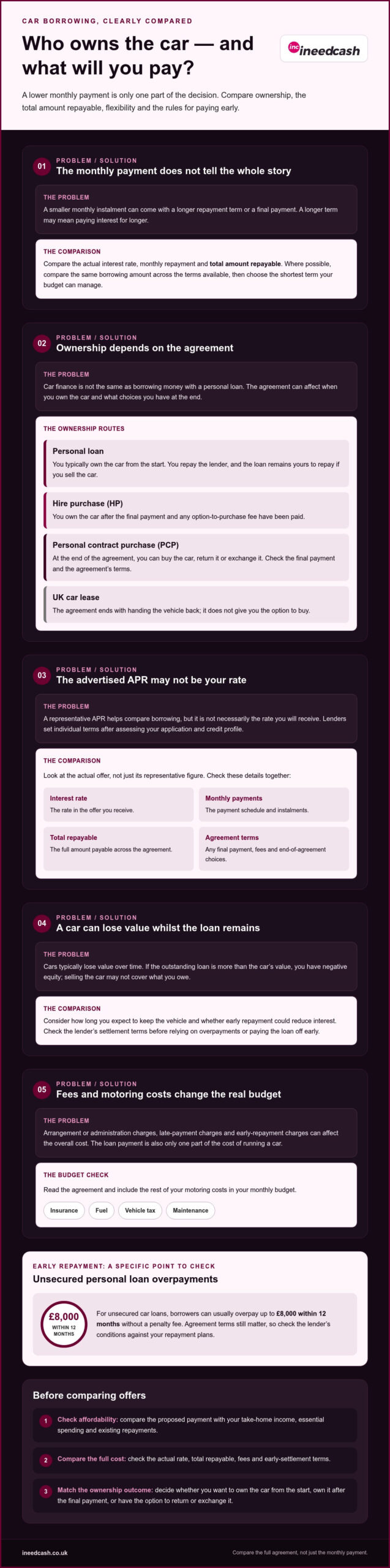
A personal car loan is money you borrow to buy a vehicle, usually from a dealer or private seller. You typically own the car from the start, then repay the amount borrowed, plus interest and any fees, in monthly instalments. With car finance, such as hire purchase (HP), the agreement is linked to the vehicle.
Ownership and loan amounts
Under HP, you own the car only after making the final payment and paying any option-to-purchase fee. Borrowing amounts are possibilities, not a guarantee of approval or a particular offer. A lender assesses your application against its criteria, including your credit information, income and existing financial commitments.
Compare APR and the total cost
A representative APR gives you an annual rate to help compare borrowing offers. The rate you’re offered may depend on your application and credit profile, so compare the actual terms, monthly repayment and total repayable, not just the representative figure. Check charges and the lender’s terms for paying off the loan early.
Choose a term that fits your budget
Choose a repayment term by balancing manageable monthly payments against the total cost. A longer term can lower each payment, but you may pay interest for longer. Compare the total repayable for the same loan across the terms available, then choose the shortest term your budget can manage. Include insurance, fuel, vehicle tax and maintenance in your monthly budget.
Consider long-term borrowing and negative equity
A long borrowing term can leave you paying for a car after it has lost value. If the outstanding loan is more than the car’s value, you have negative equity, and selling the car may not cover what you owe. Cars typically lose value over time, so consider how long you expect to keep the vehicle and whether early repayment could reduce interest.
Check your options at the agreement’s end
PCP offers a different choice at the end of the agreement: you can buy the car, return it or exchange it. A UK car lease ends with handing the vehicle back and does not give you the option to buy. Compare these ownership outcomes with a personal loan before deciding which option suits your plans.
How do car loans work?
A personal loan gives you money to buy a car, while car finance links borrowing to the vehicle. Compare payment structures, ownership and the full amount payable before choosing. MoneyHelper’s guide to car finance also outlines the main agreement types.
Car loans and dealer finance
With a personal loan, you borrow from a lender and use the money to buy from a dealer or private seller. You repay the lender and typically own the car from the start. Dealer-arranged finance is set up through the seller, with terms linked to the vehicle and finance product.
Compare the actual interest rate, total repayable, payment schedule and terms at the end of the agreement. A lower monthly payment may mean a longer term or a final payment. Choose a structure that suits your circumstances, including whether you want to own, return or exchange the car.
Representative APR and finance examples
The representative APR is an annual percentage rate intended to help compare borrowing costs. It isn’t necessarily the rate you’ll receive: lenders assess each application and set individual terms. Focus on the actual offer, including its interest rate, monthly payments and total amount repayable.
A finance example should show details such as the amount borrowed, any upfront deposit, repayment term, instalments and total payable. For PCP, check the final payment and your choices at the end of the agreement. Compare examples using the same borrowing amount and term.
Fees and charges to compare
Check each agreement for arrangement or administration charges, late-payment charges and early-repayment charges. These can affect the overall cost, so compare the total payable rather than relying on APR or monthly payments alone. The FCA says firms must “act to deliver good outcomes for retail customers” under its Consumer Duty.
Read the repayment terms to see how overpayments or early settlement affect interest. For unsecured car loans, borrowers can usually overpay up to £8,000 within 12 months without a penalty fee. Agreement terms still matter, so compare the lender’s conditions with your repayment plans.
If you sell a car bought with a personal loan, the loan remains yours to repay. With finance linked to the vehicle, settle the finance before a private buyer can legally own it. To explore borrowing options, review available loan choices.
Eligibility and application requirements
UK lenders assess credit information and affordability before deciding whether to offer a car loan. Prepare accurate details about your income, regular spending and existing borrowing so you can compare any offer with your actual budget.
Loan eligibility and income requirements
No single income figure guarantees approval across UK lenders. They consider whether your income can cover repayments as well as housing costs, bills and existing credit commitments. Before applying, make a simple monthly budget: list your take-home income, essential spending and current repayments, then compare what remains with the proposed loan payment. Lenders may ask about your income or employment, so keep your application accurate and consistent.
Credit score considerations
UK lenders check applicants’ credit information when deciding whether to lend. Start by reviewing your credit report and correcting inaccurate account or address details before applying. Bad credit may mean higher interest, a larger deposit or stricter terms. With little or no credit history, lenders have less repayment information to assess, so compare the terms offered and borrow only what fits your budget.
Age, income and residency rules
UK car finance is available to residents aged over 18, subject to terms and conditions. Lenders also assess income, commitments and repayment capacity. Before applying, check the lender’s stated criteria and prepare consistent address, employment and income information. Improving your chances means presenting an accurate application, managing existing repayments carefully and choosing an amount that fits your finances.
Affordability and FCA regulation checks
Assess affordability by comparing the proposed payment with take-home income after essential bills, existing repayments and vehicle costs. MoneyHelper’s budgeting guidance can help you organise those figures. To check whether a lender or broker is authorised, search its name on the FCA Register. The FCA says firms must “act to deliver good outcomes for retail customers” under its Consumer Duty.
What credit score is needed for a low-interest car loan in the UK?
No single credit score guarantees a low-interest car loan across UK lenders. Each lender assesses your credit information alongside your income, existing borrowing and affordability. A strong credit history can help, but your score alone does not determine the rate or approval. Compare the lender’s actual offer, including the APR and total repayments.
Credit reference agencies may use different scoring systems, so a score from one agency cannot tell you exactly how every lender will assess your application. Check your credit report for missed payments, incorrect account details or outdated addresses. Correct errors with the relevant agency or lender before applying. Accurate information gives lenders a clearer picture of your financial history.
Bad credit doesn’t automatically rule out borrowing. However, UK applicants with bad credit may face higher interest rates, need a larger deposit or receive stricter terms. A limited credit history can also make assessment harder because lenders have less information about past repayments. Focus on what you can afford and compare the full terms, not just the advertised rate.
Take practical steps before applying:
- Review your credit reports and dispute inaccurate entries.
- Pay existing credit commitments on time and avoid taking on unnecessary borrowing.
- Set a realistic budget for the car, deposit and monthly repayments.
- Compare offers using the amount borrowed, term, APR and total repayable.
These steps can help strengthen an application, but avoid submitting several full applications close together. Each lender has its own assessment criteria, and repeated applications can add checks to your credit file. Use eligibility tools where available, and read how they affect your credit record before proceeding.
If past credit problems are making mainstream borrowing difficult, a bad credit loan is one option to consider. Check its repayment schedule and total cost against your budget before deciding. Explore borrowing options and compare the terms that fit your circumstances.
I Need Cash: Homeowner Loans
I Need Cash is a credit broker that can help you explore borrowing options, including Homeowner Loans, Personal Loans and Bad Credit Loans, through a network of independent lenders. If you’re considering a homeowner loan to fund a car, compare the full repayment commitment with other options and consider how it fits your household budget.
Choose based on the amount you need, what you can afford to repay and the lender’s terms. A homeowner loan won’t suit every car purchase, so understand the agreement and compare it with a personal loan. I Need Cash can help you explore options through its network of independent lenders.
Visit ineedcash.co.uk to explore your borrowing options with I Need Cash.
Take your next step with confidence
Before applying, turn your car search into a clear borrowing plan. Decide what vehicle you need, how much you can contribute upfront and what monthly payment fits your budget. Keep those priorities beside each offer to assess whether the commitment works for you beyond the excitement of finding a car.
A low advertised rate may catch your eye, but the right agreement is one you understand and can manage throughout its term. If your circumstances or credit history need careful consideration, set a realistic budget before moving forward. This gives you a sound basis for comparing cheap car loans with other borrowing options.
If you’d like help exploring borrowing options, contact I Need Cash about your options. Take the next step at your own pace, with a clear plan in hand.
Frequently Asked Questions
Are there other ways to finance a car?
Yes. You can use savings or a personal loan, arrange hire purchase or PCP through a dealer, or lease a vehicle. Consider how long you want to keep the car and whether owning it matters. For example, leasing may suit drivers who plan to return the vehicle, while a personal loan may suit someone who wants to own it from the start.
Is a credit check done during my loan application?
Yes. Lenders use credit information to assess applications. The type of check can depend on the lender and the stage of the process. An initial eligibility search may be a soft search, while a later full application can involve a more detailed check. Read the application wording before submitting it so you understand what search may be recorded on your credit file.
What is APR (Annual Percentage Rate) and annual rate of interest?
APR is an annual measure designed to show the overall cost of borrowing, while an annual interest rate describes the interest charged on the amount borrowed. APR can include certain compulsory charges as well as interest, which makes it useful for comparing similar offers. Check that the borrowing amount and repayment term match, and read the agreement for charges listed separately.
Are car loans secured or unsecured loans?
A personal loan used to buy a car can be unsecured, meaning the car usually isn’t security for the borrowing. Hire purchase and PCP agreements are linked to the vehicle, and their terms govern ownership and what happens if you miss payments. Check the contract’s security and repossession terms before signing, as the agreement type affects your rights and responsibilities.
Are the monthly prices guaranteed?
A monthly payment shown before approval is an illustration, not necessarily your final payment. The lender’s formal offer sets out the actual instalments, interest rate and repayment schedule. Check whether the rate is fixed or variable, whether there’s a final payment and whether charges could change the total. For PCP, include any optional final payment when comparing the full commitment.
What are the cheapest car loan rates in the UK right now?
There isn’t one cheapest rate for every UK borrower. The rate offered depends on factors such as the amount borrowed, repayment term, credit history and lender assessment. Compare personalised APRs and total repayable for the same loan amount and term. An advertised representative APR is a comparison guide, not a promise that every applicant will qualify for that rate.

Article by
Mandy Paige
Social Content Writer and Blogger
Mandy has been writing for various website for a number of years, especially for companies in the consumer finance industry. She started her career guiding customers wanting help when applying for finance at a Loan Brokerage. Speaking to individuals wanting guidance, it lead her to start writing help and guidance on finding the right solution for their needs. Outside of writing, she is a wiz with a pair of scissors as she originally trained as a hairdresser.
Disclaimer
The content of this article/blog was correct to our knowledge on the date/time it was published.