 Skip to content

Poor credit history loans in the UK: check eligibility and costs
A poor credit history doesn’t automatically rule out borrowing. For poor credit history loans in the UK, each lender sets its own eligibility and affordability criteria, so your options depend on more than your credit score. Lenders also consider your circumstances and whether repayments appear affordable.
It’s understandable to worry that missed payments or a limited credit record will close every door. Lenders assess applications differently, but any loan still needs to fit your budget. This guide explains how credit history may affect eligibility, what affordability checks consider, and why borrowing costs and terms vary.
You’ll also learn what to expect with a limited credit history, which factors lenders may weigh, and how to assess repayments before taking on a loan.
Key Takeaways
- Understand how missed payments, IVAs and CCJs can affect a loan application, and why a limited credit history may be assessed differently.
- Learn what lenders consider when checking eligibility and affordability, including the information in your credit file.
- See why approval and borrowing costs depend on your circumstances, and what details may help when applying through a broker.
- Explore how bad credit, short-term, personal and homeowner loans differ, then consider whether repayments fit your budget.
What is poor credit history and how does it happen?
How credit problems develop
A poor credit history can develop after missed repayments, defaults or a County Court Judgement (CCJ). For example, repeatedly missing credit-card payments may make a later loan application appear riskier. Some records remain longer than six years, such as when a court orders a longer bankruptcy restrictions period.
How it can affect an application
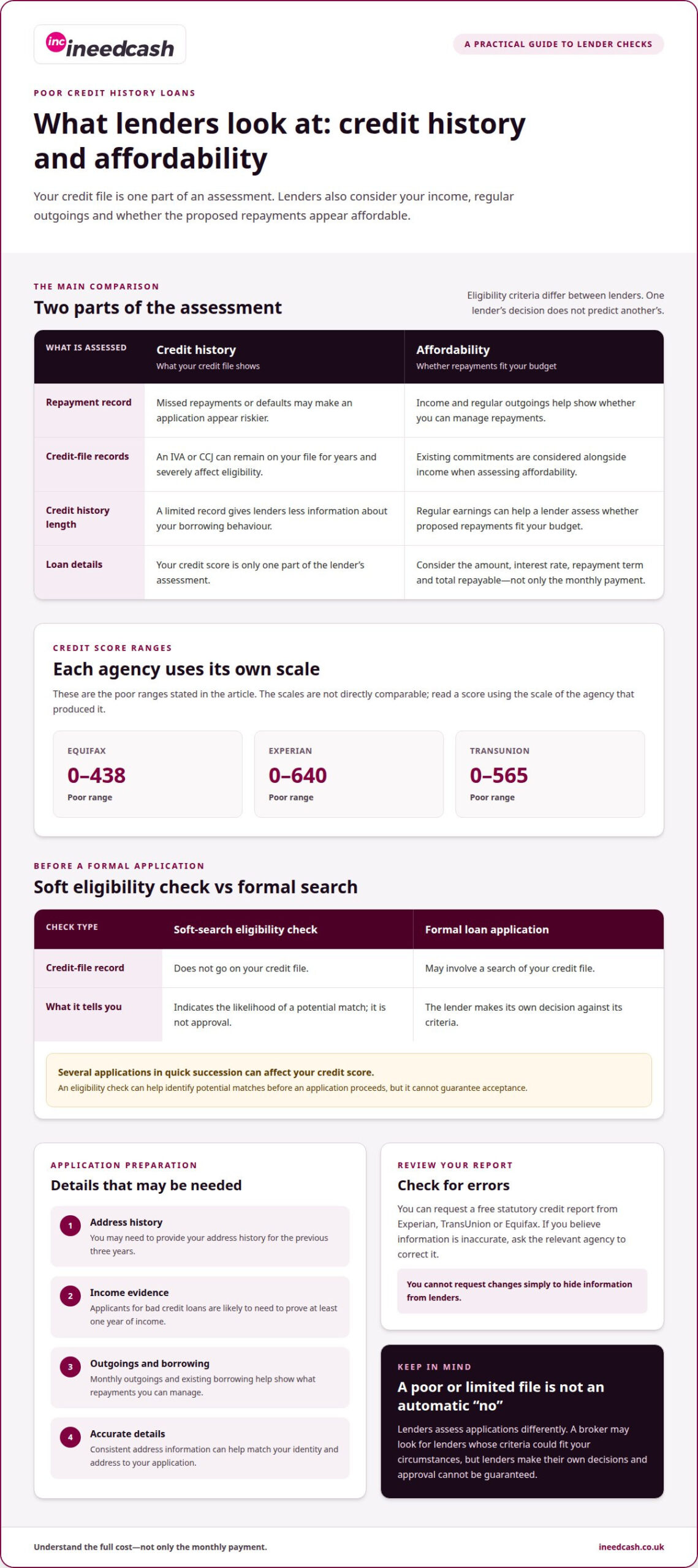
An individual voluntary arrangement (IVA) or CCJ can stay on your credit file for years and severely affect loan eligibility. A lender may refuse an application if its criteria aren’t met or repayments appear unaffordable. Your credit score is only one part of its assessment; income and existing commitments also shape how a lender views your circumstances.
Each UK credit reference agency uses a different scoring scale. Equifax’s poor range is 0 to 438, Experian’s is 0 to 640, and TransUnion’s is 0 to 565. These ranges aren’t directly comparable, so a score should be understood using the scale of the agency that produced it.
Alternatives to high-cost informal borrowing
A credit union may be an option to explore instead of borrowing from a loan shark. Some UK credit unions restrict membership by area or profession, while others require members to save before borrowing. Membership rules can affect whether you can join, and a savings condition may determine when you can borrow.
A broker can consider your circumstances and look for lenders whose criteria may fit your application. Details such as your income, existing commitments and past credit problems help identify potential options. A broker cannot guarantee approval because lenders make their own decisions.
Lender eligibility and affordability checks
Lenders assess whether your income, after regular outgoings, leaves enough to make the proposed payments. Eligibility criteria differ, so one lender’s decision doesn’t predict another’s.
A broker can help compare bad credit loans by looking at the amount borrowed, interest rate, repayment term and total repayable. This helps you assess the overall cost, not just whether the monthly payment seems manageable.
Hard searches and eligibility checkers
A formal loan application may involve a search of your credit file. An initial soft-search eligibility check, by contrast, doesn’t go on your credit file. A broker can use eligibility checks to identify potential matches before an application proceeds. This distinction matters: several applications in quick succession can affect your credit score, and an eligibility check indicates likelihood, not approval.
Electoral register and credit checks
Electoral register details can help lenders match your identity and address to your application. A broker can review whether the address details you provide are consistent, so you can address discrepancies before a lender assesses your application. For example, an outdated address may make it harder to match your details to your credit report. Accurate information supports these checks, but doesn’t determine affordability or guarantee acceptance.
You can request a free statutory credit report from Experian, TransUnion or Equifax. Review entries for errors, such as a payment wrongly shown as missed, and ask the relevant agency to correct information you believe is inaccurate. You can’t request changes simply to hide information from lenders. Credit files can also show which organisations searched them during the last 12 months, helping you understand recent application activity.
How easy is it to get a loan with ‘bad’ credit?
Getting a loan can be harder, but poor or limited credit doesn’t automatically end an application. For poor credit history loans in the UK, lenders may weigh income and regular commitments alongside your credit file.
Information needed for an application
A broker uses your personal and financial details to understand your circumstances and help prepare an application. You may need to provide your address history for the previous three years and evidence of income. Applicants for bad credit loans are likely to need to prove at least one year of income. Employment details, monthly outgoings and existing borrowing help show what repayments you can manage. An income figure that excludes regular deductions may give an incomplete picture of affordability.
Applying with poor or limited credit
A broker can use your application details to consider lenders whose criteria may suit your credit history. Someone who has recently moved to the UK, for instance, may have little local credit history, while another applicant may have missed payments on their file. Explain your circumstances honestly. Lenders make their own assessments, and acceptance by one doesn’t mean another will approve. Avoid making several applications at once, as multiple credit applications can affect your score.
Applying without a guarantor
You can apply without a guarantor; a guarantor isn’t the only route to borrowing. A lender may assess your income, outgoings and repayment record instead. For poor credit history loans in the UK, a broker can consider potential lender matches based on your application, but can’t promise approval. A guarantor may have to make repayments if you can’t, and could risk assets such as their home. Involve one only if they understand that responsibility and the proposed repayments remain affordable.
Eligibility for loans with poor or limited credit history
Eligibility depends on your income, existing commitments, credit file and how much you want to borrow. Regular earnings, for example, can help a lender assess whether proposed repayments fit your budget.
What lenders assess
A limited credit record gives lenders less information about your borrowing behaviour. That doesn’t automatically prevent approval, but lenders still need to assess affordability. Applicants for bad credit loans are likely to need to prove at least one year of income, which can help show financial stability.
Check your credit reports for mistakes, then ask the relevant agency to correct any information you believe is inaccurate. A wrongly recorded missed payment, for example, could affect how a lender views your application. Accurate records help lenders assess your circumstances, but don’t guarantee approval.
Rates and repayments
Bad credit personal loans typically have APRs of around 40% or more, depending on the borrower’s circumstances. Compare the APR, repayment amount and total repayable. For example, a lower monthly payment over a longer term may mean paying more interest overall.
Building a stronger credit record
Keeping up with repayments may improve your credit history over time and help you access better credit deals in future. For example, paying a credit-card bill on time can build a positive record, while missed payments may harm it. Keeping credit utilisation under 30% can also support your profile.
With poor credit history loans in the UK, borrow only what your budget can manage. If you have an IVA, approval from your supervising insolvency practitioner is needed to borrow more than £500. Consider this requirement before taking further credit.
I Need Cash: Bad Credit Loans
I Need Cash is a UK credit broker that helps people explore borrowing options when a poor credit history makes the search difficult. Its Bad Credit Loans service connects applicants with independent lenders, who assess each application and decide whether it meets their criteria.
Consider the type of borrowing
Bad Credit Loans may be relevant if past credit difficulties have narrowed your options. Consider the amount, purpose and repayment plan when deciding whether borrowing suits your situation. Before accepting an offer, for example, check whether the proposed repayments leave enough for regular household expenses.
Other loan options
A Personal Loan may be worth considering for a personal expense, while a Short Term Loan may suit a shorter borrowing need. These names describe different borrowing categories, not a promise that a particular term or offer will suit you. Review the repayment schedule and total amount payable before deciding.
Homeowner borrowing
Homeowner Loans may be relevant if you own a property and are considering borrowing against it. Homeownership alone doesn’t determine whether an application will be accepted. Consider the commitment carefully and read the lender’s terms, especially the consequences of falling behind on repayments.
Make an informed choice
I Need Cash can help you explore these loan categories through its brokerage service. Take time to understand any offer, including its interest rate, payment schedule and total cost. If repayments would put pressure on essential spending, borrowing may not be right for you. Choose only an option that fits your needs and budget.
For a no-pressure discussion about your options, contact I Need Cash.
Frequently Asked Questions
What are ‘bad credit loans’?
Bad credit loans are aimed at people whose credit history may make borrowing harder. A lender still assesses each application against its affordability and eligibility criteria. Someone with missed payments, for example, may be assessed differently from someone with little borrowing history. The label doesn’t mean every applicant will qualify or that a loan will suit their budget.
How much can I borrow with bad credit?
The amount varies by lender and your circumstances. These aren’t guaranteed borrowing amounts. Existing repayments or limited income, for example, may affect how much a lender considers affordable, even if its maximum borrowing limit is higher.
What counts as a bad credit score?
There’s no single UK score that defines bad credit, because credit reference agencies use different scales. Equifax’s poor range is 0 to 438, Experian’s is 0 to 640, and TransUnion’s is 0 to 565. These ranges aren’t directly comparable. For example, a score that appears low on one agency’s scale can’t be judged using another agency’s scoring system.
Can I get a loan if I’m on benefits?
Possibly. Lenders consider the income and outgoings in your application, alongside their own criteria. They may assess whether benefit income and any other earnings leave enough for repayments and essential costs. Eligibility rules apply.
What happens if I’m refused a loan?
If a lender refuses your application after checking a credit reference file, it must explain why and identify the agency it used. You can then review that agency’s report for information you believe is inaccurate and ask for a correction. A refusal doesn’t mean every lender will decide the same way, but avoid rushing into multiple applications without considering their potential effect on your credit file.
Why have I been rejected for a loan in the past?
A lender may reject an application because you don’t meet its eligibility rules or repayments don’t appear affordable. Existing credit commitments, for example, could leave too little income for another monthly payment. Missed repayments, a CCJ or an IVA may also affect how lenders assess risk. Check the reason given and the credit agency named; correcting an error may help ensure future assessments use accurate information.

Article by
Mandy Paige
Social Content Writer and Blogger
Mandy has been writing for various website for a number of years, especially for companies in the consumer finance industry. She started her career guiding customers wanting help when applying for finance at a Loan Brokerage. Speaking to individuals wanting guidance, it lead her to start writing help and guidance on finding the right solution for their needs. Outside of writing, she is a wiz with a pair of scissors as she originally trained as a hairdresser.
Disclaimer
The content of this article/blog was correct to our knowledge on the date/time it was published.