 Skip to content

Joint loans for bad credit in the UK: costs and repayment risks
- Michelle
- Finance
Bad credit doesn’t automatically rule out borrowing together, but a joint application makes both borrowers responsible under the same loan agreement. For joint loans for bad credit in the UK, lenders assess both applicants’ circumstances. A poor credit history may limit your options or result in a higher interest rate.
It pays to understand the shared responsibility: applying together doesn’t mean each person owes only half the debt. Either borrower may be liable for the full balance, and missed payments can affect both credit files. A loan may cover shared costs such as home improvements, a wedding or setting up a household, but the repayments need to fit your budget.
This guide explains what a joint loan can pay for, how lenders assess applications when one or both applicants have bad credit, and how to compare interest and repayments. It also explains how secured borrowing can put your home at risk if you fall behind, helping you weigh the potential benefit against the responsibility before deciding.
MoneyHelper explains: “You’re both responsible for repaying the loan.”
Key Takeaways
- Joint borrowing is commonly between £3,000 and £25,000 in the UK. Match the amount to the shared cost and a repayment you can both manage.
- Each borrower can be responsible for the full balance, not just half. Agree how you’ll handle repayments before taking out the loan.
- Bad credit may mean fewer options or a higher interest rate. Look closely at the APR and total repayable, not only the monthly instalment.
- A secured loan can put your home at risk if repayments fall behind. Weigh that risk carefully before using property as security.
What can I use a joint loan for?
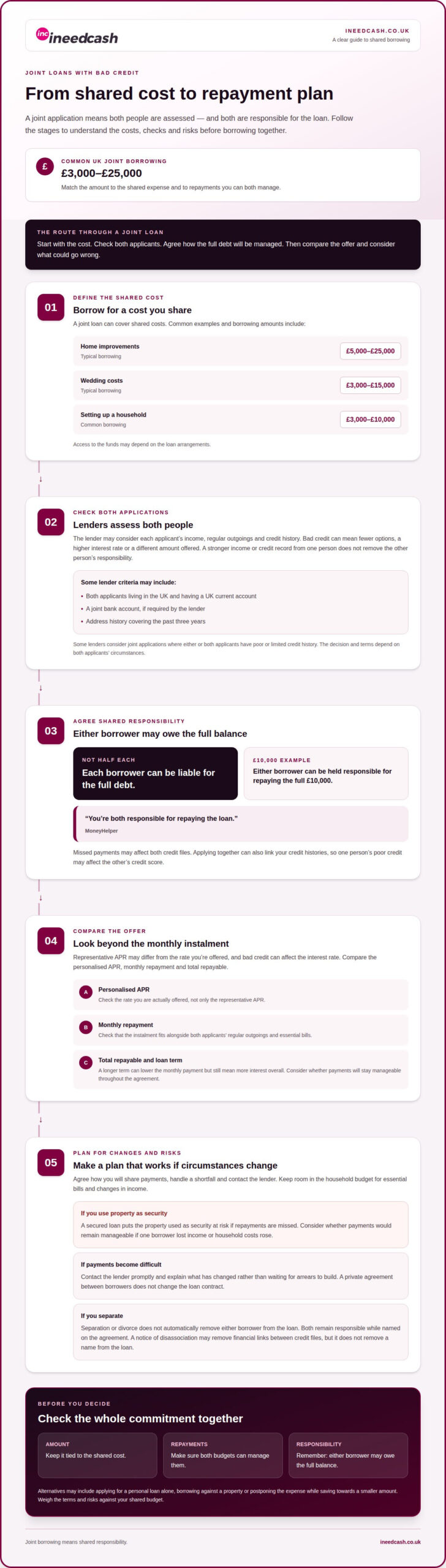
A joint loan lets two people borrow for shared costs. Common UK borrowing is £3,000 to £25,000. Uses include home improvements, typically £5,000 to £25,000; wedding costs, typically £3,000 to £15,000; and setting up a household, commonly £3,000 to £10,000. Access to the funds may depend on the loan arrangements.
Borrowing and repayments
Repayments are usually made in monthly instalments. Lenders consider both applicants’ income and regular outgoings when assessing affordability. The loan term affects both the monthly payment and the total interest, so consider whether the instalments will remain manageable throughout the agreement. For example, if you’re planning renovations together, agree how much each person will contribute before applying.
Both borrowers are responsible for the full debt, not just half. For a £10,000 joint loan, either borrower can be held responsible for repaying the full £10,000. A missed payment may affect both borrowers’ credit files. Applying together can also link your credit histories, so one person’s poor credit may affect the other’s credit score.
Credit, eligibility and alternatives
Some lenders consider joint personal loan applications from people with poor credit, but both applicants’ credit histories can affect the decision, rate and amount. One person’s stronger income or credit record doesn’t remove the other’s responsibility. No single offer suits every application, so the terms depend on both applicants’ circumstances.
Alternatives include applying for a personal loan alone, borrowing against a property or postponing the expense while saving towards a smaller amount. A secured loan puts the property used as security at risk if repayments are missed, so weigh this carefully before choosing one.
Both applicants may need to live in the UK and have a UK current account. Some lenders require a joint bank account, so having separate accounts may not meet their criteria. Lenders may also ask for address history covering the past three years.
Repayment difficulties and secured-loan risks
Build a repayment plan around both applicants’ regular outgoings, not just the amount each hopes to contribute. Lenders may assess your expenses to decide whether the repayments are affordable. Leave room in the household budget for essential bills and changes in income. If payments become difficult, contact the lender promptly and explain what has changed, rather than waiting for arrears to build.
Understand the risks before borrowing
A secured joint loan puts the property used as security at risk if repayments aren’t maintained. Before agreeing, consider whether you could still make the payments if one borrower lost their income or household costs rose. Debt consolidation combines multiple debts into one account, but the new payments still need to be made. Check that the repayment plan fits alongside your other commitments.
Agree in advance how you’ll handle a shortfall and who will contact the lender. Keep a record of how you plan to share payments, but remember that a private agreement between borrowers doesn’t change the loan contract. For borrowers facing more severe financial distress or property complications, debt-relief guidance from firms such as the Law Offices of Matthew T. Desrochers, P.C. outlines practical strategies for resolving liabilities and working towards future financing.
What happens if the relationship ends?
Separation or divorce doesn’t automatically remove either borrower from the loan. Each person remains responsible while named on the agreement, and a lender isn’t bound by a divorce agreement dividing the debt. The Information Commissioner’s Office says borrowers can apply to the three main credit reference agencies for a notice of disassociation after separation. This may remove financial links between credit files, but it doesn’t remove a name from the loan itself. When navigating severe disputes over joint liability or unmanageable debt, professional legal resources such as Ronald A. Davidson Attorney at Law can offer helpful perspective on how shared obligations are treated.
If repayments are becoming hard to manage, discuss the situation with the lender as early as possible. For information about taking the next step with a borrowing application, explore the application process.
Representative APR and example repayments
APR expresses borrowing costs as an annual rate, but the representative APR may differ from the rate you’re offered. Bad credit can affect the interest rate. Compare the personalised APR, monthly repayment and total repayable, then consider whether the payments fit alongside your existing commitments. A lower monthly payment can still mean more interest overall if the repayment term is longer.
Example repayment calculation
This example isn’t an offer. A different rate or term changes the monthly payment and total cost, so use the figures in your own loan agreement to assess affordability.
Both borrowers are responsible for meeting the agreement’s payments. If one person can’t contribute, the other may still have to cover the amount due. Agree how you’ll manage payments and unexpected changes before borrowing, rather than relying on an informal split that the lender hasn’t agreed to.
Early repayment and withdrawal
You can repay a joint personal loan early, but a lender may charge compensation when early repayments exceed £8,000 in any 12-month period. The maximum may be 1% of the amount repaid when more than 12 months remain, or 0.5% when 12 months or fewer remain. A lender may also charge up to 58 days’ interest when more than 12 months remain, or 28 days when fewer than 12 months remain.
For a regulated personal loan, the 14-day withdrawal period begins the day after the later of signing or receiving the executed agreement. After giving notice, you have up to 30 days to repay the capital plus accrued interest. Read the agreement’s early-settlement and withdrawal terms before deciding.
Joint loans for people with bad credit
Yes, you can apply for a joint loan in the UK with bad credit. Some lenders consider applications where either or both applicants have a poor or limited credit history. For joint loans for bad credit in the UK, approval depends on the lender’s assessment of both applicants. Bad credit may mean fewer options, a smaller loan or a higher interest rate, so consider the full cost as well as the approval decision.
Lenders assess both applicants and may review past debt management, current credit use, income and existing commitments. A co-applicant with a stronger credit record or higher income may support the application, but won’t erase the other person’s credit history or responsibility for repayments. For example, missed payments on one applicant’s record can still affect the decision and the rate offered.
You don’t have to be married or live with the other applicant. Couples, relatives or friends may apply together, provided both understand the shared commitment. Before applying, agree who will make the monthly payments and what you’ll do if one person’s income changes. A written plan for contributions can help clarify practical arrangements before you sign.
Compare the personalised APR, monthly repayment and total repayable in any offer. A longer term may lower monthly payments but increase the total interest. Don’t borrow simply because you’re approved. Ask whether the amount meets a shared need and whether both budgets can support the repayments. If one person’s credit history makes joint loans for bad credit in the UK unsuitable, consider whether applying alone or postponing the expense is more manageable. Explore the next steps for a loan application when you’re ready to consider your options.
I Need Cash: Bad Credit Loans
I Need Cash is a UK credit broker that matches applicants with options from independent lenders. If bad credit makes borrowing together harder, its Bad Credit Loans offering can help you explore potential routes based on your circumstances. A joint application still depends on the lender’s assessment of both applicants, including their credit histories, income and ability to manage repayments.
If a joint loan isn’t the right fit, consider whether a Personal Loan or Short Term Loan better matches your borrowing needs. A Homeowner Loan may also be an option, but secured borrowing can put your home at risk if repayments aren’t maintained. Weigh the costs and responsibilities carefully before proceeding.
Contact I Need Cash to discuss your borrowing options and the next step that may suit your circumstances.
Take your next step with confidence
The next step isn’t simply deciding whether borrowing is possible. Consider what would make the commitment manageable for both people: a clear purpose, agreed contributions and room in each budget for changes in circumstances. This gives you a practical basis for considering joint loans for bad credit in the UK, rather than focusing only on getting an application accepted.
Talk openly with the other borrower about shared responsibility, who will track payments and how you’d respond if one person’s income changed. If you can’t agree on these basics, pause and consider whether borrowing together suits your situation. A clear understanding is more useful than a rushed decision.
I Need Cash can help you explore borrowing options that fit your circumstances. Take the next step with I Need Cash and move forward at a pace that feels right for you.
Frequently Asked Questions
What are the types of joint loans?
Joint loans can be secured or unsecured. An unsecured personal loan isn’t tied to property, while a secured loan uses an asset such as a home as security. Both applicants are named on the loan agreement. Joint credit cards aren’t available in the UK, but a cardholder can add someone as an additional cardholder and remains responsible for the debt.
Can I get a loan if my partner has bad credit?
Yes, lenders may consider a joint application if one or both applicants have bad credit or a limited credit history. They assess both applicants, so your partner’s record may affect the interest rate, amount offered or approval decision. Before applying, discuss the full repayment commitment and consider whether you could manage the payments if your partner couldn’t contribute.
Does my partner need to be employed?
I Need Cash’s basic criteria require applicants to be employed. Lenders also assess income and regular outgoings to judge whether repayments are affordable. If your partner isn’t employed, don’t assume your income alone will meet the lender’s criteria. Eligibility depends on the lender’s assessment, including the income and commitments disclosed in the application.
What credit score and eligibility criteria apply to joint loans in the UK?
No single credit score guarantees eligibility. Lenders check both applicants and consider their credit histories, past debt management and current credit use. They also assess income and affordability. Applicants may need to meet criteria such as UK residency, having a UK current account and providing address history, so review the lender’s terms before applying.
How do lenders assess both applicants’ income, debts and credit histories?
Lenders assess the application as a whole, including each person’s income, regular expenses, existing borrowing and credit record. For example, a strong income may be offset by substantial existing commitments, while missed payments can influence the assessment. Give accurate details for both applicants, including debts and outgoings, so the lender can assess whether repayments fit your household budget.
What interest rates, APRs, loan amounts and repayment terms are available for joint loans with bad credit?
There’s no single rate or repayment term for every joint application. Bad credit may limit your options, lead to a higher interest rate or affect the amount offered. Lenders set terms after assessing both applicants’ credit histories and affordability. Compare the personalised APR, monthly payment and total repayable instead of judging an offer by its headline rate alone.

Article by
Mandy Paige
Social Content Writer and Blogger
Mandy has been writing for various website for a number of years, especially for companies in the consumer finance industry. She started her career guiding customers wanting help when applying for finance at a Loan Brokerage. Speaking to individuals wanting guidance, it lead her to start writing help and guidance on finding the right solution for their needs. Outside of writing, she is a wiz with a pair of scissors as she originally trained as a hairdresser.
Disclaimer
The content of this article/blog was correct to our knowledge on the date/time it was published.