 Skip to content

Logbook loan alternatives and other borrowing options
- Michelle
- Finance
Your car can be at risk with a logbook loan, so consider the alternatives before borrowing. This type of loan is secured against your vehicle, and the lender may seize and sell it if you fall behind on repayments. An unsecured personal loan, credit union loan or salary advance could be alternatives, depending on your circumstances.
It’s understandable to focus on getting money quickly when a bill can’t wait. But the cost of borrowing and what you could lose matter just as much. Lenders may assess your credit history, income and outgoings, or focus mainly on the vehicle offered as security.
This guide explains how logbook loans work, what lenders may assess and what can happen after missed payments. It also covers alternatives, including when a government budgeting loan or advance may be available, so you can compare your options with more confidence.
Key Takeaways
- Understand how a bill of sale connects a logbook loan to your vehicle, and why that matters if repayments fall behind.
- Find out what lenders may review, from your credit history to your bank statements and the vehicle offered as security.
- See why missed payments can put your car at risk, and what a default notice means for your next steps.
- Explore borrowing options that don’t use your car as security, and consider which may better fit your circumstances.
Risks of vehicle repossession after missed repayments
A logbook loan is secured against your vehicle. In England, Wales and Northern Ireland, logbook loans are set up using a bill of sale governed by the Bills of Sale Act 1878 and its 1882 amendment, according to the UK legislation portal. This document gives the lender rights over the car while the loan remains unpaid. If you default, the lender may seize and sell it. If the sale proceeds fall short of the amount owed, you may still owe the difference.
There is a legal distinction between logbook loans and some other vehicle finance. Section 90 of the Consumer Credit Act 1974 provides a court-order safeguard for repossession under hire purchase and conditional sale agreements after a borrower has paid a third of the agreement, according to the UK legislation portal. That safeguard does not apply to a logbook loan simply because you have made repayments.
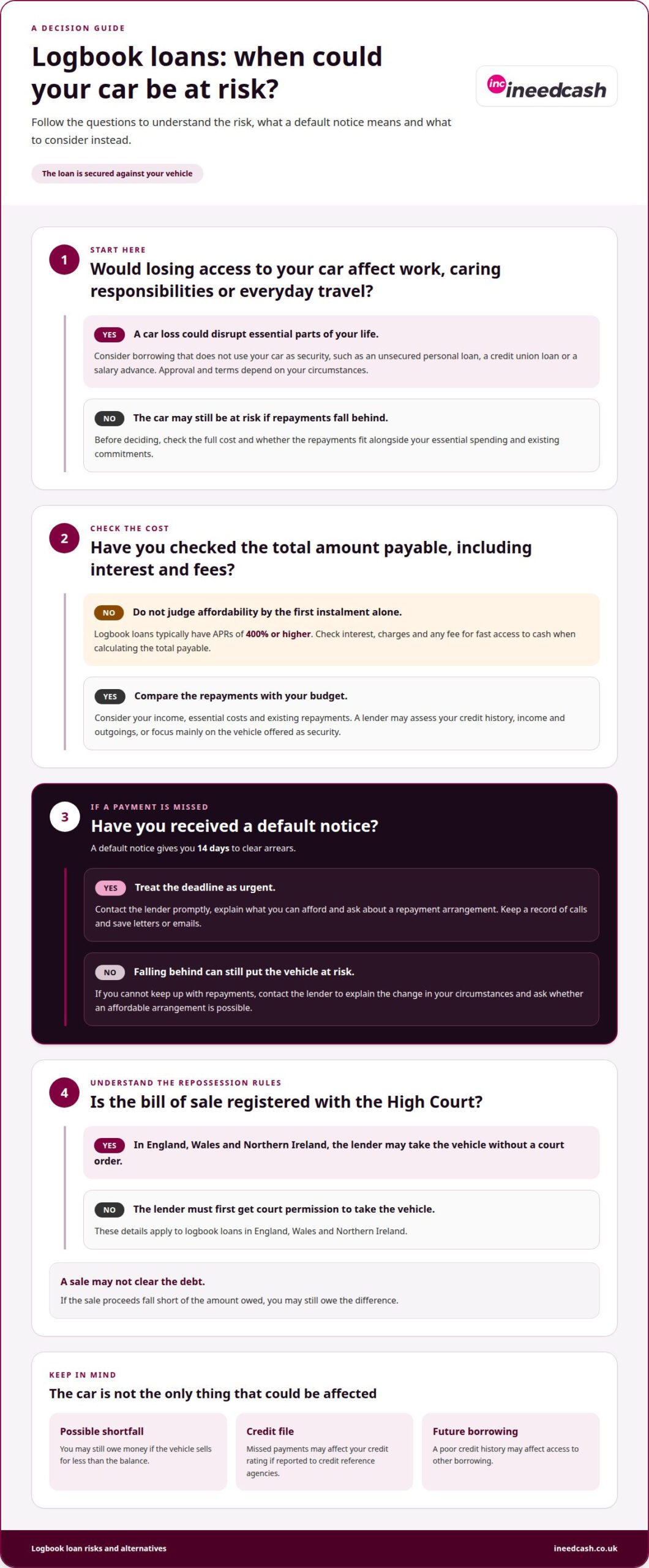
After a default notice, you must be given 14 days to clear arrears. In England, Wales and Northern Ireland, a lender may take the vehicle without a court order if the bill of sale is registered with the High Court; otherwise, it must first get court permission. A poor credit history may affect access to other borrowing, but it does not remove the risk attached to the car.
Terms and charges can make debt grow quickly. Some lenders may also charge a fee for fast access to cash, so include every charge when calculating the total amount payable.
If repayments become unaffordable, contact the lender promptly, explain what has changed and ask about an affordable arrangement. Complain in writing if you dispute a charge, state which amount you challenge and request an itemised explanation. Before taking on more secured borrowing, consider alternatives such as borrowing secured against a home, which places a different asset at risk.
Credit checks and bank statement reviews
A logbook lender may assess your credit history, income and regular payments, or focus mainly on the car offered as security. Bank statements can show whether your income covers essential spending and existing repayments. They may also reveal commitments that are easy to overlook, such as subscriptions or buy-now-pay-later instalments. Legal ownership matters because the vehicle is central to this type of application.
To check whether a lender is authorised by the FCA, search the Financial Services Register by firm name or reference number. Compare the contact details shown there with the lender’s details, because authorised firms can be impersonated.
The FCA Handbook says: “A firm must undertake a creditworthiness assessment before entering into a regulated credit agreement.” This means affordability is part of a lender’s assessment, not just your credit score. A credit check may leave a record on your credit file, and lenders can consider recent applications when assessing new borrowing. Ask whether the lender uses an eligibility search or a full credit search, and whether it could affect your score.
If you’re already struggling with bills, speak to creditors before taking on another loan. Ask whether they can agree a payment plan that fits your income and essential costs. Note the proposed instalments and dates, then check that they remain affordable alongside rent, utilities and food.
A money transfer credit card may offer 0% interest, depending on your credit score and history. Check the transfer fee and how long the promotional rate lasts, then plan to clear the balance before interest applies. Credit unions are another option; their loans are often designed to be more affordable for local members and may have lower interest rates. If poor credit narrows your choices, you can explore a borrowing application without assuming approval or affordability.
Risks of missed payments and vehicle repossession
Using your car as security means the lender may repossess it if you fail to repay. In England, Wales and Northern Ireland, a bill of sale registered with the High Court may allow a lender to take the vehicle without a court order. If it isn’t registered, the lender must get court permission first. Losing your car can affect work, caring responsibilities and everyday travel.
A default notice gives you 14 days to clear arrears. Treat it as an urgent deadline: contact the lender, explain what you can afford and ask about a repayment arrangement. Keep a record of calls and save letters or emails. If you cannot pay the arrears in time, the lender may repossess and sell the vehicle under the agreement.
Selling the car may not clear your debt. If the sale proceeds are less than the outstanding balance, you may still owe the difference. You could lose the car and remain responsible for repayments. A shortfall does not disappear when ownership transfers.
Interest adds another risk. Logbook loans typically have APRs of 400% or higher, so missed instalments can leave a substantial amount to repay. Check the agreement for interest, fees and the total payable, rather than judging affordability by the first instalment alone. A small payment can disguise a costly borrowing commitment over time.
Missed payments may affect your credit rating if the lender reports them to credit reference agencies. This can make future applications harder, especially if your file already shows poor credit. Being the registered keeper does not necessarily mean you legally own the car under a bill of sale. Before borrowing, consider whether losing access to your car would make it harder to earn an income or meet essential commitments.
Logbook loan alternatives
Start with borrowing that doesn’t put your car at risk. An unsecured personal loan isn’t secured against your vehicle, so missed payments don’t give the lender the right to repossess it. You still owe the debt, and missed payments may affect your credit file. Before applying, compare the total repayable amount, interest and instalments with your budget.
Can you get a personal loan or credit card with bad credit? You can apply, but approval and terms depend on the lender’s assessment of your credit history, income and existing commitments. Some money transfer credit cards offer 0% interest to eligible applicants, but fees and the end of any promotional period can increase the cost.
A credit union loan may suit someone looking for borrowing designed for members; these loans are often more affordable and may have lower interest rates. If you receive certain benefits, a government budgeting loan or advance may also be available, usually with little or no interest. An employer salary advance or a clear, manageable agreement with family could avoid a new credit agreement.
Are payday loans, guarantor loans or car finance safer alternatives? Not automatically. A payday loan can still create repayment pressure, while a guarantor loan makes someone else responsible if you default. Car finance has different terms and repossession rules, so it isn’t a direct substitute for borrowing cash. Compare each option’s full cost, repayment schedule and consequences of missed payments.
A homeowner loan may avoid using your car as security, but it secures borrowing against your home instead. That means your home could be at risk if you don’t repay. If debt repayments already feel unmanageable, pause before taking on more credit and seek free, independent debt advice. If borrowing remains suitable, explore borrowing options and focus on an agreement you can afford.
I Need Cash
I Need Cash is a credit broker that connects applicants with potential lenders. If you’re considering logbook loan alternatives, it can help you explore personal loans, short-term loans, homeowner loans and bad credit loans.
First consider how much you need, what repayments you can afford and whether you’re comfortable securing a loan against an asset. A personal loan doesn’t use your car as security, while a homeowner loan puts your home at risk if you don’t repay. Terms vary, so review the agreement and total amount repayable before deciding.
I Need Cash doesn’t lend directly; it connects applicants with potential lenders. To explore borrowing options, contact I Need Cash.
Choose borrowing that fits your budget
Before taking another step, decide what monthly repayment your budget can manage without cutting into essential costs. Then consider what you’re prepared to put at risk: your car, your home or neither. Setting that boundary can help narrow down the logbook loan alternatives worth considering and stop urgency from driving your decision.
Look beyond whether your application might be accepted. Focus on the total amount repayable, payment dates and what could happen if your circumstances change. If existing debts are already difficult to manage, pause before borrowing more and seek free, independent debt advice. A new loan cannot replace help with unmanageable debt.
If you’re ready to explore borrowing options, contact I Need Cash to discuss your options. Take the next step at your own pace, with your budget and priorities firmly in view.
Frequently Asked Questions
What kind of loan is a logbook loan?
A logbook loan is a secured loan that uses your vehicle as security, rather than relying only on your credit profile. In England, Wales and Northern Ireland, it is set up using a bill of sale. The V5C identifies the registered keeper, but it is not proof of ownership. MoneyHelper’s UK borrowing guidance is also useful for understanding the difference between secured and unsecured credit.
Can the lender take my car without going to court?
In some circumstances, yes. In England, Wales and Northern Ireland, a lender may take the vehicle without a court order if the bill of sale is registered with the High Court. If it is not registered, the lender must first obtain court permission. A default notice gives you 14 days to clear arrears, so act promptly and keep written records of any contact.
What are the eligibility criteria?
Requirements vary between lenders, but applicants generally need to be at least 18, live in England, Wales or Northern Ireland, and own a vehicle registered in their name. The car usually needs a valid MOT, insurance and tax. Outstanding finance can prevent an application unless the finance company gives permission. Lenders may also assess income and outgoings to judge whether repayments are affordable.
What are the alternatives to a logbook loan in the UK?
Options include an unsecured personal loan, a credit union loan, a money transfer credit card, an employer salary advance or borrowing from family. People receiving certain benefits may qualify for a government budgeting loan or advance. MoneyHelper’s UK guidance on borrowing explains how to compare options. Consider total repayments and charges, and whether missed payments could put an asset or relationship at risk.
What is the average APR and total cost of a UK logbook loan compared with alternatives?
There is no single average cost that applies to every borrower. The FCA’s 2015 market research found typical UK logbook loan APRs were 400% or more, before additional fees and charges. Compare the APR and total repayable amount for the same borrowing amount and term. Personal loan and credit card rates depend on the lender’s offer and your circumstances.

Article by
Mandy Paige
Social Content Writer and Blogger
Mandy has been writing for various website for a number of years, especially for companies in the consumer finance industry. She started her career guiding customers wanting help when applying for finance at a Loan Brokerage. Speaking to individuals wanting guidance, it lead her to start writing help and guidance on finding the right solution for their needs. Outside of writing, she is a wiz with a pair of scissors as she originally trained as a hairdresser.
Disclaimer
The content of this article/blog was correct to our knowledge on the date/time it was published.