 Skip to content

Car Loans: Professional Guide to Personal Finance Options
- Michelle
- Finance
The lowest monthly payment can end up costing more overall. If you’re considering a car loan, look beyond the amount due each month. Compare the total repayable, the agreement’s terms and who owns the car while you’re paying.
It’s understandable if the options feel confusing. A personal loan and car finance work differently. With a personal loan, you buy the car outright. Hire Purchase (HP) and Personal Contract Purchase (PCP) have their own ownership terms and end-of-agreement choices. Approval and the rate offered depend on your circumstances, so check affordability before applying.
This guide explains the main borrowing options and how to compare APR, monthly repayments and total cost. It also covers running expenses such as insurance and fuel, and what to expect when using a credit broker to explore options with independent lenders. The aim is to help you weigh up your next step with confidence and without rushing.
Key Takeaways
- A car loan can mean different types of borrowing, so identify the arrangement before comparing offers.
- Compare personal loans, Hire Purchase and PCP by who owns the car and what choices you have at the end.
- Set a budget, then weigh up APR, total repayable and agreement terms, not just the monthly payment.
- I Need Cash is a credit broker, not a lender. An application may help you explore a potential match, but it doesn’t guarantee approval or a particular rate.
What is a car loan, and when might it help you buy a car?
A car loan is money borrowed to help pay for a car, which you repay over an agreed period under the lender’s terms. The phrase doesn’t describe one standard product. It can refer to different borrowing arrangements, each with its own costs, repayment structure and ownership outcome. The right option depends on your budget and priorities, including whether you want to own the car straight away or have choices at the end of the agreement.
There’s no single figure that shows how much every buyer needs to borrow. MoneySuperMarket reported an average car loan amount of £12,759.92 through its service in September 2026, but your borrowing needs will depend on the vehicle, any deposit and your finances. Treat that figure as context, not a recommendation.
What can a car loan help pay for?
Borrowing may help fund a new or used vehicle. Before deciding how much to borrow, work out the purchase price and what you can comfortably repay. Budget separately for ownership costs such as insurance, fuel, servicing and vehicle tax. Don’t assume these expenses are included in the borrowing. Check what the agreement covers and plan for ongoing costs alongside your repayments.
Is a car loan the same as car finance?
People sometimes use “car loan” and “car finance” to mean any borrowing for a vehicle, but the terms can describe different arrangements. A personal loan is one possible route. Wider car finance options include agreements designed specifically for buying a car. Car finance is a broad term, not a guarantee that every arrangement works the same way.
Focus on the agreement’s details rather than its label. The type of borrowing can affect who owns the car during repayment and what choices you have at the end. The next section compares personal loans, Hire Purchase and PCP.
Car loan or car finance: how ownership and repayments differ
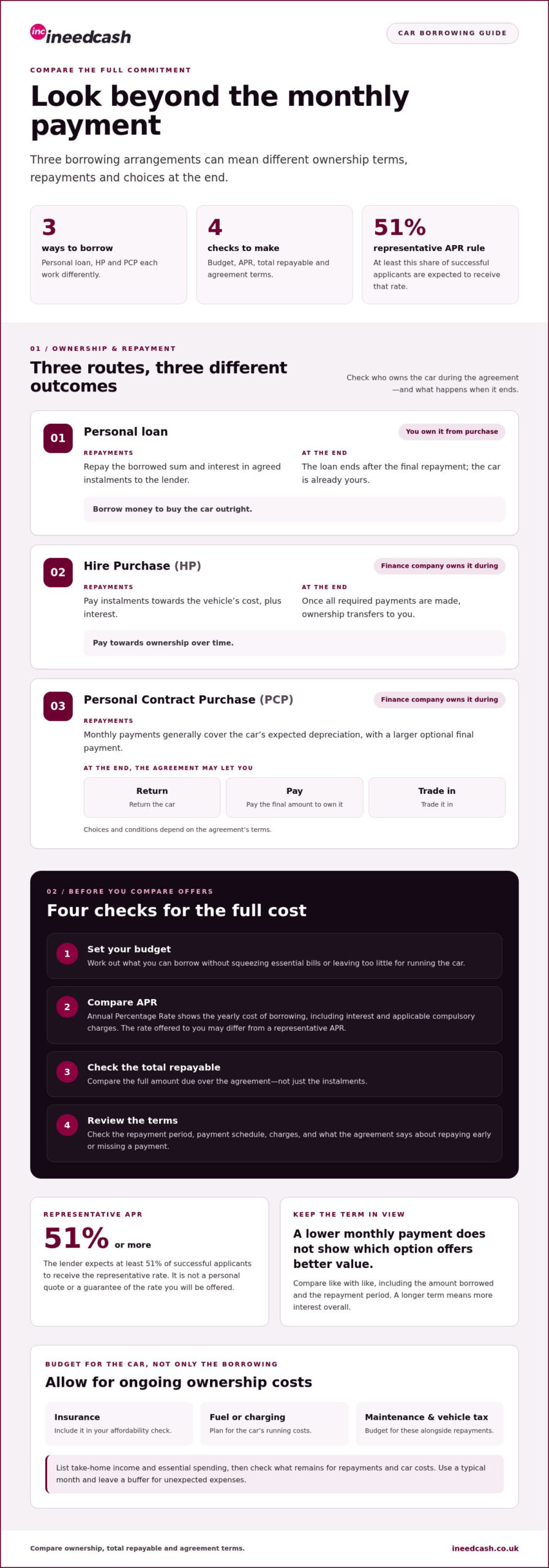
The key differences are what you’re repaying and who owns the vehicle during the agreement. A personal loan gives you money to buy the car. HP and PCP are agreements linked to the vehicle, with different repayment patterns and end points.
Personal loan, hire purchase and PCP at a glance
| Option | Who owns the car during the agreement? | Repayment pattern | What happens at the end? |
|---|---|---|---|
| Personal loan | You own it from purchase. | Repay the borrowed sum and interest in agreed instalments to the lender. | The loan ends after the final repayment; the car is already yours. |
| Hire Purchase (HP) | The finance company owns it until the agreement is fully paid. | Pay instalments towards the vehicle’s cost, plus interest. | Once all required payments are made, ownership transfers to you. |
| Personal Contract Purchase (PCP) | The finance company owns it during the agreement. | Monthly payments generally cover the car’s expected depreciation, with a larger optional final payment. | Depending on the agreement, you can return the car, pay the final amount to own it, or trade it in. |
Which borrowing arrangement may fit your priorities?
If owning the car from the outset matters to you, a personal loan may be worth comparing. HP may suit someone who wants to pay towards ownership over time. PCP can offer choices at the end of the agreement, but returning the car or taking ownership depends on the contract’s terms. Read the agreement for conditions attached to those choices, as details can vary.
Suitability and availability depend on your circumstances and the lender’s terms. For a UK car loan, compare the total repayable and any end-of-agreement obligations, not just the monthly payment. A lower instalment on its own doesn’t show which option offers better value. If you’re considering borrowing, you can explore your options, but an application doesn’t promise approval.
How to compare a car loan and check affordability
Compare offers in a clear order and judge the full commitment, not just the headline repayment. A monthly payment can hide how much you’ll repay overall and how long you’ll be committed.
- Set your budget. Work out what you can borrow without squeezing essential bills or leaving too little for running the car.
- Compare APR. The Annual Percentage Rate shows the yearly cost of borrowing, including interest and applicable compulsory charges. It helps compare credit offers, but the rate you’re offered may differ from a representative APR.
- Check the total repayable. Compare the full amount due over the agreement, not just the instalments.
- Review the terms. Check the repayment period, payment schedule and any charges. Look at what the agreement says about repaying early or missing a payment.
What should you compare beyond the monthly payment?
A representative APR is the rate the lender expects at least 51% of successful applicants to receive. It isn’t a personal quote or a guarantee that you’ll be offered that rate. The FCA’s Consumer Credit sourcebook sets out rules for how credit promotions present representative APRs. Compare like with like, including the amount borrowed and the repayment period. MoneyHelper’s personal loan guidance cautions: “The longer the term, the more interest you’ll pay overall.”
Can you comfortably afford the repayments?
List your take-home income and essential spending, then see what remains for repayments and car costs. Include insurance, vehicle tax, fuel or charging, maintenance and a buffer for unexpected expenses. Check your figures against a typical month, not an unusually good one. Avoid borrowing more than you need or relying on uncertain future income to cover payments.
Once you’ve set a realistic budget, you can explore borrowing options. Applying doesn’t guarantee approval or a particular rate.
Applying for a car loan: what to expect from a broker
An application is a way to explore whether borrowing may suit your circumstances. It isn’t a commitment to accept an offer. Take it one step at a time, and make sure the information you provide reflects your current situation.
The process generally involves:
- Sharing relevant details. Provide accurate information about your finances and the amount you’re looking to borrow. Check your answers before submitting them.
- Considering possible options. Any potential option depends on your circumstances and the lender’s assessment. Treat an initial indication as something to review, not a confirmed decision.
- Reviewing the terms. If an offer is made, compare its costs and conditions with your budget before deciding whether to proceed.
Approval, access to borrowing and the rate offered aren’t guaranteed. A lender makes its own decision after assessing your application, and its final terms may differ from what you expected. Take time to consider them rather than feeling you have to accept straight away. While car finance brokers focus on vehicle purchases, borrowers looking for guidance on other major commitments, such as commercial lending or property finance, can consult specialist brokerages like viradvisory.com.au for tailored support.
What information may be relevant to an application?
Be prepared to provide details about your income, regular outgoings and borrowing needs. These help show what repayments may be manageable, although lenders can assess applications differently. Make sure the amount requested reflects the car purchase and your budget. Avoid inflating your income or leaving out regular commitments. Accurate information gives a clearer picture of what you can afford.
What to do before accepting an offer
Read the agreement carefully before committing. Check the APR, repayment amount and schedule, total repayable, and any charges or conditions. Make sure you understand what could happen if you miss a payment or want to repay early. Then revisit your budget, including regular bills and car running costs. Proceed only if the commitment remains affordable without relying on uncertain future income.
If you’re ready to consider a next step, you can explore your options. Applying doesn’t promise approval or a particular offer, so decide only after reviewing the terms and considering whether they suit your circumstances.
Take your next step with confidence
A car loan decision doesn’t have to be rushed. Before moving ahead, consider whether the car and repayments would still fit your plans if household costs rose or your circumstances changed. Leaving room in your budget can make the commitment easier to manage. If the figures feel tight, pausing to rethink the amount or timing is a sensible step, not a setback.
I Need Cash is authorised and regulated by the Financial Conduct Authority, and its brokerage service is free to applicants. Exploring your options doesn’t commit you to accepting an offer. If a potential match is available, take time to read the terms and decide whether they work for your circumstances. You’re in control of whether to proceed.
Ready to take a considered next step? Explore your borrowing options at your own pace. Choose a commitment that fits your budget and feels right for you.
Frequently Asked Questions
Is a car loan the same as a personal loan?
Not necessarily, so check the agreement’s legal structure before signing. If you use a personal loan to buy a car, you remain responsible for repaying that borrowing even if you later sell the vehicle. Vehicle finance may set conditions around keeping or returning the car. Read the agreement for any restrictions that could affect your plans to change vehicles.
Can I get a car loan for a used car?
Potentially, but a lender’s criteria may depend on details such as the car’s age, mileage or purchase source. Gather the vehicle’s exact details before paying a deposit and make sure they fit the finance arrangement you’re considering. It’s also sensible to review the car’s history and condition independently, so you’re not basing a borrowing decision only on the advertised price.
How much can I borrow for a car loan?
Start with the car’s agreed price, then subtract any deposit or part-exchange contribution you plan to use. If you’re trading in a vehicle with finance outstanding, find out how that affects the amount available from the sale before setting your borrowing figure. This helps avoid basing an application on an assumed trade-in value.
Does applying for a car loan affect your credit score?
A credit application can leave a record of a lender’s search, and several applications in a short period may be visible to other lenders. Before applying, check your credit reports for errors and correct inaccurate details through the relevant credit reference agency. A credit score is only one part of a lender’s assessment, so a particular score alone can’t tell you whether an application will succeed.
Can a credit broker guarantee approval for a car loan?
No. Only the lender can decide whether to approve an application and set its offer. Avoid making a firm vehicle purchase commitment on the assumption that finance will be available. Wait until you’ve received and reviewed the lender’s actual agreement, including its conditions and payment schedule. If the terms don’t fit your circumstances, you can choose not to proceed.

Article by
Mandy Paige
Social Content Writer and Blogger
Mandy has been writing for various website for a number of years, especially for companies in the consumer finance industry. She started her career guiding customers wanting help when applying for finance at a Loan Brokerage. Speaking to individuals wanting guidance, it lead her to start writing help and guidance on finding the right solution for their needs. Outside of writing, she is a wiz with a pair of scissors as she originally trained as a hairdresser.
Disclaimer
The content of this article/blog was correct to our knowledge on the date/time it was published.