 Skip to content

Car Finance Loans: A Simple Guide to Your Best Options
- Michelle
- Finance
The car finance deal with the lowest monthly payment may not be the one that costs you least overall. When comparing car finance loans, look beyond what leaves your bank account each month: the total repayable, APR, loan term and ownership terms all matter.
If you’re unsure how a personal loan differs from hire purchase (HP) or personal contract purchase (PCP), start with how each agreement works. A personal loan is separate from the car purchase, while HP and PCP set out specific rules about ownership and what happens at the end of the agreement.
This guide explains the main options, what to check before borrowing and how to judge whether repayments fit your budget. It also covers what happens when you request a quote. The initial search for a car-loan quote is a soft search and doesn’t affect your credit score, although a lender may carry out a full credit check later for certain loan types. A quote isn’t a guaranteed offer, so compare the details before deciding.
Key Takeaways
- Compare car finance loans by ownership, end-of-agreement choices and total cost, not just the monthly payment.
- Before applying, set your budget, choose a vehicle and review the basic eligibility criteria, including age, employment and UK residency.
- Use representative examples to compare APR, total repayable, fees and loan term on a like-for-like basis.
- I Need Cash is a credit broker, not a lender. A quote isn’t a guaranteed offer, and vehicle quotes are valid for 30 days.
Car finance loans explained: what are your main options?
A car loan is borrowing used to pay for some or all of a vehicle. It could be a personal loan or finance arranged through a dealer. The terms and ownership conditions depend on the type of agreement. MoneyHelper’s UK guide to car finance explains common ways to pay for a vehicle.
How do a personal car loan, HP and PCP differ?
With a personal loan, you borrow money and use it to buy the car. Once you’ve paid the seller, the car is yours, and you repay the loan separately. Dealer-arranged finance is credit set up when you buy the vehicle. It may use HP or PCP, but the contract sets out the specific terms.
With hire purchase (HP), ownership usually transfers after you make the required final payment and pay any applicable option fee. Personal contract purchase (PCP) defers part of the car’s cost to a final optional payment. At the end, you can generally pay that amount to keep the car, return it subject to the agreement’s conditions, or choose another car through a new arrangement. Check the contract for the exact end-of-agreement options, mileage limits and return conditions.
What does borrowing for a car mean in practice?
You could borrow the full purchase price or just the shortfall after using savings or a deposit. Either way, look beyond the monthly payment. APR is an annualised measure of borrowing costs, including interest and certain charges where applicable. Total repayable is the full amount due over the agreement, including the amount borrowed and the cost of credit.
A longer term can reduce monthly payments but may increase the overall cost. With PCP, a lower monthly payment may also mean a substantial final payment if you want to own the car. Compare the full cost and conditions against your budget. I Need Cash’s car finance options let you explore car-loan quotes through a panel of lenders.
Car finance loans compared: what will matter most to your budget?
Compare the whole agreement, not just the monthly payment. Use each lender’s representative example to compare costs and conditions, then read the personalised offer because its terms may differ.
UK car-finance conditions can shift alongside the wider vehicle market. The SMMT’s car-registration data provides context on new-car trends, while the Finance & Leasing Association (FLA) reports on finance activity. In its September 2026 commentary, FLA Director of Research and Chief Economist Geraldine Kilkelly said: “July’s figures highlight a consumer car finance market that remains broadly resilient. While overall volumes were slightly lower than a year ago, the market has continued to grow in 2026, with volumes up 3% in the year to date.” Market trends don’t predict the rate you’ll personally be offered.
| Option | Ownership | Payments and end choices | Key question |
|---|---|---|---|
| Personal loan | You typically own the car after buying it. | Repay the loan in instalments; there’s no vehicle-finance end choice. | Will repayments fit alongside your other monthly commitments? |
| HP | Ownership usually transfers after the required final payment and any applicable option fee. | Payments run over the agreement; check whether a final amount applies. | Does the schedule suit your plans to keep the car? |
| PCP | You don’t own the car unless you meet the agreement’s ownership conditions. | End choices and any final payment depend on the contract. | Could you manage the final payment if you want to keep it? |
How should you compare APR and total repayment?
APR helps you compare borrowing costs, but a representative APR isn’t a promise of your individual rate. Check the APR, total repayable, fees and term in each representative example, then compare them with the personalised offer. A longer term may lower monthly payments while increasing the total amount paid. The lowest monthly payment isn’t automatically the lowest-cost option.
Which structure suits your ownership plans?
Think about how long you expect to keep the car and whether you want to own it. Include insurance, fuel or charging, and maintenance in your budget. If you’re considering PCP, check the mileage limits, return conditions and any final payment in the agreement. To explore an option, you can start a car-loan enquiry. A quote isn’t a guaranteed offer.
How to prepare for a car finance loan application
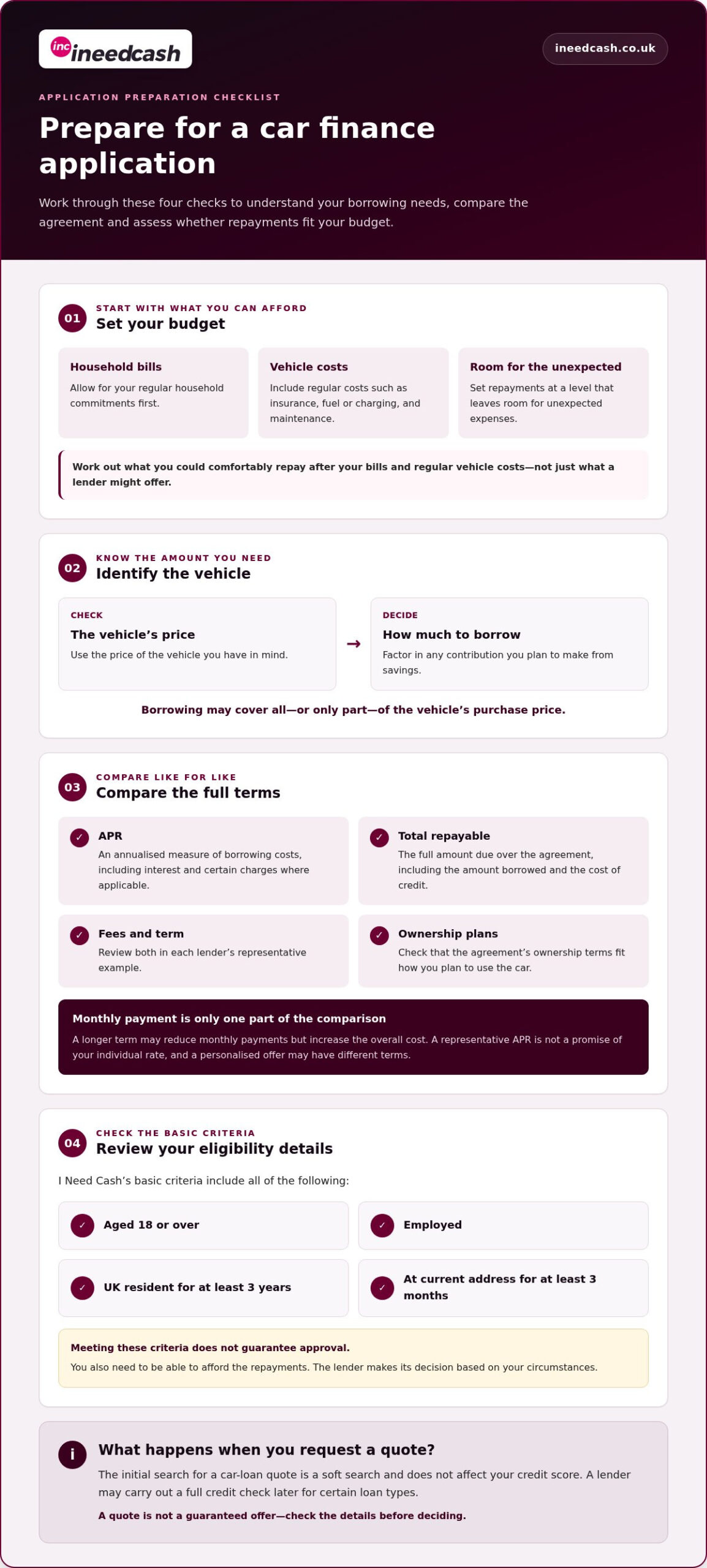
Get organised before you apply. A clear picture of your budget, vehicle and borrowing needs can help you assess whether an offer is right for you. Work through these steps:
- Set your budget. Calculate what you could comfortably repay after household bills and regular vehicle costs, leaving room for unexpected expenses.
- Identify the vehicle. Check its price and decide how much you may need to borrow after any contribution from savings.
- Compare terms. Review the APR, total repayable, fees and term in each representative example. Consider whether the agreement fits your ownership plans.
- Review the basic criteria. I Need Cash’s criteria include being aged 18 or over, employed, a UK resident for at least three years and living at your current address for at least three months.
Meeting the basic criteria doesn’t guarantee approval. You also need to be able to afford the repayments, and the lender will make its decision based on your circumstances.
What information should you have ready?
Prepare accurate details about your personal circumstances, employment and affordability. Check the vehicle’s price and work out how much you need to borrow before comparing car finance loans. Having these figures ready helps you judge whether a proposed repayment fits your budget, rather than relying on an estimate that may not match the vehicle or amount you have in mind. If you are comparing vehicle finance options in Australia rather than the UK, specialist brokers like Speaking Finance can help you source suitable car and personal loan solutions.
Will a car-loan quote affect your credit score?
The initial quote uses a soft search, which doesn’t affect your credit score. If you decide to proceed, a lender may carry out a full credit check for certain loan types. Read the application information so you understand what checks may take place before submitting further details.
Once you’ve checked your budget and borrowing needs, start a car-loan enquiry to explore a quote.
Explore car finance loans with I Need Cash
Ready to explore your options? I Need Cash is a credit broker, not a lender. It connects applicants with a panel of FCA-regulated lenders, so any quote or offer depends on your circumstances and the lender’s decision.
What happens after you request a quote?
You provide details about yourself and the vehicle, then receive a quote based on your circumstances. The initial quote uses a soft search, which doesn’t affect your credit score. A lender may carry out a full credit check later, depending on the loan type.
If a lender makes an offer, read the full agreement before accepting. Check the repayment amount and schedule, total repayable, fees, and the conditions for settling the loan early. Make sure you understand your obligations throughout the term, not just what you’ll pay at the start.
Vehicle quotes are valid for 30 days. This gives you time to review the details, but it doesn’t guarantee a particular rate, approval or funding. The online service is free and there’s no obligation to proceed, so you can decide whether an offer suits your plans.
When should you pause before borrowing?
Pause if repayments would be difficult to manage alongside household bills and the ongoing costs of owning a vehicle. A quote isn’t a loan offer or approval, and requesting one doesn’t mean you have to accept it. Borrow only if the final terms feel affordable and work for your circumstances.
If you’re ready to explore a quote, get started with a car-loan quote. Review any lender offer carefully before making a decision.
Take your next step with confidence
The right borrowing choice should support your plans without putting pressure on the rest of your budget. Before deciding, consider how long you expect to keep the vehicle, what ownership means to you and whether repayments would remain manageable if your circumstances changed.
I Need Cash Car Loans start from a Representative 8.9% APR, subject to individual circumstances. This isn’t a guaranteed rate or approval. Treat any quote as a starting point, then review the lender’s offer and decide whether it works for you. There’s no need to rush into borrowing if the figures don’t feel right.
Ready to explore your options? Get started with a car-loan quote and take the next step at a pace that feels comfortable. The decision is yours.
Frequently Asked Questions
Is a car loan the same as car finance?
Not exactly. A car loan is one way to pay for a vehicle, while car finance can describe several borrowing arrangements. For example, you borrow a personal loan separately and use it to buy a car, whereas dealer-arranged finance may use an agreement such as HP or PCP. Compare the contract’s ownership terms and repayment obligations rather than relying on the label alone.
Can I get a car loan for a used car?
Yes. Car loans can be used to buy a second-hand vehicle. I Need Cash vehicle loans cover new and used cars, as well as vans and motorcycles. Before applying, check the vehicle’s price and work out how much you need to borrow. The lender will assess your application and decide whether to make an offer based on its criteria and your circumstances.
Will checking a car-loan quote affect my credit score?
Checking an initial quote through I Need Cash uses a soft search and doesn’t affect your credit score. This lets you explore a potential option without the initial search affecting your score. It isn’t the same as a lender’s full credit assessment: a lender may carry out a full check later for certain loan types. Read the application information so you know what checks may follow.
What APR will I get on a car loan?
Your APR depends on your circumstances and the lender’s assessment, so an advertised representative rate isn’t a personal promise. I Need Cash lists Car Loans from a Representative 8.9% APR, but you may be offered a different rate or no loan. Check the APR in your actual offer alongside the total repayable and repayment schedule before deciding whether it suits your budget.
Can I repay a car loan early?
You may be able to repay early, but the terms depend on your agreement. Before making an extra payment or clearing the balance, read the lender’s full terms and conditions for its early-settlement process and any applicable costs. If you’re considering paying off the loan, ask for a settlement figure and compare it with your remaining scheduled payments before deciding what to do.

Article by
Mandy Paige
Social Content Writer and Blogger
Mandy has been writing for various website for a number of years, especially for companies in the consumer finance industry. She started her career guiding customers wanting help when applying for finance at a Loan Brokerage. Speaking to individuals wanting guidance, it lead her to start writing help and guidance on finding the right solution for their needs. Outside of writing, she is a wiz with a pair of scissors as she originally trained as a hairdresser.
Disclaimer
The content of this article/blog was correct to our knowledge on the date/time it was published.