 Skip to content

What are the Risks of Using a Loan Broker? A 2026 Guide to Safe Borrowing
- Michelle
- Finance
Could a "free" service actually cost you thousands in hidden fees and a damaged credit file? When you’re searching for a personal loan UK or a homeowner loan, it’s natural to feel anxious about the fine print. You want a quick solution and need a partner you can trust.
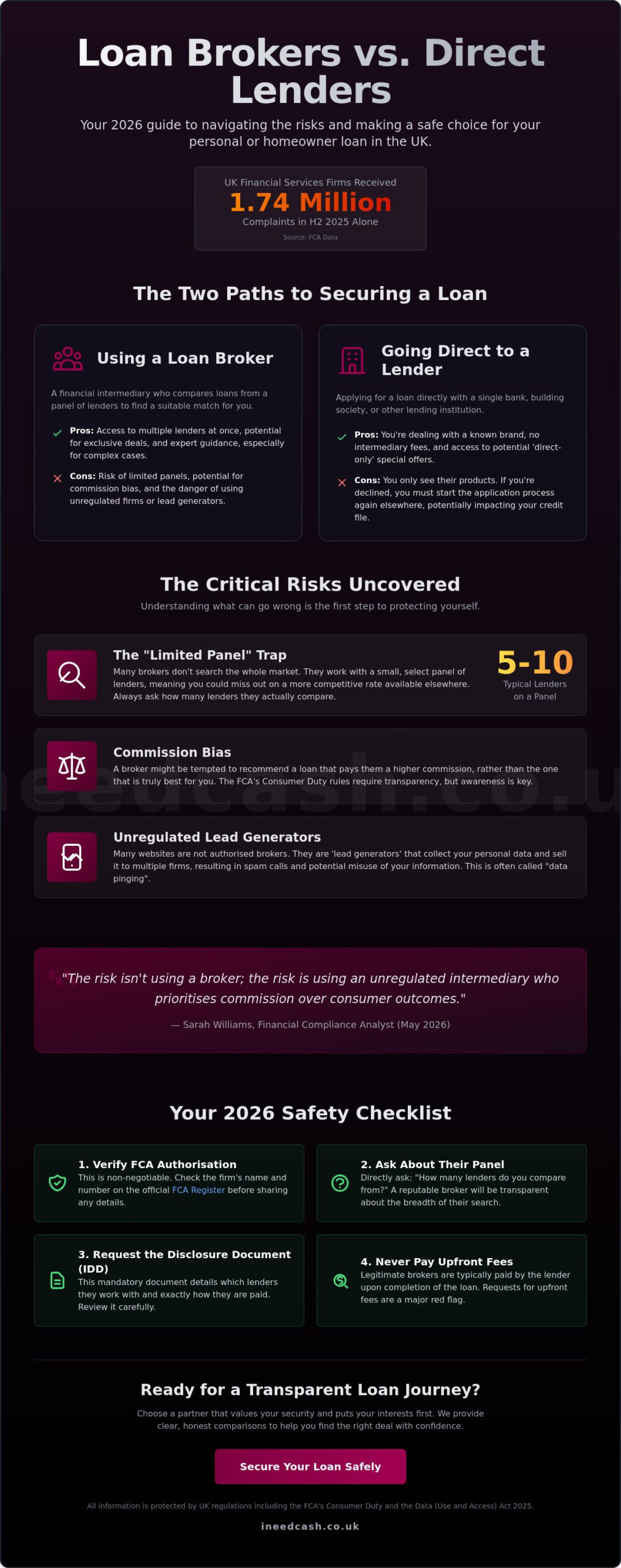
You might be asking yourself, what are the risks of using a loan broker versus going direct? It’s a valid concern. UK financial services firms received 1.74 million complaints in the second half of 2025, FCA data shows.
"The risk is not using a broker. The risk is using an unregulated intermediary. They may put commission ahead of what is best for consumers.
Sarah Williams explains this. She is a financial compliance analyst at a leading UK fintech consultancy. She was interviewed in May 2026.
We’re here to help you move from financial worry to total empowerment. This guide shows how the Data (Use and Access) Act 2025 protects your privacy.
It also explains why the new Consumer Duty rules require brokers to put your interests first.
You’ll learn how to spot a rogue intermediary. You’ll also get clear steps to secure a safe, affordable deal. These steps will help protect your credit score.
We’ll review the latest regulatory changes. This includes the ICO’s enforcement powers. This will help you choose a partner with confidence.
Key Takeaways
- Verify a broker’s FCA authorisation immediately to ensure you’re working with a regulated intermediary rather than an unauthorised firm.
- Learn what are the risks of using a loan broker, including how limited lender panels can restrict your access to the most competitive rates.
- Stop “data pinging” and unwanted spam by identifying the crucial differences between professional brokers and predatory lead generation sites.
- Master our 2026 safety checklist to navigate the UK market with confidence and secure a loan that fits your individual circumstances.
Table of Contents
Understanding Loan Brokers: Convenience vs. Potential Risks
Think of a loan broker as a financial matchmaker. They don’t lend you money directly. Instead, they’re intermediaries authorised by the Financial Conduct Authority (FCA) to find a lender that matches your profile.
It sounds simple, but you might wonder what are the risks of using a loan broker when you could just go to your bank. The UK mortgage and loan broker market will reach USD 3.37 billion in 2026. This shows that millions of people value this convenience. This global demand for expert matchmaking is mirrored in Ontario by professional firms like Dhugga Mortgages that specialise in first-time home buyer programmes and refinancing solutions.
However, the biggest danger is assuming a broker sees every deal on the market. Most only work with a specific panel of lenders, meaning you might miss out on a better offer elsewhere.
The Role of a Broker in the UK Market
Brokers specialise in different areas. Some focus on homeowner loans, whilst others handle personal loan intermediaries for smaller, unsecured amounts. Under the FCA’s Consumer Duty rules, these firms must act in your best interest., such as we do at I Need Cash.
"Transparency is key in modern UK brokerage," says Marcus Thorne, lead financial analyst at the 2026 UK Lending Summit. Despite this, some consumers go direct because they trust a well-known bank more.
They may wait longer to get an answer.
Direct Lenders vs. Brokers: A Quick Comparison
But this raises a second key risk of using a loan broker: limited choice. If your broker only partners with five lenders, they’re only showing you a tiny slice of the market.
Whilst most intermediaries act ethically, the history of predatory mortgage lending shows why checking a firm’s credentials is vital. Always ask how many lenders they actually compare before you sign anything.
The Critical Risks: Limited Panels and Commission Bias
When you’re looking for a personal loan or a homeowner loan, you expect your broker to find the best deal. But one of the biggest points regarding what are the risks of using a loan broker is the "limited panel" trap. Some brokers claim to be comprehensive whilst only searching five or six lenders. If your perfect loan is with a provider outside that small group, you’ll never see it.
You should also watch out for hidden upfront fees. Legitimate brokers usually take their cut from the lender or a clearly stated success fee. If someone asks for cash before they’ve even given you a quote, walk away immediately.
How Commission Structures Can Affect Your Deal
Commission bias is a possible conflict of interest. A broker may suggest a loan because it pays them more. It may not be the best fit for you.
Under the FCA’s Consumer Duty, brokers must be clear about these payments. They must act to deliver good outcomes for customers.
Understanding how loan brokers handle your data and their fee structures helps you spot these biases early. Many modern partners charge customers no fees and get paid only by the lender once the deal is finalised.
Why a "Whole of Market" Search is Rarely Truly Whole
No broker has access to every single lender in the UK. Many high-street banks offer "direct-only" deals that intermediaries simply cannot access. This is one main reason people ask about the risks of using a loan broker. You might miss a lower interest rate if you do not check your bank first.
To stay in control, always ask for the broker’s Initial Disclosure Document (IDD). This mandatory file lists the exact lenders they work with and explains how they receive payment. If you want to see your options, you can check your eligibility today with a transparent partner.
Data Privacy and the Danger of Unregulated Lead Generators
Not every website that offers to find you a loan is actually a broker. Some are "lead generation" sites. These businesses don’t help you find a deal; they simply collect your information and sell it to the highest bidder. This is a massive part of what are the risks of using a loan broker if you don’t check their credentials first.
Under UK GDPR and the Data (Use and Access) Act 2025, you have the right to have organisations delete your personal data. You also have full control over your personal details.
If a site feels suspicious, it probably is. The Information Commissioner’s Office (ICO) can now fine firms up to £17.5 million for data breaches. Professional partners take your security seriously.
The "Ping Tree" Phenomenon Explained
When you submit a form on an unregulated site, your data often enters a "ping tree." This automated system auctions your details to dozens of lenders in seconds.
The result? A flood of unsolicited calls, texts, and emails from third parties you’ve never heard of. It’s stressful and intrusive.
Choosing a regulated broker ensures your information stays within a secure, authorised network. You deserve a solution that respects your privacy whilst working to find the best rate for your individual circumstances.
Protecting Your Credit Score During the Search
Applying for multiple loans can wreck your credit rating if the lenders perform "hard" searches. Each hard search leaves a footprint that other lenders can see. Too many footprints suggest financial desperation. To avoid this, only use brokers that utilise "soft search" technology.
A soft search allows you to see your eligibility without affecting your score. It’s a signature safety net for savvy borrowers.
You can get a loan quote safely without worrying about your financial records. If you’re ready to move forward with a partner who puts your security first, start now and take back control of your data.
Mitigating Risk: How to Safely Navigate the UK Broker Market
Knowledge is your best defence. Now that you understand what are the risks of using a loan broker, you can take control of your financial journey.
Start by checking the Financial Services Register. Every legitimate UK broker must have a Firm Reference Number (FRN).
Look for the status "Authorised" and specifically check their permissions for "Credit Broking." If this list doesn’t include them, the FCA doesn’t regulate them. A simple step saves you from potential scams.
-
Verify the FRN: Ensure the firm is authorised to provide credit brokerage services.
-
Read Independent Reviews: Use platforms like Trustpilot or Google. Look for mentions of clear communication and helpfulness.
-
Spot the Fee Red Flag: Never pay an upfront "processing" or "admin" fee. Professional brokers usually take a commission from the lender.
-
Scan the Privacy Policy. Make sure it follows the Data (Use and Access) Act 2025. Ensure they do not sell your data to third-party "ping trees."
Signs of a Trustworthy UK Broker
Trustworthy brokers don’t make impossible promises. There is no such thing as a "guaranteed loan" in a regulated market. Every application depends on your unique circumstances and individual conditions. Authorised firms must display their regulatory status at the bottom of every page.
If you’re exploring our homeowner loan process, you’ll see transparency at every step. We focus on speed and accessibility without compromising your security.
Why Choosing a Regulated Partner Like I Need Cash Works
Choosing a partner like I Need Cash means choosing clarity over confusion. We act as a non-judgmental facilitator, matching you with our extensive network of providers without hidden costs.
According to the Financial Ombudsman Service, there were 214,600 new complaints in the 2025/26 financial year. We aim to keep you out of those statistics by being a supportive advocate. We believe in personal autonomy and work on your behalf to find the best deal.
Ready to find your match? Get started today and borrow confidently.
Take Control of Your Financial Future Today
Understanding what are the risks of using a loan broker is the first step toward financial tranquility. You’ve learned how to spot the difference between a regulated partner and a predatory lead generator. You now know that transparency regarding commissions and lender panels is non-negotiable.
By checking a firm’s status on the Financial Services Register, you can confirm it is legitimate. Using soft-search tools helps you explore your options. It also protects your credit score. You don’t have to navigate the UK lending market alone.
At I Need Cash, we act as your supportive advocate. We are FCA Authorised and Regulated, providing you with a proprietary moral code that puts your needs first. Our wide network gives you access to a diverse panel of UK lenders, helping you find a solution tailored to your needs.
Best of all, there is no impact on your credit score for an initial quote. It is a risk-free way to move from anxiety to empowerment. Find your ideal loan with a regulated UK broker today. Get the support you deserve with total confidence.
Frequently Asked Questions
Do loan brokers charge a fee for their services?
Many UK loan brokers provide their services without charging you an upfront fee. Instead, the lender pays them a commission once it finalises your loan.
However, some specialised brokers might charge a success fee or a flat rate. Always check the Initial Disclosure Document (IDD) to see the exact costs. If a broker asks for a "processing fee" before giving you a quote, treat it as a red flag.
Will using a loan broker damage my credit score?
Using a regulated broker won’t damage your credit score if they utilise soft search technology for initial quotes. This allows you to check your eligibility without leaving a footprint on your financial records. However, a key risk of using a loan broker is multiple "hard" credit searches. Always confirm that the initial search is soft before you provide your full details.
Can a broker guarantee that a lender will approve my loan application?
No broker can ever guarantee that your loan application will be approved. Approval depends entirely on the lender’s criteria, your credit history, and your individual conditions.
The FCA strictly prohibits firms from making false promises of "guaranteed" credit. If you encounter a website making such a claim, it’s likely an unregulated entity or a scam. Professional partners focus on matching you with the most likely providers instead.
What is the difference between a loan broker and a direct lender?
A direct lender provides the funds and manages your loan agreement directly. A loan broker is a middleman who compares products from several lenders to find a match for you.
Whilst lenders offer their own specific products, brokers give you access to a wider variety of options. Understanding this distinction helps you assess the risks of using a loan broker. It also helps you weigh the convenience of a broader search.
How do I know if a loan broker is legitimate and regulated in the UK?
In the UK, the Financial Conduct Authority (FCA) should authorise and regulate a legitimate loan broker. This applies if they carry out regulated credit broking.
Start by asking for their FCA firm reference number. Then check it on the FCA Register, to confirm they are FCA regulated brokers. Confirm the firm name and any trading names. Check which activities they are allowed to perform.
You should also look for clear, upfront information about fees. Reputable brokers explain whether they charge you, the lender, or both, and when any fee becomes payable.
Be cautious of brokers who ask for payment before they provide a service. Be extra careful if they call it a “processing fee” or “insurance.” Make sure there is a clear refund policy.
Check their contact details and paperwork. A legitimate broker has a physical UK address, a working phone number, a privacy policy, and clear terms. These terms explain how they use your data. Any agreement should state they act as a credit broker, not a lender.
It should explain the complaints process. It should also explain how to escalate a complaint to the Financial Ombudsman Service, if needed.
Finally, watch for common warning signs. These include guaranteed approval and pressure to act right away.
Related links
Regulated Car Finance: Hidden Risks & how it protects you
And I need Help: Where to find financial assistance resources
1000 Loan Bad Credit UK: Lender Guide
Same day loans for bad credit: 2026 guide to fast UK funding
Why regulated car finance protects you: the hidden risks and the need to know
Social Content Writer and Blogger. Mandy has been writing for various websites for a number of years, especially for companies in the consumer finance industry. She started her career guiding customers who wanted help when applying for finance at a Loan Brokerage. Speaking to individuals wanting guidance led her to start writing help and guidance on finding the right solution for their needs. Outside of writing, she is a whizz with a pair of scissors as she originally trained as a hairdresser.

Article by
Mandy Paige
Social Content Writer and Blogger. Mandy has been writing for various websites for a number of years, especially for companies in the consumer finance industry. She started her career guiding customers who wanted help when applying for finance at a Loan Brokerage. Speaking to individuals wanting guidance led her to start writing help and guidance on finding the right solution for their needs. Outside of writing, she is a whizz with a pair of scissors as she originally trained as a hairdresser.
Disclaimer
The content of this article/blog was correct to our knowledge on the date/time it was published.