 Skip to content

How to Improve Chances of Loan Approval: A Proactive UK Guide for 2026
- Michelle
- Finance
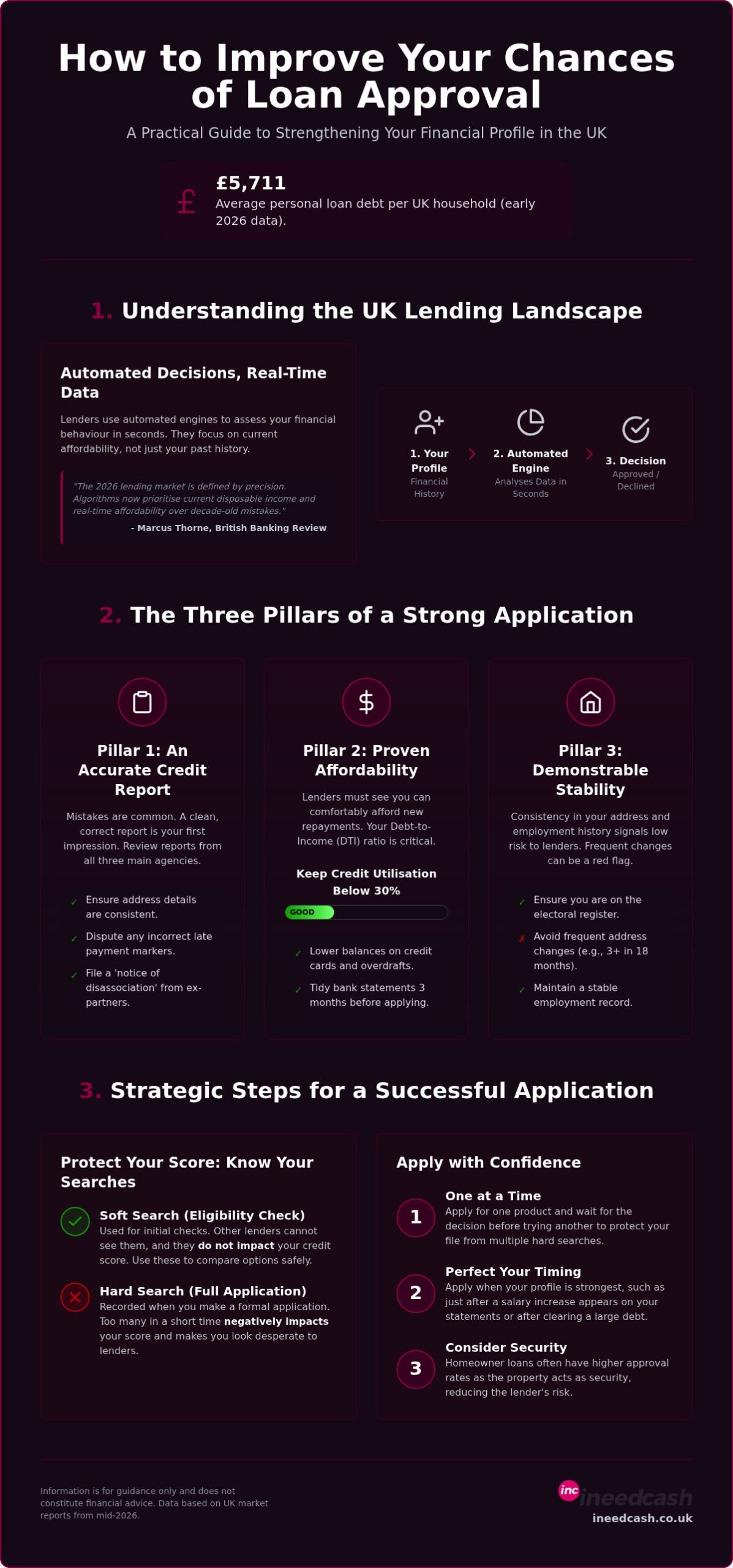
Average personal loan debt per UK household hit an all-time high of £5,711 by early 2026. With the Bank of England holding the base rate at 3.75% as of June 2026, lenders are scrutinising applications with fresh intensity. If you are wondering how to improve chances of loan approval, you aren’t alone. It’s natural to feel a sense of anxiety when you need funds quickly. We know the fear of rejection is real. You deserve a clear path forward.
This guide shows you exactly how to take back control of your financial narrative. We’ll help you master the steps to polish your profile so you can apply with confidence. “Lenders are now using internal models to prioritise real-time spending patterns,” notes the Financial Conduct Authority in their 2026 sector update. You’ll discover how the FCA’s July 2026 regulations on Buy Now, Pay Later services impact your borrowing power. We provide a supportive checklist to fix credit errors based on official guidance. Checking your options won’t impact your record.
Key Takeaways
- Learn how UK lenders use automated decisioning engines to assess your financial behaviour and stability in mere seconds.
- Discover how to improve chances of loan approval by identifying and correcting hidden errors on your credit report before you apply.
- Master the “one-at-a-time” application rule to avoid looking desperate for credit and keep your score protected.
- Understand the critical difference between soft and hard searches to ensure your initial enquiries don’t leave a lasting mark.
- Explore why homeowner loans often provide a higher acceptance rate by reducing the risk for the lender.
Understanding the UK Lending Landscape: What Lenders Really Look For
Lenders in 2026 move fast. They use automated decisioning engines to judge your risk profile in seconds. Understanding this automated process is the first step in learning how to improve chances of loan approval. Creditworthiness isn’t just a single number; it’s a narrative built from your financial history, current stability, and day-to-day behaviour. These algorithms look for patterns that suggest you can handle new debt without falling into distress.
You don’t always need a perfect score to succeed. Different products cater to different needs. For instance, homeowner loans often provide more flexibility because the lender has more security. “The 2026 lending market is defined by precision. Algorithms now prioritise current disposable income and real-time affordability over decade-old mistakes,” explains Marcus Thorne, Lead Researcher at the British Banking Review in their June 2026 report. This shift gives proactive borrowers a better chance to prove their current reliability.
The Role of Credit Reference Agencies (CRAs)
The UK relies on the “Big Three”: Experian, Equifax, and TransUnion. Each lender chooses which agency to check; some even check all three. Before applying, you should understand What is a credit score? and how these agencies calculate yours. Your score can vary between them because they use different scales. For example, as of July 2026, an “excellent” score on Experian’s 1250-point scale is 1121 or higher, whereas Equifax uses a 1000-point system.
Why Stability Matters as Much as Your Score
Stability is a silent deal-breaker for many UK lenders. They want to see you are easy to find and verify. Being on the electoral register is the simplest way to prove your identity and address history instantly. Frequent address changes can act as a red flag to an automated engine. If you’ve moved three times in eighteen months, a lender might view this as a sign of instability. Maintaining a consistent record suggests you are a low-risk borrower who is settled and reliable. In a professional context, establishing clear identity is just as crucial for building trust, and you can learn more about Imagin Products Ltd to see how their name badges and photo ID solutions help organisations maintain a secure and professional image.
Strengthening Your Financial Profile: The Big Three Factors
Your financial profile is your digital calling card. To understand how to improve chances of loan approval, you must view your data through a lender’s eyes. Mistakes on your file happen more often than you think. Even a small error can trigger an automatic rejection. Take control of your data before you submit your next application.
Cleaning Up Your Credit Report
Start with the basics. Ensure your current address is identical across all your active accounts. If you spot a late payment marker that you actually paid on time, dispute it immediately with the relevant agency. You should also consider a “notice of disassociation” if a former partner has poor credit. This breaks the financial link between your files and protects your score. For a government-backed roadmap, learn how to improve your credit score to ensure your report is accurate.
Proving Affordability in a High-Inflation Economy
Lenders in 2026 prioritise your Debt-to-Income (DTI) ratio. This is the percentage of your gross monthly income that goes towards debt repayments. Lower is always better. Aim to keep your “credit utilisation” below 30% on all credit cards. If you have a £2,000 limit, don’t carry a balance higher than £600. This shows you aren’t reliant on credit for daily survival. According to MoneyHelper, households that actively manage their debt ratios are far more likely to secure competitive interest rates.
Tidy up your bank statements at least three months before applying. Minimise discretionary spending like luxury subscriptions or frequent betting transactions. Lenders want to see plenty of “breathing room” between your income and your fixed monthly commitments. Demonstrating this surplus income proves you can comfortably handle new repayments. If you want to see which options fit your current profile, you can check your eligibility online today without any obligation.
Strategic Steps to Boost Your Success Rate
Protect your credit file like a hawk. Every time you make a formal application, a “hard search” is recorded. Too many of these in a short window makes you look desperate to lenders. Instead, use soft searches to check your eligibility. This is a vital tactic in how to improve chances of loan approval because it leaves no mark on your record. It keeps your options open whilst you find the right fit.
Apply only when your profile is at its strongest. Wait until a salary increase shows on your bank statements. Or, apply just after you’ve cleared a significant debt, such as a Buy Now, Pay Later (BNPL) balance. Since the FCA began regulating the BNPL sector in July 2026, these commitments carry much more weight in affordability checks. Lenders want to see a trajectory of improvement before they commit.
The Open Banking Advantage for 2026
Traditional credit scores don’t tell the whole story. In 2026, open banking loans offer a fairer way to prove you’re reliable. By sharing a read-only snapshot of your bank transactions, you show real-time affordability. This is a game-changer for people with “thin” credit files or those in the gig economy; for example, business owners can use lyrxpay.com to reduce processing fees and boost their visible surplus. This modern approach bypasses the rigid scoring of the past and focuses on your current behaviour.
“Open Banking provides a holistic view of financial health that a static score simply cannot match,” states a 2026 report by the Open Finance Association. It proves you can afford the repayments today, regardless of what happened years ago. If you want to see what’s available for your specific situation, get started with a quote that won’t hurt your score. It is a risk-free way to explore your autonomy.
Accuracy: The Smallest Details Matter
Precision is your best friend. Never round up your income or guess your monthly outgoings. If you earn £28,450, don’t write £30,000. Lenders cross-reference your application with your bank data and HMRC records. Inconsistencies act as a major red flag. They can even trigger fraud warnings that stay on your file for years. Be honest, be exact, and be successful. Taking ten extra minutes to check your payslip can be the difference between a “yes” and a “no”.
While managing personal finances is a priority, business owners should also consider their corporate health; you can discover Recoup Capital to see how specialised R&D tax credit consultancy can support your business goals.
Navigating Loan Types and the Broker Advantage
Choosing the right product is just as important as fixing your score. If you want to know how to improve chances of loan approval, you must match your profile to the right loan type. Personal loans are unsecured, meaning the lender takes more risk. In contrast, homeowner loans are secured against your property. This security often leads to higher acceptance rates, even for those with less-than-perfect credit. Lenders feel safer when there is an asset involved.
Specific categories like car finance also have unique rules. The vehicle itself acts as security, which can simplify the approval process compared to a standard bank loan. With the Bank of England base rate held at 3.75% in June 2026, finding the right niche product is the smartest way to secure a competitive rate whilst protecting your financial health. It’s about working with the system rather than against it.
For those looking for expert guidance on structuring their finances, Engage Financial Solutions provides comprehensive consultancy services that can clarify the path toward your financial goals.
Why Using a Broker Increases Your Options
Don’t limit yourself to one bank’s rigid criteria. A broker like I Need Cash organises the search by accessing a diverse panel of independent UK lenders. This non-judgmental approach means we look for a partner who values your current affordability over past mistakes. We act as your advocate, matching your specific profile to a lender that specialises in your situation. It’s about finding a “yes” in a market that often feels restrictive; if you want to learn more about Opolskie Centrum Kredytowe and how they assist clients with financial solutions, their expertise offers a valuable perspective.
Final Checklist Before You Apply
Run through this quick 5-point check to ensure you’ve done everything to succeed:
- Verify you are on the electoral register at your current address.
- Check your credit utilisation is below 30% on all cards.
- Ensure all income and outgoings are accurate to the penny.
- Confirm you haven’t made other hard applications in the last 30 days.
- Disassociate from old financial partners if their credit is poor.
Ready to take the next step? You can get started with a soft-search quote today. This is the safest way to see your options without any impact on your credit record. Empower yourself with a clear choice and move forward with confidence. We are here to help you bridge the gap between your needs and the right financial solution.
Take Control of Your Financial Success
You now have the blueprint to move from anxiety to action. By cleaning your credit report, lowering your utilisation, and embracing Open Banking, you’ve mastered how to improve chances of loan approval for the 2026 market. Stability is your secret weapon. Staying on the electoral roll and avoiding multiple hard searches in a short window are simple steps that yield big results. You don’t have to navigate this journey alone.
As an FCA Authorised Broker, we specialise in finding homeowner and bad credit solutions that work for your unique situation. Our soft search technology means you can explore your options without any impact on your credit file. We are here to act as your advocate amongst a wide panel of independent lenders. You deserve a facilitator that looks at your current affordability rather than just your history.
Check your eligibility with our non-judgmental loan search tool today. Your path to a secure financial future starts with a single, risk-free step. Let’s find the solution you need to move forward with confidence.
Frequently Asked Questions
Does checking my own credit score improve my chances of loan approval?
Checking your own credit score does not directly change the number, but it is a vital step in learning how to improve chances of loan approval. This action is a soft search and leaves no mark on your record. It allows you to spot errors like incorrect late payment markers or old addresses that trigger rejections. Stay proactive by monitoring your file across the big three agencies regularly.
How long does it take to improve my credit score for a loan?
Significant changes to your credit score usually take between three and six months to manifest. Most UK lenders report data to credit reference agencies on a monthly cycle. Consequently, positive actions like reducing a credit card balance or joining the electoral roll won’t show up overnight. Start your financial preparations at least one full quarter before you plan to apply to ensure your file is at its strongest.
Can I get a loan approved if I have a CCJ or bad credit history?
Yes, you can get approved for a loan even with a CCJ or a history of bad credit. Specialist lenders in our network often prioritise your current behaviour and affordability over past financial difficulties. They look for signs of stability, such as a steady income and recent on-time payments. A broker can match you with these flexible providers who offer an open-door policy for varied backgrounds.
What is the most common reason for a loan application being declined?
Failing a lender’s internal affordability assessment is the most common reason for a decline. This often happens if your disposable income is too low to comfortably cover new repayments. Another major factor is inconsistent data, such as a typo in your address or income details. Double-checking how to improve chances of loan approval means ensuring every detail on your application matches your official records exactly to avoid fraud flags.
Will applying for multiple loans at once hurt my approval chances?
Yes, making multiple formal applications in a short window will damage your approval chances. Each application triggers a hard search that remains visible on your record for a year. To a lender, this behaviour suggests you are desperate for credit or struggling with your finances. Always use soft-search eligibility tools first. They give you a clear answer without impacting your score or looking like a risk.

Article by
Mandy Paige
Social Content Writer and Blogger
Mandy has been writing for various website for a number of years, especially for companies in the consumer finance industry. She started her career guiding customers wanting help when applying for finance at a Loan Brokerage. Speaking to individuals wanting guidance, it lead her to start writing help and guidance on finding the right solution for their needs. Outside of writing, she is a wiz with a pair of scissors as she originally trained as a hairdresser.
Disclaimer
The content of this article/blog was correct to our knowledge on the date/time it was published.