 Skip to content

What to do if your loan application is declined: A step-by-step recovery guide
- Michelle
- Finance
What if a ‘no’ from your bank was actually the best thing that could happen to your long-term financial health? It’s incredibly stressful to see a rejection notification when you’re facing urgent bills or home repairs. You might worry about permanent marks on your credit file or feel confused by vague explanations. Knowing exactly what to do if your loan application is declined is the first step toward turning that rejection into a future approval.
We understand that a declined application feels like a closed door, but it’s often just a sign that your profile doesn’t match a specific lender’s criteria. This guide promises to show you how to decode your rejection letter and build a roadmap to fix your credit score. We’ll preview the immediate actions you should take, from requesting your credit report to finding a non-judgmental facilitator. As James Andrews, a leading UK personal finance expert, stated in a recent industry briefing, “A rejection isn’t a permanent stain; it’s a prompt to check for errors.” With average personal loan APRs sitting at 13.73 per cent as of July 2026, finding the right match is vital. You can find more about your rights on the Financial Conduct Authority website or review ONS data on household finance.
Key Takeaways
- Learn exactly what to do if your loan application is declined, starting with staying calm and avoiding multiple rapid applications that can harm your credit file.
- Discover how to access your statutory credit report to spot errors or identity issues that often lead to automatic rejections.
- Master practical steps to repair your profile, such as joining the Electoral Roll and lowering your credit utilisation to under 30 per cent.
- Understand the crucial 3 to 6-month waiting period required to let your financial records settle before you try again.
- Explore how a specialist broker can match you with homeowner or bad credit loans that fit your unique circumstances and financial history.
Immediate actions: Understanding the ‘Why’ behind a loan decline
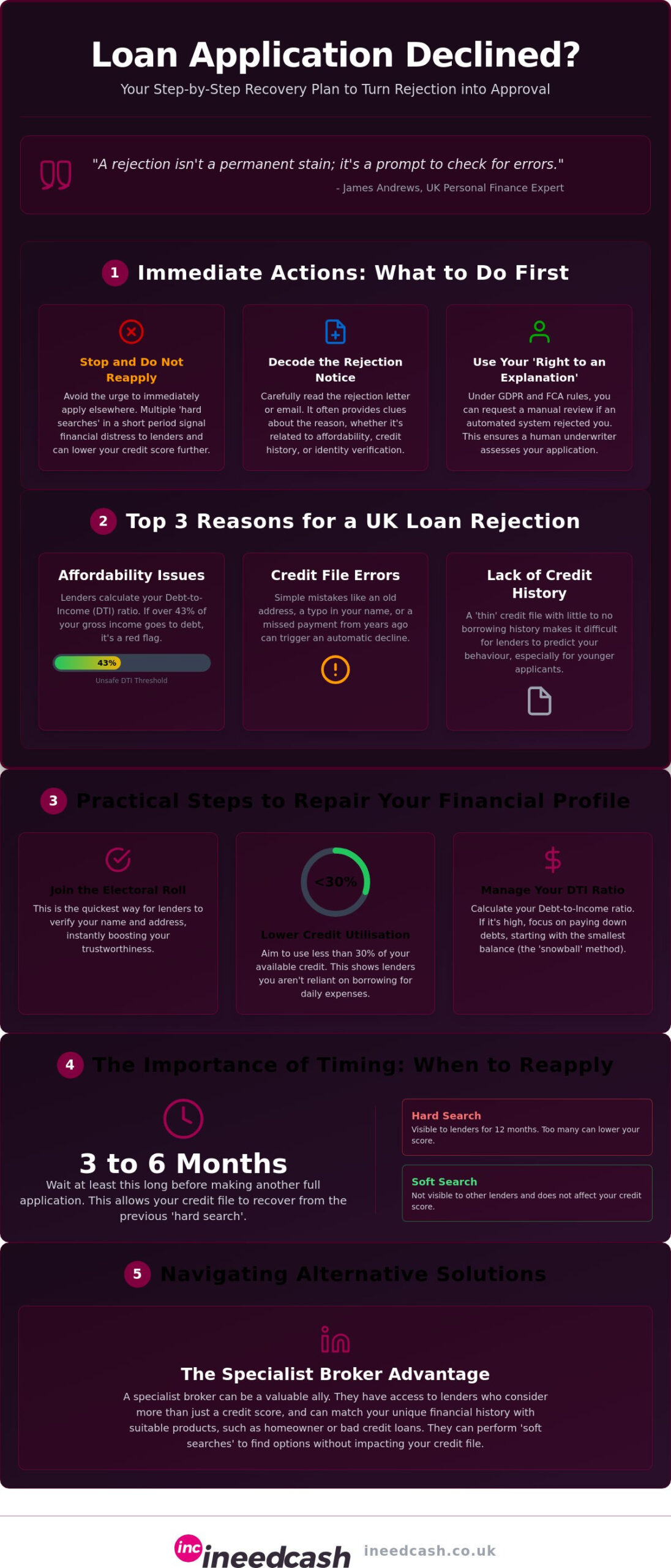
Stop. Don’t hit that ‘apply’ button on another site just yet. It’s tempting to try your luck elsewhere immediately, but this is the most common mistake people make. Every time you submit a full application, a ‘hard search’ is recorded on your file. These remain visible to other lenders for 12 months. Too many in a short window suggests financial desperation, which can further lower your credit score and lead to a cycle of rejections.
Decoding your rejection notice
Knowing what to do if your loan application is declined starts with a pause. Lenders use unique ‘scorecards’ to assess risk. A ‘no’ from a high-street bank doesn’t mean every provider will reject you. It just means you didn’t fit their specific criteria today. Check your ‘Adverse Action’ notice or rejection email carefully. It often contains vital clues about whether the issue was your income, your existing debt, or your credit history.
The three most common reasons for a UK loan rejection
- Affordability issues: Lenders look at your Debt-to-Income (DTI) ratio. If your monthly commitments exceed roughly 43 per cent of your gross income, they may deem it too risky.
- Credit file errors: Simple typos or an old address on your statutory report can trigger an automatic decline. Even one missed payment from three years ago can carry weight.
- Lack of history: If you’ve never had credit, lenders can’t predict your behaviour. This ‘thin’ file is a frequent hurdle for younger applicants.
How to use your ‘Right to an Explanation’
You have more power than you think. Under GDPR and FCA regulations, if a lender used a purely automated system to reject you, you can request a manual review. This means a human underwriter will look at your application rather than just a computer algorithm. Write a short, professional email to the lender’s underwriting team. Ask for the specific reasons behind the decline. This clarity is the foundation of your recovery plan. If you’re ready to find a lender that sees the full picture, you can get started with a broker search today.
Practical steps to repair your financial profile for 2026
Fixing your financial profile is about speed and accuracy. Now you’ve paused, you need to take control of how lenders see you. Knowing what to do if your loan application is declined means looking at the data behind the decision. Start by ensuring your digital footprint is spotless.
The ‘Electoral Roll’ boost and identity verification
Get on the register today. Being on the Electoral Roll is the fastest way to build trust with UK lenders because it verifies your identity and address instantly. If you are a non-UK national, you can add a ‘notice of correction’ to your file explaining your status or provide extra proof of residency, such as utility bills, to bridge the gap.
Managing your debt-to-income (DTI) ratio
Calculate your DTI by dividing your total monthly debt payments by your gross monthly income. DTI is the primary metric lenders use to gauge if you can afford new repayments. If your ratio is high, try ‘snowballing’ your debts by paying off the smallest balance first. You can follow these steps to take after a loan denial to ensure your next application is stronger.
Optimising utilisation and Open Banking
Lower your credit utilisation next. Try to keep balances below 30 per cent of your available limit. If you have a £1,000 credit card, don’t spend more than £300. This shows you aren’t reliant on credit for daily living. Finally, use ‘Open Banking’ tools to prove your real-time income. If you’re ready to see which lenders might accept your current profile, you can get started with a non-judgmental search today.
The importance of timing: When is it safe to apply again?
Patience is your strongest asset right now. If you’re wondering what to do if your loan application is declined, the most effective answer is often to wait. Making another full application too soon signals financial stress to lenders. Aim for a gap of at least 3 to 6 months. This gives your credit score time to breathe and recover from the previous hard search recorded on your file.
Hard vs Soft credit searches explained
Visualise the difference between these two assessments. A soft search is a ‘peek’ at your file that lenders use for eligibility checks; it’s invisible to other companies and has zero impact on your score. A hard search is a ‘permanent mark’ that stays on your record for 12 months. In 2026, more lenders are moving toward soft-search-first models. This allows you to check your chances without any risk to your financial reputation.
Building a 90-day ‘Financial Buffer’
Three months of clean banking behaviour can flip a ‘decline’ to an ‘accept’. Lenders often request recent statements to check your habits. To improve your profile, you should:
- Avoid gambling transactions: These are major red flags for underwriters and suggest high-risk behaviour.
- Stay out of your overdraft: Showing you can live within your means proves you can handle new repayments.
- Manage ‘Pay Later’ services: Clear any outstanding balances, as multiple active BNPL accounts can clutter your short-term creditworthiness.
Don’t forget to check for ‘Notice of Corrections’ or disassociations. If a past financial associate, like an ex-partner, has a poor record, it might be dragging you down. You can file a request with credit bureaus to separate your files. Once your 90-day buffer is ready, you can get started with a search that matches you to the right provider based on your updated profile.
Navigating alternative solutions and the broker advantage
High-street banks have rigid, automated systems that often say ‘no’ to anyone who doesn’t fit a perfect mould. If you’ve been rejected, it doesn’t mean you’re out of options. Knowing what to do if your loan application is declined involves looking beyond traditional lenders toward specialists who value current affordability over historical records. These providers often have the flexibility to look at your full financial picture rather than just a computer-generated score.
For entrepreneurs or those seeking business-specific financing, organisations like Allen Capital Funding offer tailored financial solutions that prioritise a broader assessment of affordability over standard credit scores.
Why a broker is your non-judgmental ally
A broker acts as your personal advocate. Instead of you guessing which lender might say yes, a broker uses a single enquiry to scan a wide panel of independent UK providers. This protects your credit file because many brokers use soft-search technology. They understand which lenders ‘like’ certain profiles, such as the self-employed. As Sarah Coles, head of personal finance at Hargreaves Lansdown, noted in a recent market analysis, brokers provide a vital layer of protection for your credit score.
Homeowner loans: A strategic alternative
If you own your home, homeowner loans can be a powerful recovery tool. By using the equity in your property as security, you can often unlock lower interest rates and higher borrowing limits than a standard personal loan. It’s a strategic way to consolidate debt or fund major repairs. However, remember the risk: your home may be repossessed if you do not keep up repayments on a mortgage or any other debt secured on it.
For homeowners who would rather release equity without the burden of monthly repayments, selling a property for cash can be a viable alternative. Firms such as The Local Cash Buyer specialise in direct property investment, providing a route to liquidity by purchasing residential or commercial assets quickly, which can be a helpful strategy when traditional borrowing isn’t an option.
Specialised bad credit and builder tools
For those without property, bad credit loans focus on your present income and stability. You might also consider credit-builder cards to ‘prime’ your file. These prove you can manage credit responsibly over a 6 to 12-month period, preparing you for larger borrowing later. Ready to see your options? Get a tailored loan quote today without impacting your score.
Take control of your financial future today
A loan rejection isn’t the end of your financial story; it’s a signal to pivot. By understanding exactly what to do if your loan application is declined, you can move from a state of anxiety to one of absolute empowerment. Start by pausing your applications to protect your score. Focus on quick wins like joining the Electoral Roll and lowering your credit utilisation. These small shifts build a profile that lenders find much more attractive whilst giving your record time to breathe.
You don’t have to face this process alone. As an FCA Regulated Broker, we work on your behalf to navigate the complex world of UK lending. We offer a soft-search eligibility check that gives you answers without leaving a footprint on your record. Our network includes a wide panel of UK lenders; this means we can often find a home for applications that traditional banks might reject. We specialise in looking past historical hiccups to find the solution you need right now.
Stop worrying about past mistakes and start focusing on your next step. You have the autonomy to change your financial path. Start your non-judgmental loan search here and let us help you find the flexibility you deserve. Your recovery starts today.
Frequently Asked Questions
How long should I wait to apply for a loan after being declined?
Wait at least three to six months before you try again. This gap gives your financial records time to stabilise and ensures you don’t look like a high-risk borrower to prospective lenders. If you’re still wondering what to do if your loan application is declined, focus on improving your profile during this window. Registering on the Electoral Roll or correcting address typos can make a massive difference to your next attempt.
Will being declined for a loan hurt my credit score?
The rejection notification itself isn’t recorded on your credit report, so the ‘no’ won’t lower your score. However, the hard search performed during the application process is visible for 12 months. Applying for several loans in a few weeks creates multiple marks, which signals financial instability to future providers. This is why using soft-search eligibility checkers is a much safer way to find a solution without causing damage.
Can I get a loan with a very bad credit history in 2026?
You can still access borrowing in 2026 even with a poor credit history. Specialist lenders now focus on your current ability to repay rather than mistakes from years ago. By using Open Banking to share your real-time bank data, you can prove your income is stable. This allows facilitators to match you with bad credit loans or homeowner loans that fit your specific financial profile and monthly budget.
What is the most common reason for a loan to be declined in the UK?
Failing an affordability assessment is the most common reason for a decline in the UK. Lenders calculate your Debt-to-Income ratio to ensure you aren’t overstretched. If your monthly debt payments exceed roughly 43 per cent of your gross income, you’re more likely to be refused. Other frequent issues include simple data errors on your credit report or not being registered to vote at your current address.
Is it better to use a broker or apply directly to a lender after a rejection?
A broker is usually the best choice after a rejection because they protect your credit score from further harm. If you’re unsure what to do if your loan application is declined, a broker can scan an entire panel of providers using a single soft search. This identifies which niche lenders are most likely to accept you based on your unique circumstances, saving you time and preventing a cycle of hard-search rejections.

Article by
Mandy Paige
Social Content Writer and Blogger
Mandy has been writing for various website for a number of years, especially for companies in the consumer finance industry. She started her career guiding customers wanting help when applying for finance at a Loan Brokerage. Speaking to individuals wanting guidance, it lead her to start writing help and guidance on finding the right solution for their needs. Outside of writing, she is a wiz with a pair of scissors as she originally trained as a hairdresser.
Disclaimer
The content of this article/blog was correct to our knowledge on the date/time it was published.