 Skip to content

How Many Loan Applications Is Too Many? A UK Guide to Protecting Your Credit
- Michelle
- Finance
Could your next click be the one that shuts the door on your financial future? If you’re stressed by an urgent bill, it’s tempting to fire off requests to every lender you find. However, knowing exactly how many loan applications is too many is the difference between getting a “yes” and being locked out of credit. With average household debt in the UK hitting £5,711 in early 2025, lenders are more cautious than ever about what they call “credit hunger.”
We understand the anxiety that comes with a dropping credit score and the fear of another rejection. It’s frustrating when you need support but feel like the system is working against you. That’s why we’re here to help you navigate the process safely. You’ll discover the specific number of searches that trigger red flags and learn how to use modern soft-search tools to check your eligibility without any risk to your file.
This guide breaks down the January 2026 Experian credit score update, which moved to a 1250-point scale, and reveals how to secure a loan quote whilst keeping your record pristine. We’ll show you how to move from financial worry to total empowerment by finding the right support for your unique situation.
Key Takeaways
- Identify the difference between hard and soft searches to ensure your credit file remains untouched whilst you explore your borrowing options.
- Find out exactly how many loan applications is too many by learning about the “danger zone” that triggers red flags for UK lenders.
- Protect yourself from automated fraud blocks by understanding why multiple rapid-fire applications can stop your funding in its tracks.
- Discover how to use soft-search eligibility checkers to find your best rate with total peace of mind and zero impact on your score.
- Learn how to organise your paperwork properly to avoid mid-application delays that lead to unnecessary repeat credit searches.
Hard vs Soft Searches: What Happens When You Apply for a Loan?
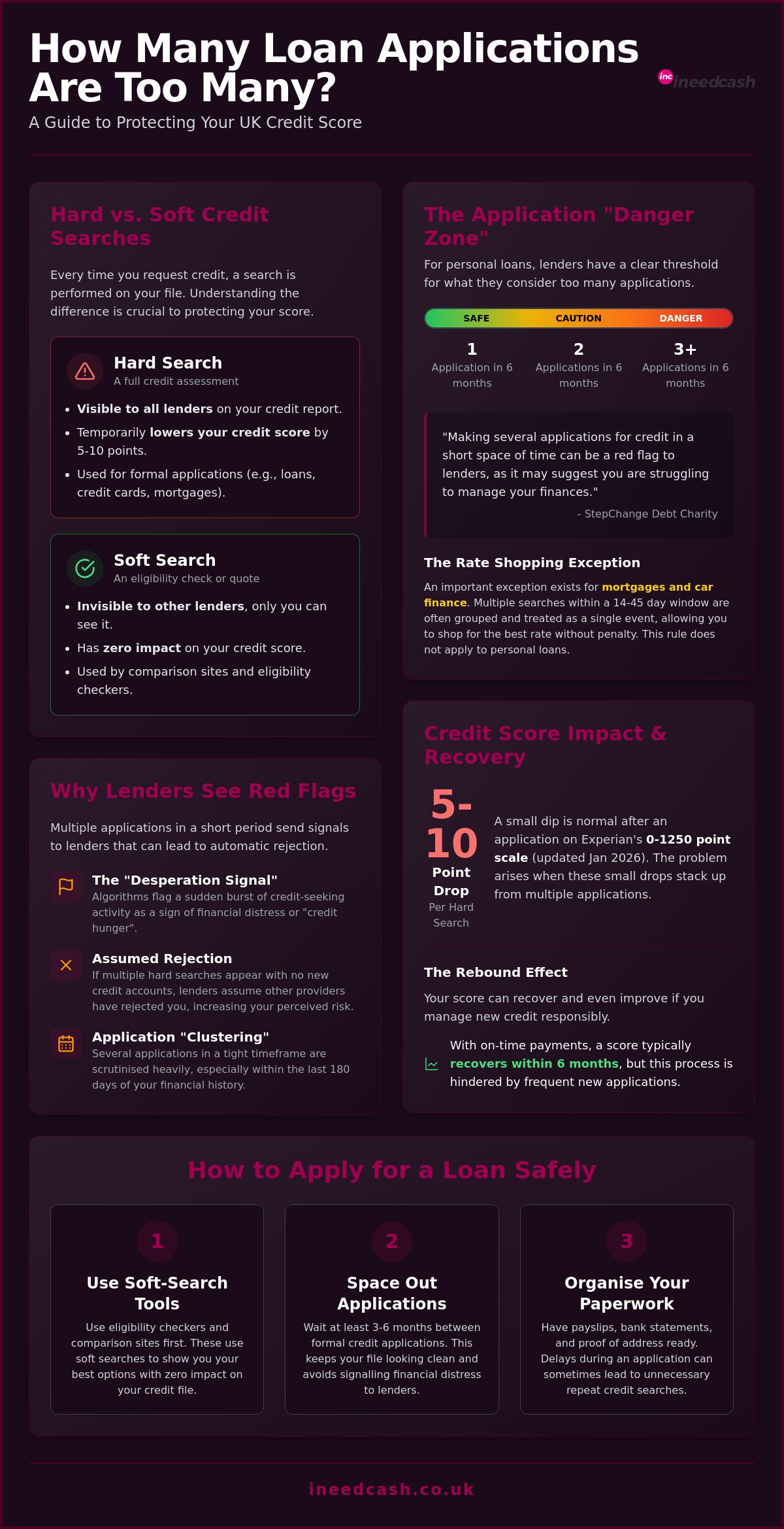
Every time you request credit, you leave a mark. A hard search is a formal enquiry where a lender performs a full assessment of your credit report to determine your creditworthiness for a specific financial product. This search creates a permanent footprint that other lenders can see. If you are wondering how many loan applications is too many, you must first distinguish between these “hard” footprints and “soft” searches. Soft searches are invisible checks. They allow you to see your eligibility for personal loans without any impact on your record.
Lenders pay close attention to your “search to debt” ratio. This calculation compares how often you ask for money against how much you actually owe. If you have five hard searches in a month but no new accounts, algorithms assume you were rejected by everyone else. This makes you look like a high-risk borrower. Keeping your applications spaced out ensures you don’t look desperate for cash, which protects your ability to secure competitive rates in the future.
Why Your Credit Score Drops After an Application
It is normal to see a small dip in your score after a hard enquiry. Most borrowers experience a temporary drop of 5 to 10 points. Since Experian updated its model in January 2026 to a scale of 0 to 1250, a 10-point move is relatively minor. This is known as the “rebound effect.” If you manage the new debt well and make every payment on time, your score typically recovers within six months. The problem only arises when you apply for multiple loans in a short window, causing these small dips to stack up into a significant decline.
The Role of UK Credit Reference Agencies
The UK financial market is monitored by three main agencies: Experian, Equifax, and TransUnion. These organisations track your financial behaviour to build your credit score, which acts as a digital passport for your life. When you submit an application, the lender reports the search to these agencies. Because they share data amongst themselves, your “search history” follows you everywhere. By using a broker with a large lender panel, you can often find a match whilst only undergoing one formal credit check, keeping your profile clean and attractive to future providers.
How Many Loan Applications Is Too Many in the UK?
How many loan applications is too many? For most UK lenders, the “Danger Zone” begins when you exceed two hard searches in a six-month period. According to a guide on the official StepChange Debt Charity website, “Making several applications for credit in a short space of time can be a red flag to lenders, as it may suggest you are struggling to manage your finances.”
The Rate Shopping Exception
There is a helpful exception for specific financial goals. When you are shopping for a mortgage or car finance, credit agencies often group multiple searches within a 14 to 45-day window as a single event. This allows you to find the best deal without fear. Whether you are in the UK or seeking expert mortgage broking in Australia from The Home Loan Partners, professional guidance can help you manage these searches effectively. This rule does not apply to standard personal loans. For those, the 12-month mark remains the gold standard for a pristine record.
The 6-Month Rule for Personal Loans
Lenders scrutinise the last 180 days of your financial history. They look for “clustering,” which is when several applications appear in a tight timeframe. To an algorithm, this signals financial distress. The answer to how many loan applications is too many usually sits at three requests in a short window. If you need a solution now, you can explore your eligibility safely through our network. It is vital to improve your credit score by spacing out your requests.
When One Application Is Too Many
In some cases, even a single application is too risky. If your file shows a recent County Court Judgment (CCJ) or multiple missed payments, a fresh hard search might trigger an automatic rejection. It is much safer to use a soft-search tool first. This gives you a clear picture of your chances without leaving a permanent mark on your file. This non-judgmental approach ensures you don’t damage your score whilst looking for help.
Why Lenders View Frequent Applications as a Red Flag
Lenders don’t just see a number; they see your financial behaviour. When you ask how many loan applications is too many, you’re really asking about the “Desperation Signal.” Algorithms are programmed to flag accounts that show a sudden burst of activity. Citizens Advice, in their official guidance on how lenders decide whether to give you credit, states: “If you’ve made a lot of applications for credit in a short space of time, it could look like you’re in financial trouble.”
There is also the risk of “Fraud Spikes.” If you submit multiple applications within minutes, security systems may trigger an automatic block. This is because rapid-fire applications are a hallmark of identity theft or “loan stacking.” Whilst homeowner loans involve more human oversight than payday options, a history of frequent searches can still lower your chances. If you’ve been rejected recently, bad credit loans through a broker offer a more tailored approach without the risk of further damage.
Don’t keep clicking if you’ve hit a wall. You can check your eligibility safely today through our expert network. We look at your current affordability, not just your past mistakes.
The Psychology of the Automated Underwriter
Modern lending software scores your recent search activity in seconds. Whilst the system cannot see if you were “declined” by another lender, it can see the search footprint that led to that outcome. If a lender sees five searches but no new loan accounts on your file, they assume you were turned down. This creates a cycle of rejection that is hard to break without professional assistance. It’s why knowing how many loan applications is too many is vital before you start your search.
Impact on Interest Rates and Offers
Too many searches often lead to “risk-based pricing.” This means that even if you are approved, you might be offered a much higher APR than advertised. To combat this, some providers now offer open banking loans. These use your real-time bank data to prove your actual income and spending. This is a much smarter way to borrow because it focuses on your current reality rather than just a list of past credit searches.
How to Apply for a Loan Without Damaging Your Credit
Applying for credit doesn’t have to be a gamble. Use an eligibility checker that only performs a soft search as your first step. This tool allows you to see your chances of approval without leaving any footprint on your credit file. By using this method, you can explore your options whilst avoiding the risk of a rejection that others can see. It is the smartest way to navigate the market when you are unsure how many loan applications is too many for your current score.
Organise your documents before you hit the submit button. Have your photo ID, proof of address, and recent bank statements ready to go. Mid-application delays often lead to timed-out sessions. If a session expires, some systems may require a completely new submission, which could accidentally trigger a second hard search. Being prepared ensures a smooth, single-search process that keeps your credit record clean.
Space out your formal applications by at least three to six months. This “cooling-off” period allows your score to recover from the minor dip that follows a hard enquiry. It also shows future lenders that you are managing your finances with patience rather than urgency. If you need a more immediate solution, using a Broker Service can help you compare multiple lenders through a single point of entry. For example, those looking for property finance in Australia can use brisbanecityhomeloans.com.au to find the right mortgage deal without the risk of multiple individual credit searches.
The Broker Advantage: One Search, Many Lenders
I Need Cash acts as a supportive facilitator for your financial needs. We use a single application to scan our diverse panel of lenders on your behalf. This approach is a “Broker’s Secret” that protects you from the damage of multiple individual applications. We provide a non-judgmental environment where your personal autonomy is respected, regardless of your past credit history. It’s a faster, safer way to find the right loan quote without the stress of manual searching.
Your Credit Cooling-Off Checklist
If you’ve been rejected recently, follow the “Stop, Check, and Wait” rule. Stop all new applications immediately to prevent a downward score spiral. Check your credit report for simple errors, such as an old address or an unlinked bank account. One actionable tip is to ensure you are registered on the electoral roll at your current home. This provides a vital stability signal to lenders and can boost your score whilst you wait for previous searches to age off your file.
Take Control of Your Borrowing Power Today
Protecting your financial future starts with making informed choices. You now know that soft searches are your best friend and that spacing out hard enquiries is vital for a healthy score. When considering how many loan applications is too many, remember that the third request in a six-month window is often the tipping point for UK lenders. By following the “Stop, Check, and Wait” rule, you can rebuild your profile whilst keeping your options open for the future.
Don’t let the fear of a “no” stop you from finding the support you deserve. We are FCA Authorised and Regulated, offering a completely free service that connects you to a wide panel of trusted UK lenders. We work as a supportive facilitator on your behalf to find a solution that respects your personal autonomy. Our goal is to move you from financial anxiety to a state of total empowerment.
Ready to see what’s possible? Get a personalised loan quote today without affecting your credit score. It’s fast, secure, and designed to give you total peace of mind. You have the tools to borrow with confidence. Take the next step toward financial tranquility today.
Frequently Asked Questions
Does checking my own credit score count as a loan application?
Checking your own credit score does not count as a loan application and will never damage your credit file. This is classified as a “soft search,” which is essentially invisible to lenders. You can check your score through agencies like Experian or TransUnion as often as you like; it has zero impact on your ability to borrow money in the future.
How long do hard searches stay on my UK credit report?
Hard searches typically remain visible on your UK credit report for 12 months. Whilst they might stay on your file for up to two years, most lenders focus on your activity within the last six months. This is why spacing out your requests is the best way to avoid being told that how many loan applications is too many for your specific profile.
Can I get a loan if I have already been rejected this month?
Yes, you can still get a loan after a rejection, but you must change your strategy immediately. Applying again with the same type of lender usually results in another “no” and more damage to your score. Instead, use a broker service that uses soft-search technology to match you with a provider that specialises in your current financial situation without adding more hard enquiries.
What is the difference between a quote and a full application?
A quote is usually based on a soft search, providing an estimate of your costs without leaving a permanent mark on your record. A full application involves a hard search, where the lender performs a deep dive into your history to make a final decision. Always ask for a “quote” or use an “eligibility checker” first to protect your record from unnecessary footprints.
How many points does a hard search actually take off my score?
A single hard search typically results in a temporary dip of 5 to 10 points. Under the Experian model updated in January 2026, which uses a scale of 0 to 1250, this is a relatively minor change for a single request. However, if you don’t know how many loan applications is too many, these small dips can quickly stack into a significant drop that signals financial distress to automated systems.

Article by
Mandy Paige
Social Content Writer and Blogger
Mandy has been writing for various website for a number of years, especially for companies in the consumer finance industry. She started her career guiding customers wanting help when applying for finance at a Loan Brokerage. Speaking to individuals wanting guidance, it lead her to start writing help and guidance on finding the right solution for their needs. Outside of writing, she is a wiz with a pair of scissors as she originally trained as a hairdresser.
Disclaimer
The content of this article/blog was correct to our knowledge on the date/time it was published.