 Skip to content

Loan to pay for dental work and treatment costs
Could you spread the cost of dental treatment instead of paying it all upfront? A loan to pay for dental work can cover treatment costs and is typically repaid in monthly instalments over an agreed period. Personal loans used for dental treatment typically have terms of 1 to 5 years.
It’s understandable to want treatment without taking on repayments that are difficult to manage. The right option depends on the treatment, the terms and what you can afford, so look beyond the monthly payment and compare the total cost of borrowing.
This guide explains how dental finance works in the UK, how it compares with practice payment plans and other borrowing options, and what to consider before applying. It also covers how missed payments can affect your credit record, helping you make a more informed decision about funding your care.
Key Takeaways
- Dental finance may cover treatments from routine care to implants, but promotional 0% offers are usually limited to 12 months or less and may require an upfront payment.
- Compare the APR, monthly repayments, loan term and fees across payment plans and borrowing options before deciding how to fund treatment.
- Build repayments into your budget: late payments can lead to fees and may harm your credit score.
- Explore personal, short-term or bad credit borrowing options if you need help spreading treatment costs, and consider whether the repayments are affordable.
Financing orthodontic, cosmetic and restorative treatments
A loan to pay for dental work can spread dental treatment costs into monthly payments, subject to the lender’s assessment. The right finance depends on your treatment plan and the agreement’s terms.
Treatment types and finance
Dental finance can help fund orthodontic, cosmetic and restorative work, from braces to crowns or implants. Private treatment costs depend on the work required, its complexity and the practice. There is no single typical UK price for each treatment, so use your written treatment plan to establish how much you need to fund.
Some practices offer promotional 0% finance, normally for 12 months or less in the UK, and may require an upfront payment. Check how long the offer lasts, what happens afterwards and whether the payments fit your budget. NHS guidance outlines the criteria for free care, noting that exemptions depend on circumstances such as age, income or receiving certain benefits. The NHS dental charges guidance sets out who may qualify for help with NHS charges.
Applications and affordability checks
A broker can help match an application with independent lenders and organise information for assessment. Applications commonly request income, employment history and credit history. The lender conducts any credit check and decides based on creditworthiness and affordability. The Financial Conduct Authority’s guidance on credit brokers explains the broker’s role in helping consumers find credit.
Before accepting an agreement, consider whether the monthly payments fit alongside essential bills. If a hard search is planned, you can ask what checks will be carried out before applying. A hard search is visible to other lenders for 12 months.
Options for poor credit
Some lenders consider applications from people with poor credit, but still assess each applicant. A broker can help identify relevant options and pass an application to a lender, but cannot guarantee approval. Before borrowing, check the repayment schedule and make sure the payments are affordable.
Missed payments can affect your credit record and make future borrowing harder. Before deciding whether finance is right for your treatment, compare the agreement’s terms with your budget.
Dental payment plans, personal loans and credit cards
A dental practice payment plan, personal loan or credit card may help spread treatment costs. Compare how each option works and what its repayments would mean for your budget.
A practice plan may divide the treatment bill into instalments, while a personal loan gives you a sum to repay under agreed terms. A credit card is another way to pay, but interest and repayment conditions vary. For each option, compare the total amount repayable, monthly payments and fees, not just whether the first instalment seems affordable.
Dental insurance may cover some procedures in part, while other treatment could leave you responsible for a share of the cost. Check how your policy covers the planned care before relying on it to fund the whole bill. If insurance contributes, you can consider whether a practice plan, card or personal loan could cover the balance.
Credit history and declined applications
When assessing an application, a lender considers credit history alongside income and existing financial commitments. A decline does not reveal by itself which factor mattered most, so avoid immediately submitting several more applications. Review the information you provided, check whether repayments fit your budget and consider suitable alternatives before applying again.
Some lenders consider applications from people with poor credit, but a previous decline does not mean another application will be accepted. The lender still assesses creditworthiness and affordability. Focus on the agreement’s repayments and terms rather than assuming a card or loan will be available because it funded someone else’s treatment.
Credit checks and score impact
A dental-finance application may involve a hard credit check, which can temporarily lower your credit score. The search is visible to other lenders for 12 months. Before applying, ask which credit check will be conducted and whether an initial eligibility assessment uses a different type of search.
Make each application purposeful. A credit check is one part of a lender’s assessment, not a promise of approval or a complete measure of affordability. Before accepting, read the proposed agreement, including the repayment schedule and fees, and decide whether the payments fit alongside your regular commitments.
To explore an application, you can get started online and consider the borrowing option that fits your treatment costs and budget.
Budgeting for repayments and missed-payment consequences
Plan for the full repayment, not just the first monthly amount. A lender’s APR, loan term and fees affect the total cost, and a dentist’s payment plan may have different conditions.
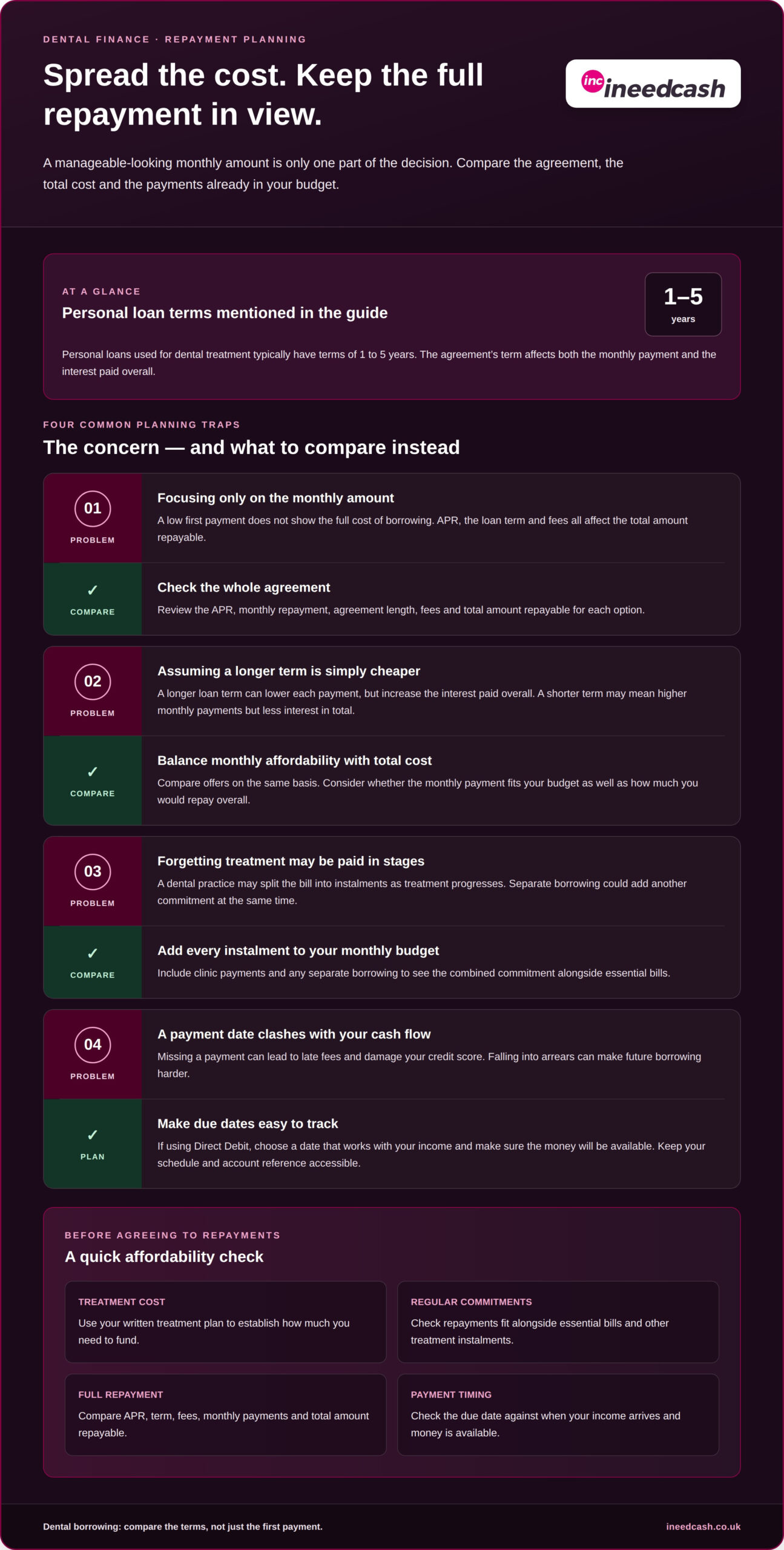
Compare the APR, monthly repayment, agreement length and fees for each available option. A longer loan term can lower each payment but increase the interest paid overall. A shorter term may mean higher monthly payments but less interest in total. Compare the figures in each offer on the same basis, including the total amount repayable.
A dental practice may let you pay in stages instead of paying the full treatment bill upfront. This can help align payments with treatment, such as an implant completed over several stages. Include clinic instalments and any separate borrowing in your monthly budget to see the combined commitment. If you set up a Direct Debit, choose a payment date that works with your income and make sure the money will be available in your account.
A missed payment can lead to late fees and damage to your credit score. If repayments fall behind, arrears can make future borrowing harder. Keep your payment schedule and account reference accessible, and note each due date alongside your regular bills. If you’re struggling to make an instalment, contact the lender promptly to understand the options under your agreement.
Before choosing an option, list your essential outgoings and the repayment you’re considering. Check that your remaining budget can cover it consistently, including in months with unexpected expenses. For a dentist’s plan, note each instalment and its due date. For a loan, compare the APR, term and total amount repayable. This makes the commitment clearer before treatment begins.
Borrowing limits and eligibility
NHS dental charges vary across England, Wales, Scotland and Northern Ireland. The amount depends on the nation, the treatment and whether you qualify for help with charges.
For private treatment, a lender decides any borrowing limit after reviewing your application. Income, existing commitments, credit history and the proposed repayments can all affect its decision. Use your written treatment plan to establish how much you need, then check whether the monthly payments fit your budget. An available borrowing amount is not a recommendation to borrow it all.
A broker can organise an application and connect it with independent lenders whose criteria may suit your circumstances. Lenders commonly consider income and employment details, credit history and affordability. The broker helps with the application, but the lender decides whether to offer credit and on what terms. Keep your treatment estimate and financial details accurate so the application reflects both the care needed and your ability to repay.
NHS dental care remains a subject of public discussion, but eligibility for implants depends on clinical need, not headlines. NHS dental implants are rarely available and are usually funded only where there is a clear medical need. Availability varies by health board. Limited circumstances can include clinical reasons a person cannot wear dentures. If NHS treatment is unavailable, you may need to consider private funding.
Keep the clinical decision and borrowing decision distinct. An NHS assessment determines whether implants meet relevant treatment criteria; it does not establish whether a lender will approve finance. Before applying, consider the amount needed, your income and existing repayment commitments together. This helps you focus on funding the planned treatment without taking on repayments that strain essential spending. You can start an application with your treatment amount and budget in mind.
I Need Cash
I Need Cash is a credit broker that connects applicants with independent lenders. If dental costs are difficult to cover upfront, its Personal Loans, Short Term Loans and Bad Credit Loans may be options to consider, depending on your circumstances and the lender’s assessment. Homeowner Loans are another option, but they involve borrowing against your home, so consider the risks carefully.
Before applying, work out how much you need for treatment and what monthly repayment fits your budget. Read the agreement, including its term, APR and total amount repayable, before accepting an offer. If repayments would leave too little for essential bills, borrowing may not be the right next step.
If you’d like to explore your options, contact I Need Cash.
Take your next step with confidence
Before choosing a loan to pay for dental work, turn your treatment plan into a clear borrowing decision. Start with the amount you need, then consider how repayments would fit alongside your regular commitments. This keeps your focus on the care you intend to fund and a financial commitment you can plan for.
Start by clarifying how much you need to borrow and what repayment you could manage. Exploring options does not commit you to accepting an offer. Take time to read any proposed terms and decide whether they suit your circumstances. If repayments would put pressure on essential spending, pause and reconsider the timing or payment route.
When you’re ready to take that next step, contact I Need Cash to discuss your options. A considered choice can help you move forward with greater clarity and confidence.
Frequently Asked Questions
How Does the Dental Financing Process Work?
Start with a treatment plan and identify the amount you need to fund. Then compare a practice payment plan with a loan to pay for dental work, and read the terms before accepting. For borrowing, the lender assesses your application and affordability. Keep treatment dates and repayment dates together, especially if care takes place in stages, so you can plan both.
How can a broker help with a dental loan application?
A broker can connect your application with independent lenders and organise the details they need to assess it, which may include income, employment information and credit history. The lender makes the decision and sets any offer. Before applying, ensure your details are accurate and the amount requested reflects the treatment you plan to fund, rather than unrelated spending.
How much are the repayments?
There is no standard repayment amount for dental borrowing. It depends on how much you borrow, the interest rate, repayment term and any applicable fees. Compare the monthly payment with the total amount repayable: a longer term can lower each instalment but increase the overall interest. Before agreeing, use the lender’s repayment schedule to understand the amount and timing of each payment.
How much can I borrow?
A lender sets the amount it may offer after assessing your application, income, existing commitments and credit history. For a loan to pay for dental work, start with the treatment costs you need to cover, including any balance after other payment arrangements. Base your request on the planned care and repayments that fit your budget, while recognising that the lender makes the final decision.
So how much will it cost?
The overall cost includes the dental treatment and any borrowing costs. Treatment charges depend on the work involved, while finance costs depend on the lender’s interest rate, term and fees. Compare a written treatment plan with the loan agreement to distinguish the cost of care from the total amount repayable. This gives you a clearer view of the full commitment before accepting finance.
Can I get dental implant finance with a poor credit history?
Some lenders consider applications from people with poor credit, but still assess each applicant. Approval and terms depend on creditworthiness and affordability, including income and existing financial commitments. A past credit problem does not automatically determine the outcome. Before accepting an agreement to fund dental implants, check that its instalments remain manageable alongside essential bills and other repayments.

Article by
Mandy Paige
Social Content Writer and Blogger
Mandy has been writing for various website for a number of years, especially for companies in the consumer finance industry. She started her career guiding customers wanting help when applying for finance at a Loan Brokerage. Speaking to individuals wanting guidance, it lead her to start writing help and guidance on finding the right solution for their needs. Outside of writing, she is a wiz with a pair of scissors as she originally trained as a hairdresser.
Disclaimer
The content of this article/blog was correct to our knowledge on the date/time it was published.