 Skip to content

Should I Consolidate My Debts with a Loan? A Complete 2026 UK Guide
- Michelle
- Finance
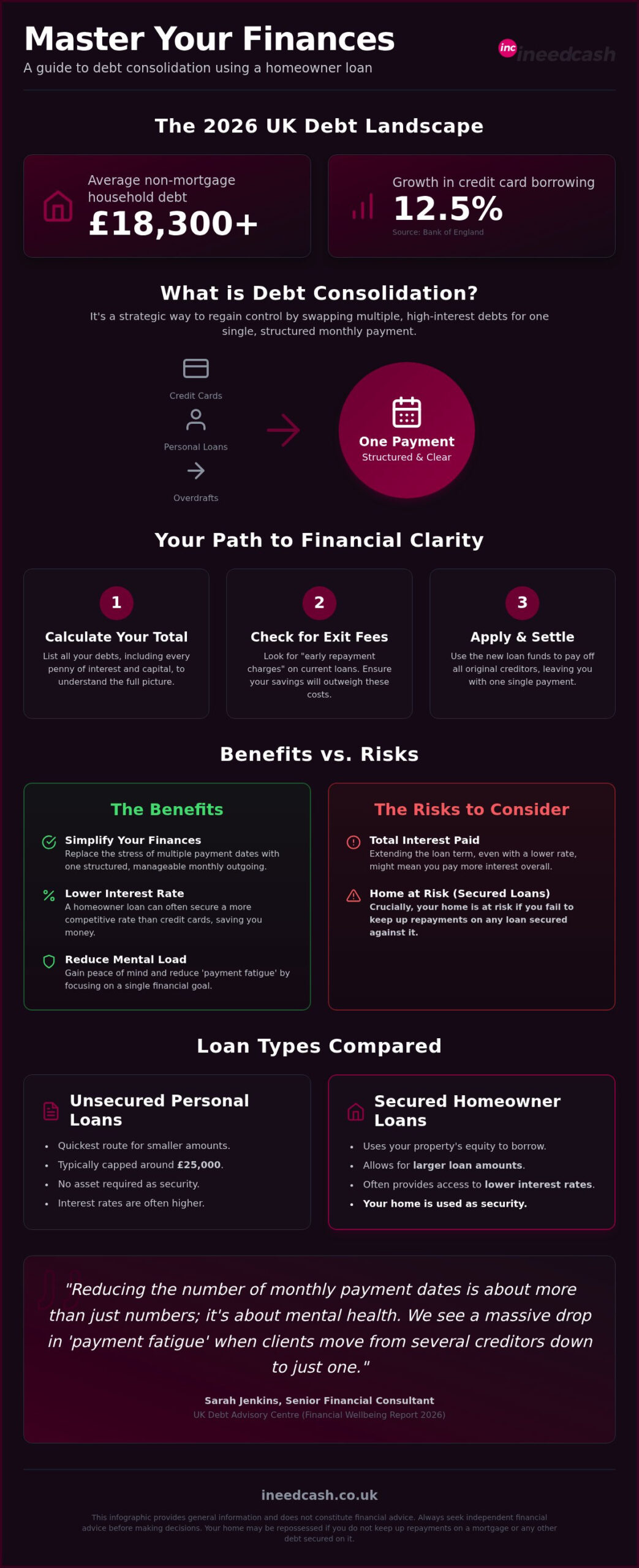
Did you know the average UK household started 2026 with over £18,300 in non-mortgage debt? With credit card borrowing up 12.5%, based on Bank of England data, it makes sense you feel stressed. Is using a homeowner loan to pay off debt the right choice?
Multiple payment dates can feel overwhelming. You want to regain control. You want to stop the fear of missed payments. Many people now consider using a homeowner loan to pay off debt. This can create one manageable monthly payment. It may also reduce total interest costs. It is about moving from financial anxiety to empowerment.
This guide helps you decide if debt consolidation is your smartest financial move this year. We’ll explore how the Bank of England’s 3.75% base rate affects your choices. We will also cover the new FCA regulations on Buy Now, Pay Later. These rules updated the credit landscape in July.
As an FCA spokesperson said in a 2026 briefing, “Affordability checks are now important. They help protect consumers from debt they cannot sustain.” We will compare secured and unsecured options to help you find a lower interest rate and a clear date to be debt-free.
Key Takeaways
- Replace the stress of multiple payment dates with one structured monthly outgoing that organises your finances.
- Discover if using a homeowner loan to pay off debt offers the lower interest rate you need to save money in the long run.
- Weigh up the benefits of lower monthly costs against the risk of extending your repayment term.
- Learn how specialist lenders in 2026 look beyond your credit score to focus on your current affordability.
- Access a wide panel of independent lenders through a broker to find a solution tailored to your specific circumstances.
Understanding Debt Consolidation: Is It the Right Move for You?
Debt consolidation is a strategic way to regain control over your money. It involves taking out one single, structured loan to pay off various high-interest debts like credit cards or overdrafts. You might be asking, What is debt consolidation? Put simply, it is a tool to swap financial chaos for clarity. In 2026, UK households are using "financial streamlining" more often. They do this to manage changing inflation. Data shows a 15% rise in people who want simpler spending than in 2024.
The Psychological Benefit of One Payment
"Cutting the number of monthly payment dates is about more than numbers. It can also affect mental health," says Sarah Jenkins, Senior Financial Consultant at the UK Debt Advisory Centre. Jenkins, featured in the 2026 Financial Wellbeing Report, adds, “We see a big drop in ‘payment fatigue.’
This happens when clients move from several creditors to one.” One effective option is using a homeowner loan to pay off debt. It lets you use your home’s value for easier repayment.
How Consolidation Loans Work in the UK – using a homeowner loan to pay off debt
The process is straightforward but requires a bit of homework. You start by calculating the exact total of your current debts. You then apply for a new loan that covers this amount. Once the funds land, you settle your original creditors immediately. This leaves you with just one monthly payment to track. It’s a clean break that helps you organise your future with confidence whilst removing the constant fear of a missed deadline.
A Simple Step-by-Step Checklist
- Calculate your total: Include every penny of interest and capital.
- Check for exit fees: Look for "early repayment charges" on your current debts.
- Apply and settle: Use the new loan to wipe the slate clean.
Watch Out for Hidden Exit Fees
Don’t skip the check for early repayment charges. Some lenders charge a fee, often equivalent to one or two months of interest, if you pay off your balance early. You must ensure the long-term savings from your new homeowner loan outweigh these initial costs. If the math works, you’ve just taken the first step toward a debt-free date and regained your financial autonomy.
Weighing Up the Benefits and Risks of Combining Debts when using a homeowner loan to pay off debt
Deciding to consolidate balances immediate relief with long-term goals. The primary advantage is the potential for a lower interest rate. With credit card borrowing rates growing by 12.5% in 2026, many people feel trapped by compound interest. By using a homeowner loan to pay off debt, you can often secure a more competitive rate compared to high-cost store cards. This shift reduces your monthly outgoings, giving your bank balance breathing room.
Balancing Monthly Savings and Total Interest
There is a risk to consider, though. Extending your loan term may lower each payment, but you may pay more interest over the loan’s life. It’s a calculated choice. You gain the freedom to manage your monthly budget better, but you must stay disciplined to avoid new card debt. If you feel overwhelmed, reaching out for free, impartial debt advice is a great way to verify your strategy.
Personal Loans vs Homeowner Loans for Consolidation
Unsecured personal loans are the quickest route for smaller amounts. They don’t require an asset but are typically capped at £25,000. For many, this doesn’t cover multiple high-interest balances.
This is where using a homeowner loan to pay off debt offers an advantage. By using property equity, you can access larger sums at lower rates than unsecured alternatives. It is a powerful tool for those with significant equity wanting to overhaul their financial situation in one go.
The Security Factor for Homeowners
A vital warning for 2026: secured loans carry serious responsibility. Your home is at risk if you fail to keep up repayments on any loan secured against it. Always ensure your new monthly payment is truly affordable over the long term.
You can check possible rates today with our helpful broker network. See which option fits your needs and money goals.
Essential Eligibility: Can You Qualify for a Consolidation Loan?
Qualifying for a loan in 2026 depends on more than just a three-digit number from Experian or Equifax. Lenders now place heavy emphasis on your debt-to-income ratio to ensure you aren’t overstretched.
Even if your score has dropped, specialist lenders often focus more on your current financial habits. They also look at your residency status, not past mistakes. They want to see that you have a stable foundation to manage a single, structured payment.
Specialist Lending and Affordability
Using a homeowner loan to pay off debt is a viable path even for those with a less-than-perfect credit history. Because the loan is secured by your property, lenders have extra security. This often makes them more flexible than high-street banks.
An Affordability Assessment is the main tool UK lenders use for ethical lending. It checks you can repay comfortably without financial stress. This process protects you as much as the lender.
Proving Income with Open Banking when using a homeowner loan to pay off debt
To speed up the process, many modern providers now offer Open Banking loans. This technology lets you safely share your transaction history and prove your income at once. No more piles of paperwork. It is a transparent way to show you are a responsible borrower in real-time.
For those considering the wider implications of property-based debt, this National Debtline guide on equity release provides an excellent breakdown of how to handle home equity responsibly.
Impact on Your Credit Score and Long-Term Finances
When you apply, you will likely see a small, temporary dip in your credit score due to a "hard search." However, the long-term benefits can be substantial. By using a homeowner loan to pay off debt, you reduce your credit utilisation across multiple cards.
This is a major factor in boosting your score over time, as it shows you are no longer maxing out your available credit limits.
Breaking the Cycle of "Reloading"
You must stay vigilant against the behaviour known as "reloading." This happens when you clear your credit card balances with a new loan but then start spending on those same cards again. It is a dangerous cycle that can double your total debt in a matter of months.
If you are ready to break the cycle and see what you qualify for, start your eligibility check now. Find a partner who understands your specific needs.
Taking the Next Step: How to Find Your Ideal Consolidation Loan
Finding the right path doesn’t have to be a solo mission. Brokers act as your advocate, connecting you with multiple lenders through one simple application. This is very useful when using a homeowner loan to pay off debt. Lenders vary in risk tolerance and equity requirements. Instead of applying to banks one by one, you can see a range of tailored options in minutes. It is about speed, transparency, and finding a partner who works for you.
Before you dive in, use a loan calculator to run the numbers. This tool helps you estimate your monthly costs based on the amount you need and the term you choose. It’s a risk-free way to see if the repayment fits your budget before any formal checks occur. We believe in personal autonomy, so we give you the tools to decide what works for your life. Declaring all income and ensuring your address history is accurate will further smoothen the process.
To give your application the best chance of success, be meticulous with your details. Declare all income sources, including benefits and part-time work. Make sure your three-year address history is correct. Lenders value transparency.
Our approach is non-judgmental; we look at where you are now, not just where you’ve been. We are here to help all UK residents find a supportive route to financial stability.
Using a Broker to Compare Regulated UK Lenders when using a homeowner loan to pay off debt
Think of a broker as a facilitator. They save you hours of research and, more importantly, protect your credit score. By using a panel of independent lenders, they can often perform a soft search first. This allows you to see your likelihood of approval without leaving a mark on your record. It’s a safer way to explore using a homeowner loan to pay off debt while maintaining your financial health.
Before you sign any agreement, run through this final checklist:
- Check the APR: Ensure the rate is competitive compared to your current high-interest debts.
- Total Repayable: Look at the total cost over the full term, not just the monthly figure.
- Affordability: Confirm you can comfortably meet the payments even if your budget tightens.
Ready to simplify your monthly payments? Get started with your loan quote today and take the first step toward financial tranquility.
Secure Your Financial Future Today
Whether you are thinking about using a homeowner loan to pay off debt or a personal loan, the goal is the same. You want a clear path to becoming debt-free. You’ve seen how modern tools like Open Banking and specialist brokers can close the gap.
They can move you from financial anxiety to peace of mind.
Don’t let the weight of high interest hold you back in 2026. As an FCA Regulated Credit Broker, we provide a free service for all applicants. Our network includes bad credit and homeowner loan specialists ready to find a solution tailored to your specific circumstances. We look past previous mistakes to help you build a stronger financial foundation. Take control of your repayments and start your journey toward a simpler, more organised life.
Check your eligibility for a consolidation loan today and discover the difference a supportive partner can make. Your future self will thank you for taking this step.
Frequently Asked Questions – using a homeowner loan to pay off debt
Is debt consolidation bad for my credit score?
No, debt consolidation isn’t bad for your score long-term, though you’ll see a small initial dip from the hard search. Once you start paying off multiple high-interest cards, your credit utilisation ratio drops significantly. This often leads to a score increase within six to twelve months. The key is to avoid "reloading" those old credit cards once they’re cleared, as that behaviour would hurt your financial record again.
Can I get a consolidation loan with very poor credit in 2026?
Yes, you can still qualify by using a homeowner loan to pay off debt even if your credit history is less than perfect. Specialist lenders in 2026 use Open Banking to review your current income and spending habits.
They do not rely only on past credit scores. As long as you can show the new payment is affordable, many providers on our panel can help. They can help you move forward with a fresh start.
What happens if I cannot keep up with my new loan payments?
You should contact your lender immediately if you struggle with repayments to discuss a revised plan. If you’ve used a secured homeowner loan, your property is at risk of repossession if you fail to keep up with the agreed schedule.
Most lenders must follow FCA rules and treat customers fairly. So they often work with you to find a manageable solution before taking formal legal action.
Is it better to get a secured or unsecured loan for debt?
The best choice depends entirely on how much you need to borrow and your current credit profile. Unsecured loans are faster and don’t require assets, but they’re often capped at £25,000.
In contrast, using a homeowner loan to pay off debt lets you borrow more money. It may also lower your interest rate. This is because the loan is secured by your home’s equity. Always weigh the lower rate against the asset risk.
Will a consolidation loan stop me from getting other credit in the future?
No, a consolidation loan won’t stop you from getting credit later. In fact, it can make you look more appealing to future lenders. By simplifying your debt into one payment and reducing your total credit utilisation, you demonstrate better financial organisation. As long as you keep up with your new payments and avoid extra debt, your creditworthiness should improve. It should improve as your total balance drops over time.
Related links
Home Owner Loans in the UK 2026

Article by
Mandy Paige
Social Content Writer and Blogger
Mandy has been writing for various website for a number of years, especially for companies in the consumer finance industry. She started her career guiding customers wanting help when applying for finance at a Loan Brokerage. Speaking to individuals wanting guidance, it lead her to start writing help and guidance on finding the right solution for their needs. Outside of writing, she is a wiz with a pair of scissors as she originally trained as a hairdresser.
Disclaimer
The content of this article/blog was correct to our knowledge on the date/time it was published.