 Skip to content

How to Manage Multiple Loan Repayments: Your 2026 UK Strategy
- Michelle
- Bad Credit, Finance, Homeowner Loans
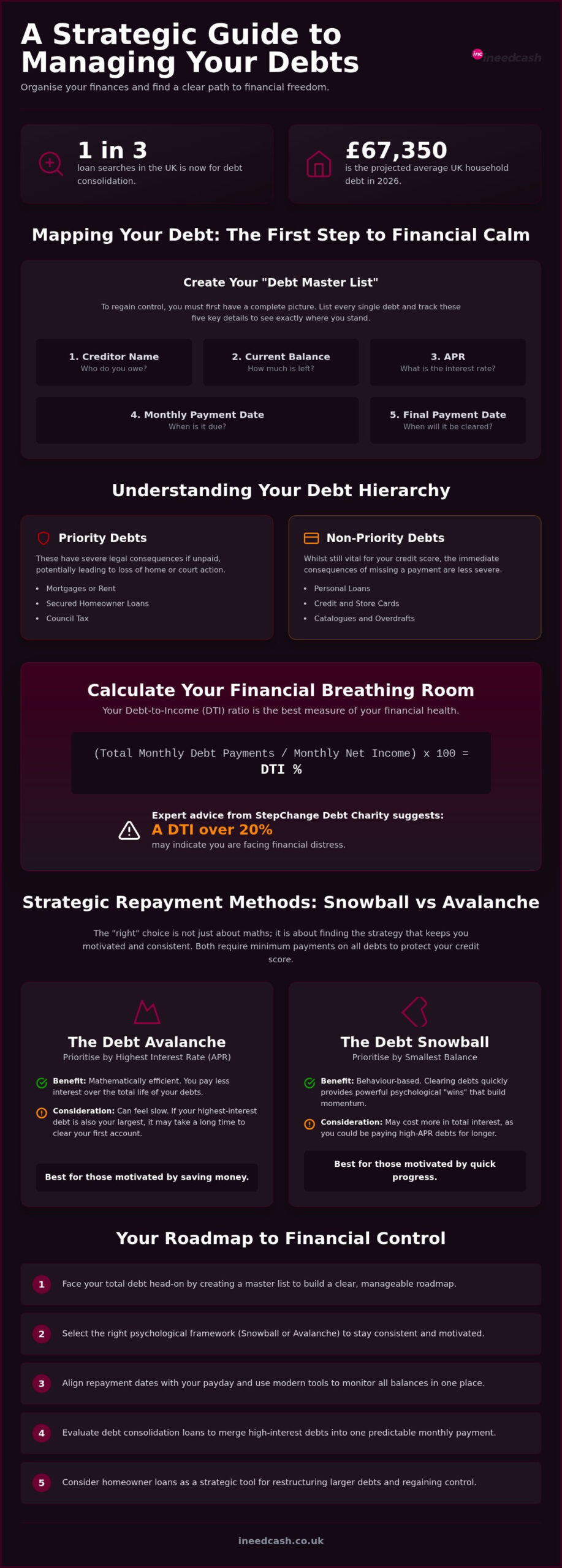
Did you know that one in three loan searches in the UK is now specifically for debt consolidation? With average household debt reaching £67,350 in 2026, you are not alone. Many people feel buried by a mountain of due dates and look for debt consolidation loans uk.
Juggling various interest rates is exhausting. It is stressful to manage multiple creditors whilst worrying that one missed payment could ruin your hard-earned credit score. You deserve a solution that respects your time and your budget.
We agree that the current financial climate is tough, but you don’t have to face it without a plan. This guide promises to show you how to organise your debts and find the right path to financial freedom.
You will learn how to use debt consolidation loans uk to your advantage. You will also see how recent 2026 reforms to the Consumer Credit Act affect your options. We will preview the best market rates and give you actionable tips to move from anxiety to empowerment. Let’s get your finances back on track today.
Key Takeaways
- Face your total debt head-on and synchronise your interest rates to create a clear, manageable roadmap to financial calm.
- Select the right psychological framework, like the Snowball or Avalanche method, to ensure you stay consistent and motivated throughout your journey.
- Align your repayment dates with your payday and use open banking tools to monitor all your balances in one single, secure location.
- Evaluate whether debt consolidation loans uk could help you merge high-interest debts into one lower, more predictable monthly payment.
- Understand the benefits of homeowner loans as a strategic tool for restructuring debt and regaining control of your personal autonomy.
Mapping Your Debt: The First Step to Financial Calm
Managing multiple loans is about more than just paying bills on time. It is the active synchronisation of different interest rates and terms into one clear strategy. Many people struggle because they avoid looking at the "Total Owed" figure. This psychological hurdle is real. Ignoring the grand total feels safer in the short term, but it keeps you trapped in a cycle of financial anxiety. Facing the numbers is the only way to regain your personal autonomy.
Start by identifying the hierarchy of your debts. Secured debts, such as a homeowner loan, are tied to your property. These often offer lower rates but carry the risk of repossession if you fall behind. Unsecured credit, like personal loans or credit cards, doesn’t have an asset attached but usually carries higher interest. Create a "Debt Master List" today to see exactly where you stand. Use this checklist for every single balance:
- Creditor Name: Who do you owe?
- Current Balance: Exactly how much is left?
- APR: What is the annual percentage rate?
- Monthly Payment Date: When does the money leave your account?
- Final Payment Date: When will this debt be gone?
Identifying Priority vs Non-Priority Debts
Not all debts are created equal. Priority debts are those with the most severe legal consequences if ignored. Rent, mortgages, and council tax sit at the top of this list. Failing to pay these can lead to losing your home or even a court summons. Personal loans, store cards, and catalogues are categorised as non-priority debts. They are still vital for your credit health, but the immediate physical risks are lower.
Learning what debt consolidation is can help you. You can combine high-interest, non-priority balances into one monthly payment. This can make your payments easier to manage. Using debt consolidation loans uk is a popular way to simplify this process and lower your daily stress.
Calculating Your Debt-to-Income Ratio
Your debt-to-income (DTI) ratio is the best measure of your financial breathing room. It shows how much of your monthly take-home pay is swallowed by repayments. Calculate it by dividing your total monthly debt payments by your monthly net income, then multiply by 100. For example, if you pay £600 in debt from a £2,400 salary, your DTI is 25%.
StepChange Debt Charity says that if your consumer debt payments are over 20% of your income, you may be in trouble. Keeping this ratio low is essential for long-term tranquility. If your ratio is rising, a debt consolidation loan in the UK may help you combine debts into a cheaper payment.
Strategic Repayment Methods: Snowball vs Avalanche
Choosing how to attack your debt is a personal decision. Two primary frameworks dominate the UK market: the Snowball and the Avalanche. Both strategies require you to maintain minimum payments on every single loan to protect your credit score.
The "right" choice isn’t about maths alone; it is whichever strategy keeps you consistent. If you find it hard to manage several due dates, consider debt consolidation loans uk. It may help you combine balances into one monthly payment.
Consider a typical UK scenario based on 2026 data. You might have an average unsecured debt of £4,455, including a £1,412 credit card balance at a high interest rate. Juggling this alongside a larger car loan requires a clear plan. Your choice depends on whether you value psychological wins or mathematical savings. We provide the assistance you need to weigh up these options effectively.
Debt Avalanche: Save on Interest
The Debt Avalanche prioritises the debt with the highest interest rate first. APR, or Annual Percentage Rate, is the total annual cost of borrowing, including interest and compulsory fees. By targeting a 24% credit card balance whilst paying the minimum on an 8% car loan, you reduce the total cost of borrowing. This is the most efficient route, but it requires patience if your highest-interest debt is also your largest balance.
Debt Snowball: Build Momentum
Targeting the smallest balance first is the core of the Debt Snowball. In our example, you would clear the £1,412 credit card balance before focusing on the larger car loan. This creates a "quick win" feeling that boosts your confidence. This behaviour-based approach is excellent for preventing fatigue amongst long-term borrowers. It builds momentum as you see individual debts disappear from your list.
Before deciding, review the official government debt options to see how these strategies fit your wider financial picture. If you are ready for the next step toward financial peace, check your loan options here.
See if debt consolidation loans uk fit your 2026 plan. We are here to provide the support you need to make an informed choice.
Practical Tools for Daily Debt Management
Execution is where many people fail, but 2026 technology makes it easier than ever to stay on track. You need a system that works whilst you sleep. Follow these four steps to secure your finances and regain your personal autonomy:
- Step 1: Synchronise repayment dates. Align all your outgoing payments with your payday. This ensures your most important bills are settled whilst your balance is at its highest, preventing mid-month stress.
- Step 2: Use digital aggregators. Utilise open banking loans to see all your balances in one secure place. Transparency is the enemy of debt.
- Step 3: Automate your safety net. Set up Direct Debits for at least the minimum amount on every account. This protects your credit score from accidental misses.
- Step 4: Review your budget monthly. Identify "leaking" cash from unused subscriptions and redirect those funds toward extra repayments.
If your current setup feels too scattered, research debt consolidation loans uk. This may help you combine payments into one predictable monthly payment. This simplifies your daily life and restores your sense of financial tranquility.
Leveraging 2026 FinTech and Open Banking
Open Banking is a game-changer for transparency. It enables clearer and faster loan management by giving you a real-time view of your total liabilities. This data-driven approach moves you from financial anxiety to total empowerment, while fintech innovators like Paracini show how digital platforms can simplify the management of various household costs.
For free UK budgeting tools and expert support, use the MoneyHelper website. It has helpful resources.
These resources can help you track every penny. These digital tools ensure you remain the master of your own money.
Communicating with Creditors Early
Don’t wait for a missed payment to speak up. Under the Financial Conduct Authority (FCA) "Treating Customers Fairly" rules, lenders must provide assistance to those in distress. This is a protective layer designed for your benefit.
If you feel overwhelmed, contact your lender immediately. Use a clear, direct sentence like: "I am experiencing financial difficulty and wish to discuss a plan." Most providers prefer to work with you rather than against you.
If you need a more structured solution, start your application to see how debt consolidation loans uk can help.
Consolidation Options: Is a Homeowner Loan the Answer?
Debt consolidation involves taking out one larger loan to pay off several smaller, high-interest debts. It is a powerful way to replace the chaos of multiple creditors with one single, predictable payment.
This strategy often results in lower monthly repayments, giving you immediate breathing room in your budget. While this may lower your monthly payments, remember that a longer term may raise total interest.
For those with strong home equity, homeowner loans can help with major financial restructuring.
We act as a non-judgemental facilitator in your search for debt consolidation loans uk. Instead of acting as a gatekeeper, we work for you to find a solution that fits your needs. This approach moves you from a state of anxiety to a feeling of empowerment. You gain the autonomy to choose a path that suits your specific 2026 financial goals.
How a Broker Simplifies the Search
Searching for debt consolidation loans uk by yourself is time-consuming and potentially risky. Every direct application you make to a lender can leave a footprint on your credit file, which might lower your score. Using a broker is a safer strategy.
We search an extensive panel of independent UK lenders simultaneously, which protects your financial record. We also specialise in bad credit options. If traditional banks have rejected you, our open-door approach means we will still work to find a lender to help you.
The Pros and Cons of Debt Consolidation
Every financial choice involves a balance of benefits and responsibilities. We value transparency and want you to understand both sides of the coin before you commit. This ensures you feel the thrill of a solution whilst remaining anchored by the facts.
- Pros: You get one monthly date for total simplicity. You could secure a lower APR compared to high-interest store cards. Most importantly, you experience a significant reduction in daily stress.
- Cons: The total interest paid may increase if you choose a longer term. Secured loans put your home at risk if you fail to keep up with repayments.
Ready to simplify? Get started with a loan quote today. We are here to provide the supportive service you need to regain your financial tranquility.
Step Into Your Financial Future Today
You now have the 2026 strategy needed to move from financial anxiety to total tranquillity. By mapping your debts and choosing a framework like the Snowball or Avalanche method, you have already taken the hardest step.
Using modern tools like Open Banking helps you control daily spending while keeping your personal autonomy. Facing the numbers is no longer a hurdle; it is your new path to empowerment.
If managing many due dates still feels overwhelming, debt consolidation loans uk could be the key to financial freedom. We are here to act as your supportive partner and efficient facilitator.
As an FCA authorised and regulated broker, we provide a free service with no obligation to proceed. We search our extensive network of independent UK lenders to find the right fit for your individualised conditions. Our goal is to help you find the speed and accessibility you deserve.
Simplify your finances today with a tailored loan quote. Take the first step toward a clearer, calmer financial future today. You have the tools to succeed.
Frequently Asked Questions
Is it better to pay off the smallest loan or the one with the highest interest first?
Choosing to pay the smallest loan or the highest interest first depends on your goals. You may want quick motivation or the most savings. The "Avalanche" method targets high interest to reduce the total cost of borrowing.
The "Snowball" method clears small balances first to provide a "quick win" feeling. Both are valid strategies. Pick the one that keeps you consistent and motivated throughout your journey toward financial freedom.
Can I consolidate my loans if I have a bad credit history in the UK?
You can definitely find debt consolidation loans uk even with a less-than-perfect credit history. Many independent UK lenders specialise in bad credit and homeowner options that traditional banks might overlook. We act as a non-judgmental facilitator to match you with providers who understand your individualized conditions.
This inclusive approach ensures that past mistakes don’t prevent you from finding a supportive path to financial empowerment.
What should I do if I cannot afford my minimum loan repayments this month?
Contact your lenders immediately if you cannot afford your minimum repayments this month. Under the FCA "Treating Customers Fairly" rules, they are required to provide assistance and discuss a plan with you. Being proactive protects your credit health and stops the situation from escalating.
Don’t wait for a missed payment notice. Reach out early to explain your financial difficulty and request a temporary arrangement that respects your current budget.
Will managing multiple loans through a consolidation loan hurt my credit score?
Applying for a consolidation loan may cause a small, temporary dip in your credit score due to the lender’s hard search. However, managing multiple debts through debt consolidation loans uk often improves your score in the long run. By lowering your credit utilization and making all payments on one date, you show more reliable borrowing behavior.
It is a strategic move that replaces financial anxiety with a clear, positive record.
Are there free UK services that can help me manage my debt repayments?
Several free UK services provide expert assistance for managing debt repayments. Organisations like StepChange Debt Charity, MoneyHelper, and Citizens Advice offer non-judgmental support and professional budgeting tools. These services are funded by the government or the financial industry, so they don’t charge you a penny for their advice. Using these resources with a clear strategy can help you regain personal freedom. It can also help you find a lasting path to calm.
Related links
Top 5 tips for Securing the Best Car Loan Rate

Article by
Mandy Paige
Social Content Writer and Blogger
Mandy has been writing for various website for a number of years, especially for companies in the consumer finance industry. She started her career guiding customers wanting help when applying for finance at a Loan Brokerage. Speaking to individuals wanting guidance, it lead her to start writing help and guidance on finding the right solution for their needs. Outside of writing, she is a wiz with a pair of scissors as she originally trained as a hairdresser.
Disclaimer
The content of this article/blog was correct to our knowledge on the date/time it was published.