 Skip to content

Debt Consolidation for Bad Credit: 2026 UK Guide
- Michelle
- Finance
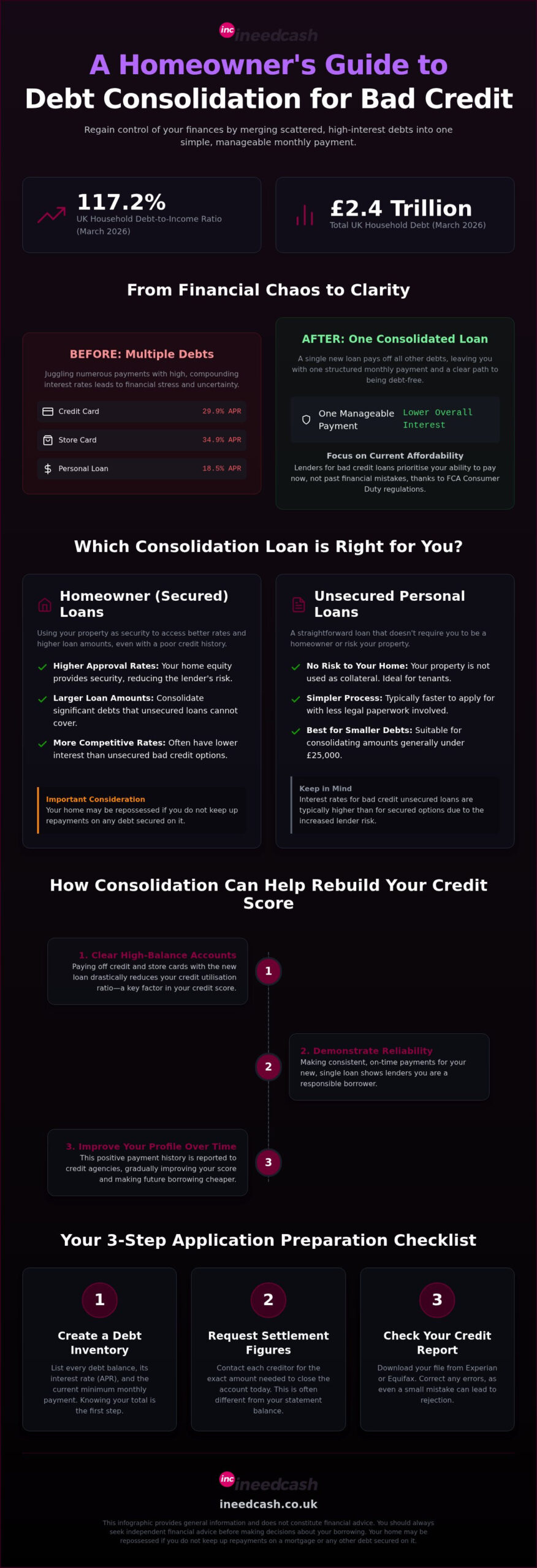
Did you know that the UK household debt-to-income ratio climbed to 117.2% in March 2026? If you’re struggling to keep your head above water, you’re not alone. It’s exhausting to manage multiple payment dates whilst high interest rates eat your income, and it’s natural to fear that debt consolidation loans for bad credit are out of reach. As the Financial Conduct Authority (FCA) recently stated, “delivering good outcomes for consumers” is now the primary focus for lenders navigating this £2.4 trillion debt landscape.
This guide reveals how to regain control by merging scattered bills into one manageable monthly payment. You’ll learn how to reduce your total outgoings and find a clear path to becoming debt-free through tailored options designed for UK residents. We’ll break down the new FCA regulations on deferred payment credit and compare homeowner loans with unsecured alternatives. It’s time to move from anxiety to empowerment with a tactical financial plan built for 2026.
Key Takeaways
- Transform multiple high-interest debts into a single, manageable monthly repayment to simplify your finances and reduce stress.
- Discover why homeowner options are often the most effective debt consolidation loans for bad credit, providing higher approval rates for those with complex histories.
- Learn the essential steps to prepare your application, from calculating exact settlement figures to ensuring your credit report data is accurate.
- Understand the advantage of using a regulated broker to access a diverse panel of independent lenders who value your current affordability over past mistakes.
What are Debt Consolidation Loans for Bad Credit?
Stop juggling multiple due dates and start breathing again. Debt consolidation is a strategic financial move where you take out one new loan to pay off scattered debts. It turns chaotic monthly outgoings into a single, structured payment. With total UK household debt reaching £2.4 trillion in March 2026, these loans have become a vital tool for families. They provide a way to escape the cycle of high-interest revolving credit and move toward a fixed end date for your debt.
Understanding Bad Credit Variants
For those seeking debt consolidation loans for bad credit, the process focuses on your current affordability rather than past mistakes. Whilst standard loans might offer lower rates, bad credit variants are designed for inclusivity. They feature different eligibility criteria to help those traditional banks might reject. The Financial Conduct Authority (FCA) ensures you’re protected through the Consumer Duty. This requires lenders to deliver positive outcomes for every borrower, ensuring transparency and safety throughout your financial journey.
How Consolidation Can Help Your Credit Score
Clearing high-balance credit cards reduces your credit utilisation ratio, which often gives your score a healthy boost. By making consistent, on-time payments on your new loan, you demonstrate reliable financial behaviour. This builds a positive track record over time, making future borrowing cheaper and more accessible as your profile improves. It’s a long-term strategy to rebuild your financial reputation whilst simplifying your daily life.
Common Debts You Can Organise
You can typically merge various high-cost unsecured debts into one manageable pot. This helps stop interest from compounding across multiple accounts. Common examples include high-interest credit cards, store cards, personal loans, and expensive bank overdrafts. Actionable Tip: Create a “debt inventory” before you apply. List every balance, its interest rate, and the monthly minimum payment. Knowing your exact total settlement figure is the first step toward regaining your financial autonomy. If you’re ready to see your options, you can get started with a quick search today.
Secured vs Unsecured: Which Consolidation Loan Fits Your Situation?
Choosing the right path depends on your assets and the total debt you’re tackling. Most high-street banks rely heavily on your credit score, which makes debt consolidation loans for bad credit difficult to secure without collateral. If you own your home, you have a powerful advantage. By using your property as security, you shift the lender’s focus from your past credit mistakes to your current home equity.
Expert Insight on the Equity Advantage
“The equity advantage allows borrowers to bypass credit score barriers by using property as a guarantee,” states Marcus Thorne, a UK-based financial consultant, in a 2026 industry review. This shift from credit-based to asset-based lending often results in higher approval rates for those with defaults. However, secured loans carry the risk of repossession if you don’t keep up with repayments. Before committing, consider seeking debt advice from Citizens Advice to explore every avenue.
The Power of Homeowner Loans for Consolidation
If you have equity in your property, Homeowner Loans are often the most effective way to consolidate larger sums. Because the lender has security, they typically offer more competitive interest rates than unsecured bad credit loans. This can significantly reduce your monthly outgoings and provide a clear end date for your debt. It’s about using what you own to fix what you owe whilst protecting your home through responsible budgeting.
When an Unsecured Loan is the Better Choice
Unsecured Personal Loans work best for smaller debt amounts, usually under £25,000. They’re the safer option for tenants or those who don’t want to link debt to their home. If you only need to clear store cards or an overdraft, this route avoids legal complexities. You can check your eligibility online in minutes to see which lenders on our panel are ready to assist you.
Essential Steps to Prepare Your Consolidation Loan Application
Preparation is the bridge between rejection and approval. Start by requesting a “settlement figure” from every current creditor. This is the exact amount needed to close the account today, which often differs from the balance on your statement. Next, download your credit report from Experian or Equifax. Check for errors; even a misspelled address can lead to an automatic rejection. This ensures your application for debt consolidation loans for bad credit starts on a solid, accurate foundation.
Gathering Your Documentation
Gather your paperwork early to speed up the process. You’ll need your last three months of payslips or tax returns if you’re self-employed. Lenders in 2026 focus heavily on your “residual income”, which is what’s left after your essential bills are paid. Being transparent about your outgoings helps lenders see your actual repayment capacity beyond your history. Providing clear evidence of a stable income can significantly strengthen your position during the underwriting phase.
Leveraging Open Banking for Better Rates
Modern lenders increasingly use secure digital links to view your bank transactions directly. This gives them a real-time view of your affordability, often looking past a low credit score to see your true financial discipline. It’s a faster, more inclusive way to borrow. For a deeper look at how this technology works, read our Open Banking Loans Guide to see how it can help you secure better terms.
Avoiding the “Hard Search” Trap
Applying to multiple lenders directly in a short window is a common mistake. Each application triggers a “hard search” that stays on your record for 12 months, potentially lowering your score further. Brokers use “soft search” technology to provide quotes first. This protects your financial reputation whilst you explore your options. If you’re ready to see what’s available without any risk to your score, you can get a loan quote now and take control.
Finding Your Financial Ally: The Benefits of Using a Credit Broker
High-street banks often act as gatekeepers. If your credit file has a few scars, their rigid algorithms might issue an immediate “no”. A credit broker acts as a facilitator instead. They work on your behalf, searching a diverse panel of independent lenders who specialise in debt consolidation loans for bad credit. This approach ensures you aren’t limited by one bank’s strict rules. Instead, you gain access to a network of providers who value your current affordability and personal autonomy over past financial hurdles.
Speed and non-judgmental support define the broker experience. While traditional lenders might judge your history, a broker focuses on your future. One application covers multiple possibilities, saving you time and protecting your credit score from unnecessary hard searches. Actionable Tip: Look for brokers that offer a free search service. They should provide a supportive service that is cost-effective, ensuring you don’t pay upfront fees just to see your options.
Why I Need Cash is Your Ideal Partner
As an FCA-authorised and regulated broker, we provide a protective and ethical layer to your search. Our online application process is built for speed, allowing you to move from stress to a solution in minutes. We leverage our extensive network to present personalised conditions that empower you to take back control. We value transparency over traditional formalities, ensuring you feel the thrill of a solution while being anchored by responsible lending practices.
Taking the First Step Towards Financial Freedom
Take Control of Your Financial Future Today
You’ve seen how merging scattered debts into one manageable payment can transform your monthly budget. Whether you choose the equity-based power of a homeowner loan or the simplicity of an unsecured option, the goal remains the same: clarity and control. Finding debt consolidation loans for bad credit is no longer a matter of facing rigid high-street gatekeepers alone. You now have a tactical roadmap to navigate the 2026 lending landscape with confidence.
As an FCA regulated broker, we provide a risk-free way to explore your options. Our no-obligation soft search gives you access to a panel of specialist bad credit lenders without impacting your financial record. This means you can see exactly what’s available before making any commitments. You deserve a partner who understands your needs and works to find the most favourable terms on your behalf. Apply for a Debt Consolidation Loan Quote Now and start your journey toward a debt-free life today. You have the tools; now it’s time to use them.
Frequently Asked Questions
Can I really get a debt consolidation loan with a very poor credit score?
Yes, you can access specialised debt consolidation loans for bad credit even with a low score. Many lenders focus on your current affordability and employment status rather than historical defaults. If you’re a homeowner, your property equity can act as a powerful guarantee, significantly increasing your approval chances. Brokers search a wide panel of independent providers who specifically cater to those often rejected by traditional high-street banks.
Will a debt consolidation loan lower my monthly payments?
Lowering your monthly outgoings is a primary goal of consolidation. By merging high-interest store cards and overdrafts into a single loan with a longer term or lower rate, you reduce the immediate pressure on your income. However, remember that extending the repayment period might mean you pay more interest overall. It’s about finding a balance that makes your day-to-day life manageable whilst staying on track to be debt-free.
How does debt consolidation affect my credit rating in the long term?
Consolidating your debts can lead to a significant improvement in your credit rating over time. When you use debt consolidation loans for bad credit to clear multiple credit card balances, your credit utilisation ratio drops. This is a key factor for scoring. By maintaining consistent, on-time monthly payments on your new loan, you demonstrate reliable financial behaviour. This builds a positive track record that helps you access cheaper borrowing.
Is it better to get a secured or unsecured loan for consolidation?
The better choice depends on your property status and total debt amount. Secured homeowner loans often provide lower interest rates and higher borrowing limits, making them ideal for clearing large sums. Unsecured loans are faster to arrange and carry less risk to your home; however, they often have higher rates for those with poor history. Always weigh the benefit of lower monthly costs against the security required for the loan.
What information do I need to provide for a consolidation loan application?
You’ll need to provide proof of identity, address, and income. Lenders typically request your last three months of payslips and bank statements. Many providers now use Open Banking to assess your real-time affordability quickly. You should also have a clear list of the settlement figures for every debt you intend to pay off. This ensures the new loan covers your existing obligations exactly without leaving any expensive gaps behind.

Article by
Mandy Paige
Social Content Writer and Blogger
Mandy has been writing for various website for a number of years, especially for companies in the consumer finance industry. She started her career guiding customers wanting help when applying for finance at a Loan Brokerage. Speaking to individuals wanting guidance, it lead her to start writing help and guidance on finding the right solution for their needs. Outside of writing, she is a wiz with a pair of scissors as she originally trained as a hairdresser.
Disclaimer
The content of this article/blog was correct to our knowledge on the date/time it was published.