 Skip to content

How are Loan Repayments Calculated in the UK? A 2026 Guide to Monthly Costs and Overpayments
- Michelle
- Finance
Did you know the average UK household entered 2026 carrying over £67,350 in total debt? It is a staggering figure that leaves many borrowers feeling trapped by monthly instalments. You likely feel frustrated by how interest is front-loaded, making it seem like you are barely denting the balance. If you have ever wondered how are loan repayments calculated uk, you are not alone. This guide promises to help you master these maths and slash interest costs using smart strategies. We will preview APR, interest rates, and your legal rights to overpay whilst maintaining your financial autonomy.
Key Takeaways
- Understand the core variables of principal, term, and interest to see exactly how are loan repayments calculated uk for your specific situation.
- Learn why the APR provides a truer picture of costs than a flat interest rate, helping you compare loan offers with absolute confidence.
- Discover your legal rights to make overpayments under the Consumer Credit Act 1974, allowing you to bypass future interest and settle debt early.
- Master actionable strategies like automated “round-ups” to reduce your total borrowing costs whilst maintaining your monthly budget.
The Mechanics of a Loan: How Repayments are Calculated
Grasping your debt is the first step toward financial tranquility. Loan repayment calculation is the process of spreading the principal plus interest across equal monthly instalments. If you’ve wondered how are loan repayments calculated uk, it’s actually a fixed formula designed to clear your balance by a specific date. Most UK personal loans use a fixed interest rate. This means your monthly commitment stays predictable even when the Bank of England base rate sits at 3.75% as it does in August 2026.
The Three Pillars: Principal, Interest, and Time
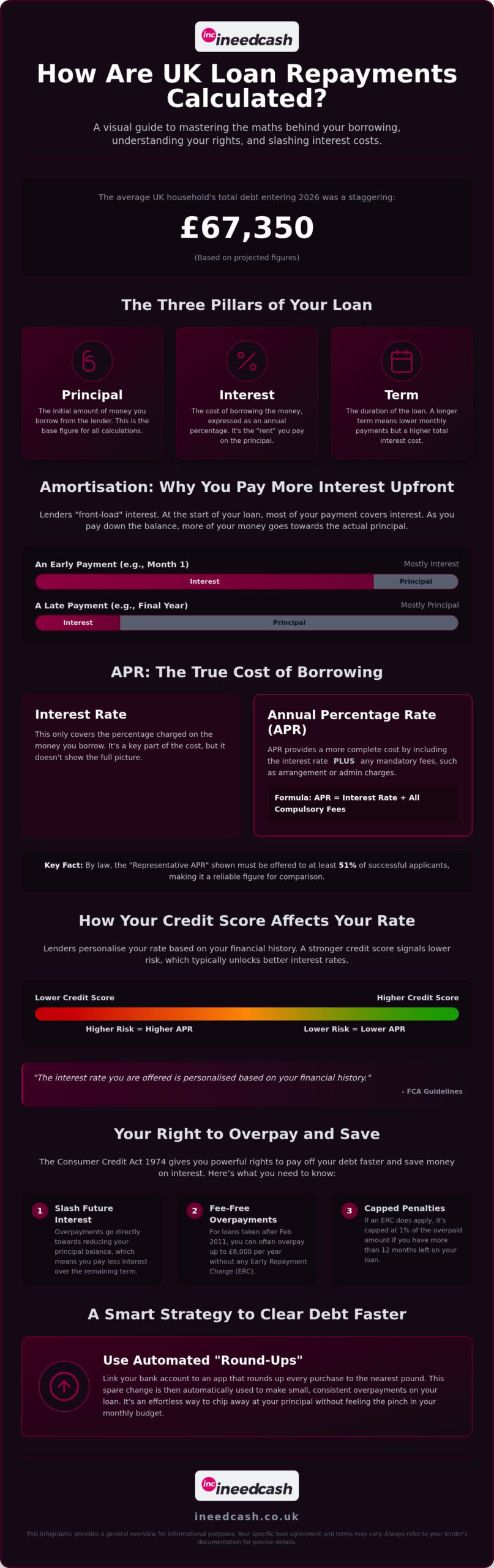
Three core variables dictate your monthly bill. The principal is the initial amount you borrow from the lender. Interest acts as the “rent” you pay to use that money, typically expressed as an annual percentage. Finally, the term is the duration of the loan. Whilst a longer term makes monthly costs more manageable, it significantly increases the total interest you’ll pay over the life of the agreement. For instance, a £10,000 loan over five years carries a very different total cost than the same amount over three.
Amortisation: Why You Pay More Interest Early On
Lenders use an Amortizing loan formula to structure your debt. This ensures the loan is cleared exactly by the end of the term. Interest is calculated on your remaining balance every month. Since your balance is highest at the start, your initial payments are “front-loaded” with interest. As you pay down the debt, more of your money goes toward the principal. This is why homeowner loans with longer terms require careful calculation to avoid high long-term costs. Understanding this mechanism helps you see the immense value of making early overpayments to bypass future interest charges.
APR and the Real Cost of Your Monthly Instalments
Don’t let a low headline interest rate fool you. Truly understanding how are loan repayments calculated uk requires looking beyond the “flat rate” to the Annual Percentage Rate (APR). Whilst a flat rate only applies to the initial amount borrowed, the APR covers both interest and mandatory fees. This provides a clearer picture of APR and the Real Cost. By law, lenders must provide a “Representative Example”. This ensures at least 51% of successful applicants receive the advertised rate, helping you compare offers fairly. To see how these figures shift with security, explore homeowner loan options to see how secured rates compare to personal ones.
How Fees Influence the Calculation
Fees can silently inflate your monthly bill. Arrangement fees are often added to the loan principal, meaning you’ll pay interest on the fee itself over the entire term. Broker fees are also typically included in the APR to provide total transparency. Always check your credit agreement for any “hidden” costs that might affect the final monthly figure. These can include:
- Admin or setup charges
- Annual service fees
- Compulsory insurance costs
The Impact of Credit Scores on Your Rate
Your credit history is the primary driver of your final APR. Higher scores usually unlock lower rates and smaller monthly repayments, rewarding your financial record. Conversely, bad credit loans carry higher rates to reflect the lender’s increased risk. “The interest rate you are offered is personalised based on your financial history,” according to FCA guidelines. This personalisation ensures your offer is based on your unique situation rather than a one-size-fits-all model.
Find Your Tailored Loan Solution
This personalisation means two people borrowing the same amount might see vastly different monthly costs. It’s about your individual agency and finding a supportive partner that matches your needs. If you’re ready to find a flexible solution tailored to your circumstances, get started with our panel of lenders today. We work on your behalf to find options that offer the transparency and speed you deserve.
UK Regulations: Your Rights to Overpay and Save
You have more power over your debt than you think. The Consumer Credit Act 1974 provides the legal right for most UK borrowers to repay their loans early. When you make an overpayment, the money goes directly towards the principal balance. This is a game-changer. By reducing the principal, you effectively bypass future interest charges that would’ve accrued. Understanding how are loan repayments calculated uk shows that interest is a charge for time. If you shorten that time, you slash the cost.
Understanding Early Repayment Charges (ERCs)
Lenders can charge an Early Repayment Charge (ERC), but these are strictly regulated. For most personal loans, this penalty is typically capped at 28 to 58 days of interest. Under rules for loans taken after 1 February 2011, you can often overpay up to £8,000 in a single year without any fee at all. Always request a “settlement figure” from your lender whilst planning to clear the balance. This figure includes the remaining principal plus any allowable interest penalties, giving you a final “buy-out” price.
The 1% Cap and Statutory Rights
The Financial Conduct Authority (FCA) ensures clearing debt doesn’t become a financial trap. If you have more than 12 months remaining, the fee is capped at 1% of the amount repaid early. This falls to 0.5% if you have less than a year left. According to GOV.UK data, these rights apply to both partial and full settlements. Read our guide on Open Banking Loans to see how digital tools help. If you want a lender that supports your autonomy, find your flexible loan offer today.
Strategies to Reduce Repayments and Clear Debt Faster
Consistency is your greatest ally when tackling debt. Whilst big lump sums are great, even adding £20 extra a month to your instalment can significantly reduce your loan term. This works because you’re attacking the principal directly. As we’ve explored regarding how are loan repayments calculated uk, reducing that balance means less interest accumulates every month.
Automating Your Overpayments
Use a “round-up” tool on your banking app to automate these small overpayments. These tiny shifts improve your debt-to-income ratio. Over time, this can boost your credit score and open doors to better rates. To find a partner that supports this journey, get a tailored loan quote from lenders who reward flexible behaviour.
Refinancing for a Lower Monthly Cost
If interest rates have dropped since you signed your agreement, refinancing could save you hundreds. It’s a simple calculation. Compare the cost of the Early Repayment Charge (ERC) on your current debt against the potential savings from a lower APR. If the new rate is significantly better, the switch pays for itself. This is particularly effective for large balances. For example, if you’re paying high rates on a vehicle, you should check car finance options to see if you can lower those specific monthly costs.
The Role of a Broker in Repayment Planning
Brokers like I Need Cash act as your advocate. We help you navigate an extensive panel of lenders to find flexible terms that suit your life. When comparing offers, look for “no-fee overpayment” clauses. These allow you to pay more whenever you have extra cash without being penalised. For those with bad credit, a broker can help find manageable repayment structures that foster financial recovery rather than stress. We value your autonomy and work to ensure you aren’t just another number in a system.
Take Control of Your Financial Future Today
You now have the tools to demystify your debt and move from confusion to tranquillity. Understanding how are loan repayments calculated uk is the first step toward clearing your balance faster. Remember that your monthly instalments are a mix of principal and interest. Reducing that principal through smart overpayments bypasses future interest costs. You have the legal right to repay early; use this autonomy to your advantage.
Expert Guidance for Debt Management
“Making overpayments can save you a significant amount of interest and help you pay off your loan much sooner,” according to the experts at MoneyHelper. We are here as your non-judgmental ally to help you find flexible terms. As an FCA Authorised Credit Broker, we provide access to a diverse panel of UK lenders who value your individual situation. Start your journey to financial freedom with a tailored loan quote. You’ve got this.
Frequently Asked Questions
Will overpaying my loan hurt my credit score?
No, overpaying usually boosts your score by reducing your total debt-to-credit ratio. Lenders see this as a sign of financial stability and responsible behaviour. “Paying more than the minimum can significantly improve your credit standing over time,” notes the team at StepChange Debt Charity. It demonstrates your personal agency and commitment to clearing debt. Just ensure you maintain your regular monthly instalments to avoid any accidental missed payment markers.
How much interest can I save by overpaying £50 a month?
Your savings depend on your APR and the time remaining. On a £10,000 balance at 6.9% APR, adding £50 monthly could save you over £250 in interest. This is because you’re attacking the principal directly rather than just servicing the interest. Understanding how are loan repayments calculated uk allows you to see that every extra pound reduces the base amount that the lender can charge interest against each month.
What is the difference between a settlement figure and my remaining balance?
Your remaining balance is simply the total principal you still owe. A settlement figure is the actual “buy-out” cost to close the account today. This includes your balance plus up to 58 days of interest as a penalty. It’s a precise calculation that ensures the lender is compensated whilst you clear the debt. Always request this specific figure before making a final payment to ensure your account is fully settled.
Can a lender refuse to let me make an overpayment in the UK?
No, UK lenders cannot legally stop you from making overpayments on standard personal loans. The Consumer Credit Act 1974 ensures you have the right to repay your debt early. Whilst they must accept your payment, they’re allowed to charge a regulated fee for the privilege. Knowing how are loan repayments calculated uk helps you determine if the interest you’ll save justifies the small early repayment charge the lender applies.
Should I use my savings to pay off my loan early?
You should compare the interest rates of both. If your loan APR is higher than your savings interest rate, using savings to pay off debt is usually more cost-effective. As Citizens Advice points out, “it usually makes sense to pay off your debts before you start saving.” However, always keep a small emergency fund for unexpected costs. This strategy ensures you maintain tranquillity whilst aggressively reducing the total cost of your borrowing.

Article by
Mandy Paige
Social Content Writer and Blogger
Mandy has been writing for various website for a number of years, especially for companies in the consumer finance industry. She started her career guiding customers wanting help when applying for finance at a Loan Brokerage. Speaking to individuals wanting guidance, it lead her to start writing help and guidance on finding the right solution for their needs. Outside of writing, she is a wiz with a pair of scissors as she originally trained as a hairdresser.
Disclaimer
The content of this article/blog was correct to our knowledge on the date/time it was published.