 Skip to content

Are There Penalties for Paying Off a Loan Early? UK Guide 2026
- Michelle
- Finance
Did you know that roughly 1.8 million fixed-rate mortgage deals are set to expire in 2026? With so many homeowners racing to clear balances, you might wonder: are there penalties for paying off a loan early? It’s frustrating to feel punished for being financially responsible. We agree that hidden jargon shouldn’t stand in your way. This guide reveals the legal limits lenders can charge based on FCA guidelines and how to calculate if settling early saves you money. We’ll preview the 58-day rule and help you reclaim your financial autonomy today.
Key Takeaways
- Understand why lenders use Early Repayment Charges to protect their expected interest. Learn the logic behind these fees so you can stay one step ahead of your contract.
- Discover how the Consumer Credit Act limits charges to a maximum of 58 days of interest. Use this legal shield to ensure you aren’t overcharged for being financially responsible.
- Get a clear answer to are there penalties for paying off a loan early by requesting a 28-day settlement quote. Compare this figure to your remaining payments to see your true savings.
- Learn how to identify flexible loan products that feature zero exit fees. Use a broker to filter through lenders and find terms that respect your financial autonomy and prioritise your freedom.
What are Early Repayment Charges (ERCs) and Why Do They Exist?
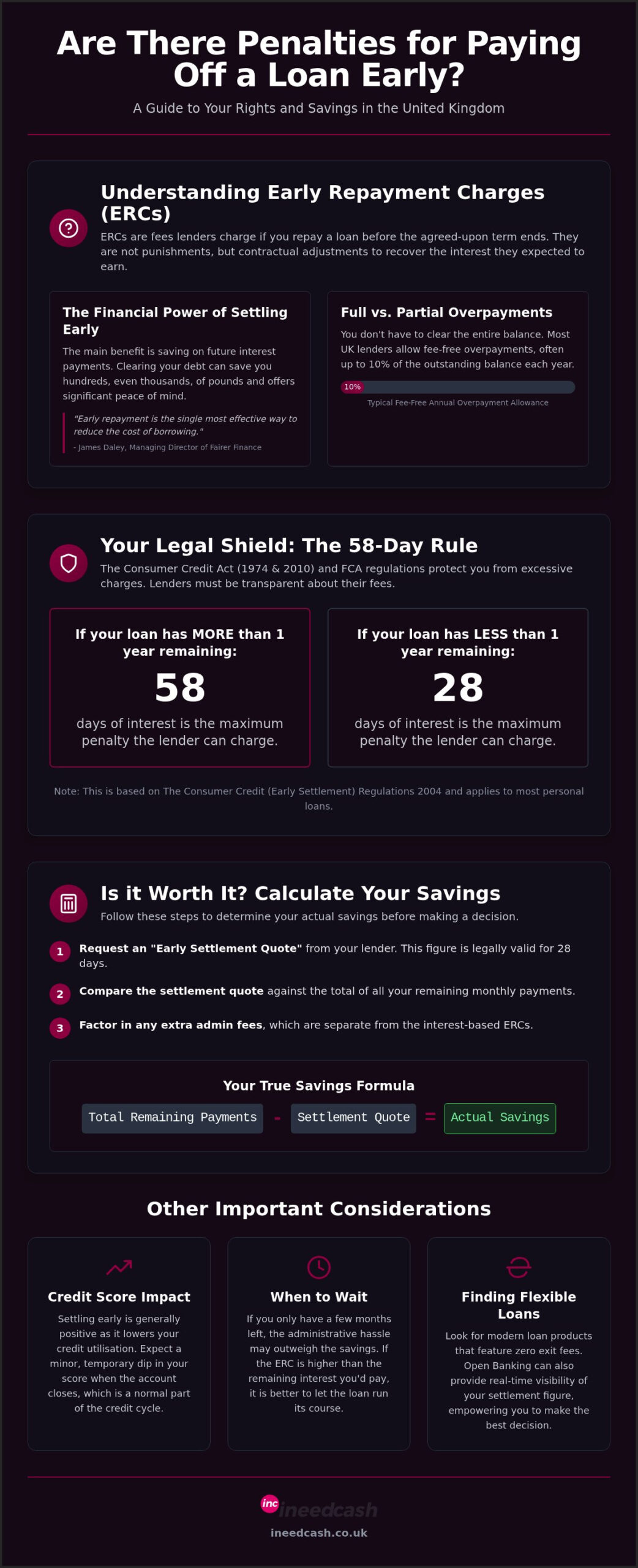
ERCs are fees charged when you repay a loan before the agreed term ends. From the lender’s perspective, these charges recoup the interest they expected to earn over the years. Whether you have a personal loan or a homeowner loan, these fees are contractual adjustments rather than punishments. They are strictly regulated by the Financial Conduct Authority to ensure transparency. You’ll often find that are there penalties for paying off a loan early depends on the specific product type and the remaining term of your agreement.
Why Settling Early is a Financial Power Move
The primary benefit of early settlement is the massive saving on future interest. “Early repayment is the single most effective way to reduce the cost of borrowing,” says James Daley, Managing Director of Fairer Finance, in a recent consumer report. By clearing your balance, you could save hundreds of pounds over the remaining life of the loan. Beyond the maths, reducing your “debt cloud” provides significant mental health benefits and financial tranquillity. It allows you to reclaim your autonomy and focus your income on personal goals.
The Difference Between Full and Partial Overpayments
You don’t always have to clear the entire balance to save money. Most UK lenders allow a “fee-free” overpayment allowance, which is often 10% of the outstanding balance each year. Making partial overpayments reduces the total term and interest without triggering full settlement fees. It is a smart way to chip away at debt whilst maintaining liquidity. Always check your Key Facts Illustration to see your specific allowance. This small habit can drastically cut your total borrowing costs over time.
The Legal Limit: What UK Lenders Are Allowed to Charge
You aren’t at the mercy of your lender’s whims. The Consumer Credit Act (1974 and 2010) acts as a legal shield for UK borrowers. When asking are there penalties for paying off a loan early, remember that legislation strictly caps what banks can take. Under The Consumer Credit (Early Settlement) Regulations 2004, most personal loans follow the “58-day rule”. If you have more than a year remaining on your term, the lender can usually charge a maximum of 58 days of interest. For shorter terms, this drops to just 28 days.
Statutory Protections and Your Rights
The Financial Conduct Authority (FCA) ensures transparency is mandatory. Lenders must clearly state their settlement terms before you sign. You’ll find these details in the “Early Settlement” section of your agreement. There’s also a specific £8,000 threshold to keep in mind. Many lenders allow overpayments up to £8,000 per year without any additional restrictions or complex calculations. This gives you the autonomy to chip away at your debt whilst staying protected by law.
How Open Banking is Changing the Game
Modern tech is making these calculations easier than ever. Choosing open banking loans provides real-time visibility of your settlement figure. Seeing a live balance helps you decide exactly when to clear your debt for maximum savings. It strips away the mystery of traditional banking jargon. If you want to explore your options with transparent providers, you can get started online to find a partner that respects your financial freedom.
Calculating the Savings: Is it Actually Worth It?
Don’t guess your savings. Start by requesting an “Early Settlement Quote” from your lender. This figure is legally valid for 28 days. Once you have it, compare that settlement amount against the total of your remaining monthly payments. This is the only way to answer: are there penalties for paying off a loan early that actually eat your profit? Remember to factor in specific “admin fees”. These sit outside the interest-based ERC limits defined by The Consumer Credit (Early Settlement) Regulations 2004.
The £50 Rule for Savvy Borrowers
If your total saving is less than £50, it might be better to keep your cash in a high-interest savings account. Use your autonomy to decide where your money works hardest. Sometimes, the interest earned elsewhere beats the interest saved on the debt. It’s about being smart with your liquidity whilst clearing the path to financial peace. This approach ensures you don’t waste time on admin for negligible gains.
Does Paying Off Early Affect Your Credit Score?
Settling early is generally a positive move. It lowers your total credit utilisation, which lenders love to see. You might notice a minor, temporary “dip” in your score when the account closes. This happens because the average age of your accounts changes. Don’t panic. This is a normal part of the credit cycle and usually resolves quickly. Your long-term financial health is the priority.
When to Wait: The “Close to the End” Scenario
Timing matters. If you only have two or three months left, the admin hassle might outweigh the interest savings. A good rule of thumb? If the ERC is higher than the interest you’d pay by just letting the loan run, wait it out. You want your exit to be a victory, not a paperwork headache. If you’re looking for a fresh start with a flexible partner, get started today to find lenders that match your pace.
How to Choose Flexible Loans with No Early Exit Fees
When you’re shopping for credit, the best way to handle the question are there penalties for paying off a loan early is to avoid them from the start. Look for lenders who market “no early repayment penalties” as a key product feature. This transparency allows you to plan your exit strategy before you even sign the contract. It’s about maintaining your personal autonomy throughout the life of the loan.
The Broker Advantage: Finding Your Ally
Walking into a high-street bank often feels like facing a gatekeeper. They have rigid criteria and fixed penalty structures. The broker advantage is simple: we work for you. I Need Cash connects you to a diverse panel of independent lenders. Many of these providers specifically target borrowers who value flexibility. For real estate investors, Level 4 Funding offers similar specialist support through private financing options. They understand that life changes, so they offer terms that allow you to clear debt faster without being penalised for your success.
Securing a flexible deal requires a bit of preparation. Check your credit report for errors before applying. Whilst we work with bad credit lenders, a cleaner file often unlocks lower interest rates. Consider these steps to optimise your application:
- Keep your address history consistent and up to date.
- Ensure you are on the electoral roll at your current residence.
- Review your current debt-to-income ratio to show affordability.
If you have equity in your property, homeowner loan options provide a secure way to access larger sums with more generous repayment terms. If you are looking for a new start, get a loan quote that puts you in control.
Take Control of Your Financial Freedom
You have navigated the technicalities of ERCs and the legal protections offered by the 58-day rule. The path to financial peace is now clear. Deciding if are there penalties for paying off a loan early shouldn’t be a source of anxiety anymore. You possess the legal framework to protect your interests and the calculation steps to verify your savings. It is about taking that final step to organise your finances for a more stable, debt-free future.
Your Partner in Flexible Finance
If you are ready to find a loan that respects your autonomy, we are here to assist. As an FCA Regulated Broker, I Need Cash provides access to specialist homeowner and bad credit lenders who offer the flexibility you deserve. Our no-impact soft search options mean you can explore your options without affecting your credit rating. Check your eligibility for a flexible loan with I Need Cash today and take the first step toward lasting tranquillity.
Frequently Asked Questions
Can I be charged for paying off my loan early in the UK?
Yes, you can be charged an Early Repayment Charge (ERC) if your contract includes it. Most fixed-term personal loans and mortgages have these clauses to protect the lender’s interest income. However, the Financial Conduct Authority (FCA) regulates these fees to ensure they’re fair. Always check your agreement for the “Early Settlement” section to see if your specific provider applies these charges before you commit to clearing the balance today.
How much interest can a lender charge for early settlement?
Lenders are restricted by the Consumer Credit Act regarding how much they can take. For most personal loans, the maximum charge is roughly one to two months of interest. If you’re clearing a mortgage, charges often range from 1% to 5% of the outstanding balance. The law ensures these fees are a “reasonable pre-estimate” of costs rather than a punitive fine designed to trap you in a cycle of debt.
What is the 58-day interest rule for UK loans?
The 58-day rule is a legal limit that prevents lenders from overcharging you. If your loan has more than one year remaining, the lender can charge a maximum of 58 days’ interest as an exit fee. If you have less than a year left, this usually drops to 28 days. This statutory protection means you don’t need to wonder are there penalties for paying off a loan early that could wipe out your savings.
Will paying off my loan early hurt my credit rating?
Settling early is generally positive because it improves your debt-to-income ratio. You might see a small, temporary dip in your score when the account closes, as the total number of active accounts on your file changes. However, this is usually short-lived. Demonstrating that you can successfully manage and clear a debt actually builds trust with future lenders. It shows you’re a responsible borrower who values their financial autonomy and long-term stability.
Are there any loans in the UK without early repayment penalties?
Yes, many flexible products, including some tracker mortgages and standard variable rate loans, don’t carry exit fees. Some modern digital lenders also market “no fee” settlement as a core feature. When asking are there penalties for paying off a loan early, it’s best to use a broker. We can filter our panel of lenders to find providers that allow you to overpay or settle in full without charging you a penny extra.

Article by
Mandy Paige
Social Content Writer and Blogger
Mandy has been writing for various website for a number of years, especially for companies in the consumer finance industry. She started her career guiding customers wanting help when applying for finance at a Loan Brokerage. Speaking to individuals wanting guidance, it lead her to start writing help and guidance on finding the right solution for their needs. Outside of writing, she is a wiz with a pair of scissors as she originally trained as a hairdresser.
Disclaimer
The content of this article/blog was correct to our knowledge on the date/time it was published.