 Skip to content

Equifax UK Guide: Master Your Credit Score for Better Loan Options in 2026
- Michelle
- Finance, Guide
Your Equifax credit score isn’t a permanent judgment on your character. It’s a dynamic tool you can master to unlock better financial options. If you’ve ever felt frustrated by a lack of transparency or anxious about past mistakes, you aren’t alone. Many people feel trapped by a number they don’t fully understand, especially whilst trying to secure a homeowner loan or a personal loan. It’s time to take control of your equifax profile and stop letting the unknown hold you back.
This guide changes everything. You’ll discover how the 0-1000 scale actually works and learn the exact steps to improve your standing for a successful application. We’ll show you how to fix errors on your report and explain how the July 15, 2026, regulation of “Buy Now, Pay Later” products impacts your borrowing power. We provide the support you need to move from financial stress to total confidence. Your unique circumstances matter, so learn how to boost your score without impacting your financial records today.
Key Takeaways
- Master the new 0-1000 scoring scale to understand exactly how lenders view your financial reliability in 2026.
- Learn how to spot and fix errors on your equifax report to ensure your credit history works for you, not against you.
- Secure your address history by joining the electoral roll to instantly improve your credibility with potential lenders.
- Explore how working with a supportive broker provides access to an extensive network of lenders who look past previous financial mistakes.
- Gain clarity on why credit data varies amongst different agencies and how to use this knowledge to your advantage when applying for a homeowner or personal loan.
What is Equifax and How Does it Influence Your Borrowing Power?
Equifax is one of the three major Credit Reference Agencies (CRAs) operating in the UK. Think of them as a massive data library. They don’t just hold your name; they track your financial behaviour across several years. They gather details from your bank accounts, mobile phone contracts, and utility providers. Even your presence on the electoral roll is logged. This data forms your credit report. It’s essentially a financial CV that you have the power to organise and improve. Every time you pay a water bill or a credit card statement, a digital footprint is left behind. We are here to support you in managing that footprint effectively.
When you apply for homeowner loans or personal loans, lenders don’t just guess your reliability. They check your file. They use this history to calculate risk. A solid report means lower interest rates. A messy one might lead to higher costs or rejection. Understanding this dynamic puts the power back in your hands. You aren’t just a number; you’re a story of financial responsibility that you can rewrite starting today. Our role is to facilitate this journey for you, ensuring you find the right path forward regardless of your past mistakes.
The Role of a Credit Reference Agency
Equifax operates under a strict legal framework. They’re regulated by the Financial Conduct Authority (FCA). This ensures your data is handled safely and ethically. It’s a common misconception that Equifax rejects loan applications. They don’t. They simply provide the data library. The lender makes the final call based on their own internal rules and risk appetite. Think of Equifax as the witness, not the judge. We provide the support you need to ensure that witness has the best possible story to tell about your finances.
Why Your Equifax Profile is a Priority in 2026
Financial products move at lightning speed in 2026. Lenders now rely on real-time data to make instant decisions. With over 28.8 million users globally, the Equifax platform is a cornerstone of modern lending. If your file is “thin”, meaning you have little credit history, you might struggle as much as someone with bad credit. Monitoring your profile is also your first line of defence against identity theft. If someone tries to take out paydayloans in your name, your alerts will catch it. Speed and security are the new standards. Don’t leave your financial future to chance when the tools to protect it are right in front of you. Checking your options with us is always safe. It carries our signature guarantee of no impact on your permanent financial records.
Decoding the Equifax Credit Score: What the Numbers Actually Mean
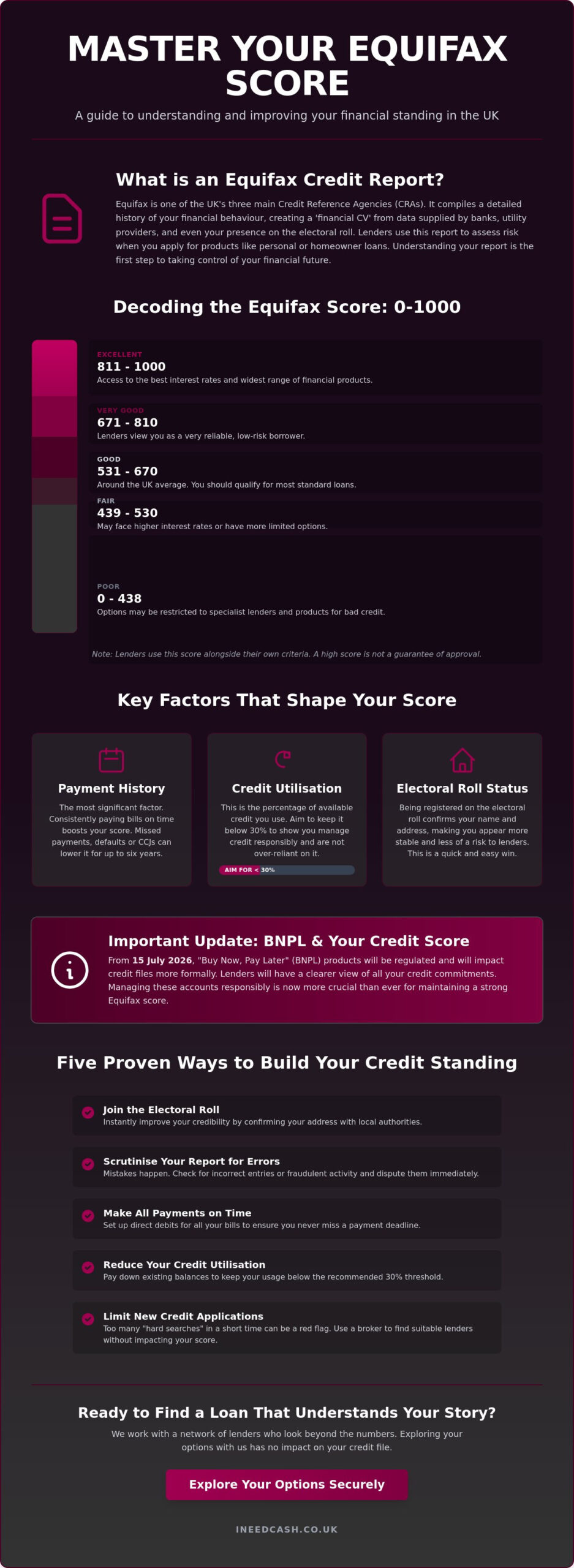
Your Equifax score is a snapshot of your financial health. It isn’t a permanent label or a judgment of your character. Since 2021, the equifax scale has ranged from 0 to 1000. This wider range allows for more nuance in how your financial behaviour is tracked. If your number is lower than you’d like, don’t panic. Scores are dynamic; they change whilst your habits improve. Understanding the bands is the first step toward taking control of your financial future.
- Excellent (811-1000): You have access to the widest range of products and the best interest rates.
- Very Good (671-810): Lenders see you as a low-risk borrower with a strong credit history.
- Good (531-670): This is around the UK average; you’ll likely qualify for most standard loans.
- Fair (439-530): You may face slightly higher interest rates or more limited borrowing options.
- Poor (0-438): Your options might be restricted to specialist products like bad credit loans.
There is no such thing as a universal credit score. Every lender uses their own secret recipe to decide who gets a loan. They combine your equifax data with their own internal rules and affordability checks. The Information Commissioner’s Office provides guidance on how this data should be handled, but the final decision always rests with the lender. We are here to help you find the providers amongst our network who value your current progress over past mistakes.
Factors That Shape Your Score
Payment history is the most significant factor. Missing a single payment can cause a dip. More serious issues like defaults or CCJs stay on your file for six years. Another vital element is credit utilisation. This is the percentage of your available credit that you actually use. Aim for the “sweet spot” of 30% or less. If you have a £1,000 limit, try to keep your balance under £300. The length of your credit history also matters. Keeping old, well-managed accounts open shows you can maintain long-term financial relationships.
Modern Supplements: Open Banking and Real-Time Data
Traditional reports don’t always tell the whole story. This is where Open Banking steps in. It allows you to share real-time transaction data directly with lenders. This is a game-changer for freelancers or people with non-traditional income. It proves your ability to manage money today, regardless of what happened years ago. For a deeper look at how this technology works, read our Open Banking Loans guide. It’s a modern way to show lenders you are ready for a fresh start. If you’re ready to see what’s possible for your situation, get started now. Checking your eligibility with us is safe; it carries our signature guarantee of no impact on your permanent financial records.
Equifax Amongst the Big Three: Why CRA Data Varies
You might notice your score looks different depending on where you check it. This is perfectly normal. In the UK, the credit market is dominated by three main agencies: Equifax, Experian, and TransUnion. Whilst they all collect similar data, they don’t always share it. Some lenders only report to one agency. Others might report to all three but at different times of the month. This creates discrepancies in your files. It isn’t a mistake; it’s just how the system operates. You need to understand how lenders decide which agency to trust before you apply for a homeowner loan.
Each agency also uses a different scoring scale. As we’ve discussed, equifax uses a 0-1000 range. Experian uses 0-999. These numbers are just interpretations of your data. A “good” score on one might be “fair” on another. This is why checking all three reports is vital whilst you prepare for a major application. You want a complete picture of your financial standing. Don’t let a hidden error on one report block your access to a personal loan or car finance. Total transparency is your best tool for success.
Why Lenders Choose Different Agencies
Lenders often have a favourite agency based on their industry. Mortgage lenders might prefer one, whilst providers of short term loans might look elsewhere. Some use multiple agencies to get a broader view. When you search for credit, you’ll encounter “hard” and “soft” searches. A hard search leaves a mark on your file. Too many can lower your score. I Need Cash uses soft searches to protect your standing. This allows you to see your options without any risk to your equifax profile. It’s a safer, faster way to find the assistance you need.
The Importance of the Statutory Credit Report
You have a legal right to see your data. Under GDPR, you can access your statutory credit report for free from every agency. You don’t need a paid subscription for this. Request your report once a year or before applying for a loan. If you spot an error, act fast. You can raise a dispute directly with the agency. They have a legal obligation to investigate and correct inaccuracies. This process ensures your financial CV is accurate and ready for review. We are here to facilitate your journey, providing a supportive path to the credit you deserve regardless of past hurdles. Your personal autonomy is our priority, and we ensure you stay in control of your financial record throughout the process.
Five Proven Ways to Build Your Credit Standing Whilst Planning a Loan
Your credit file is a living record. It changes as your habits evolve. If you’re planning to apply for a homeowner loan or a personal loan, you need to take control of the narrative. Don’t wait for things to happen. Act now to strengthen your profile. These five steps provide a clear path from financial anxiety to a position of strength. We are here to facilitate this transformation with a supportive, non-judgmental approach to your finances.
- Register on the electoral roll: This is the fastest way to verify your identity and address history. Lenders see this as a marker of stability.
- Dispute inaccuracies: Review your equifax file for errors. Even a tiny mistake in an old address can cause a dip. Raise a dispute immediately to clear your record.
- Automate your success: Set up direct debits for every bill. Consistency is king. Never miss a payment whilst you’re building your history.
- Keep old accounts open: Long-term relationships show you’re reliable. Don’t close that old credit card account; keep it active with a small, monthly purchase.
- Space out applications: Every “hard” search leaves a footprint. Avoid making multiple applications in a short window. It can make you look desperate for cash.
Quick Wins for a Faster Score Boost
If you have a “thin” file with very little history, consider a credit builder card. Use it for a small weekly shop and pay it off in full. This creates a rhythm of reliability. You should also check for “financial associations”. If you’re still linked to a former partner with poor credit, disassociate from them officially. This protects your equifax profile from their mistakes. Finally, focus on paying off small, high-interest balances first. Reducing these shows immediate improvement in your debt-to-income ratio.
Managing Bad Credit and Defaults
Past mistakes don’t define your future. Defaults and CCJs are stressful, but they aren’t permanent. Time is the ultimate healer. As these marks age, they carry less weight with lenders. We understand that life happens. Our network of providers looks beyond the surface to find solutions that fit your current reality. If you’re struggling, explore bad credit loan options designed for your specific situation. You have the autonomy to rebuild. Get started today and see how our flexible assistance can help you move forward with confidence. Our process is safe and won’t impact your permanent financial records.
Finding the Right Financial Ally: How I Need Cash Uses Your Credit Profile
Understanding your equifax profile is the first step toward financial freedom. Finding a partner who can act on that data is the second. Applying to a direct lender often feels like a gamble. If they reject your application, you’re left with a hard search and a fresh dent in your standing. We do things differently. As a broker, we act as your dedicated advocate. We don’t just look at a single number on a screen. We connect you with an extensive network of independent providers who understand that life is complicated and mistakes happen.
Our approach is built on transparency and speed. We know that when you need a loan, you usually need it now. Waiting weeks for a decision isn’t an option. Our digital-first system is designed for rapid consumption and even faster results. We facilitate the connection between your needs and the lenders most likely to say yes. This supportive process ensures you aren’t just another file in a cabinet. You’re a person with a specific goal, and we’re here to help you reach it. We prioritise your personal autonomy throughout the entire journey.
Tailored Solutions for Every Credit Type
We offer flexibility where traditional banks offer barriers. If you’re looking for homeowner loans, our partners can often leverage your property equity to secure a solution, regardless of your past credit history. Perhaps you need to get back on the road? We specialise in matching users with car finance options that fit their actual monthly budget. Our service is entirely free for you to use and fully FCA-authorised. You get expert assistance and access to a wide market without any hidden fees or upfront costs.
For readers who are specifically seeking specialised residential property finance, you can discover Mortgage Suite Ltd to explore dedicated loan options.
Your Next Steps to Financial Tranquillity
It’s time to move from financial anxiety to total empowerment. You’ve learned how the equifax 0-1000 scale works and how to improve your standing. Now, let us do the heavy lifting. Our 3-step process is designed for your convenience:
- Apply: Fill in our simple online form in just a few minutes.
- Match: We instantly scan our network for the best possible fit for your situation.
- Decide: Review your personalised quote with absolutely no obligation to proceed.
Don’t let the fear of rejection hold you back any longer. Take the first step toward a brighter financial future today. Access the support you deserve and find a solution that respects your individual circumstances. Get your personalised loan quote now. Our initial search is a soft check, which means it carries our signature guarantee of no impact on your permanent financial records.
Empower Your Financial Journey Today
You’ve mastered the 0-1000 equifax scale and identified the exact steps to build a stronger profile. Whether it’s joining the electoral roll or correcting errors, you now have the tools to organise your financial CV effectively. Don’t let past mistakes or a lack of transparency stop you from moving forward. We are here to act as your supportive advocate, looking beyond the numbers to find the flexibility you need. Every individual has a unique story; we prioritise your personal autonomy above all else.
Start your non-judgmental loan search today. Our service is free to use and carries our signature guarantee of no impact on your financial record during the initial search. We are FCA authorised and regulated, providing you with immediate access to a diverse panel of independent UK lenders. Stop feeling anxious and start feeling tranquil. You deserve a facilitator that values speed and security as much as you do. Your fresh start is just a few clicks away, and we’re ready to facilitate your success.
Frequently Asked Questions
Is Equifax free to use in the UK?
Yes, you can access your statutory credit report for free. This is a legal right under data protection laws. Equifax also offers a free “Basic” product which provides a monthly score update. Whilst they have paid subscriptions for daily alerts and identity protection, the core information about your credit history is available at no cost to you.
Will checking my own Equifax score lower it?
No, checking your own score has zero impact on your credit standing. This is classified as a “soft search” and is invisible to lenders. You can monitor your equifax profile as often as you like without worrying about damaging your borrowing power. It’s a safe way to stay informed about your financial health whilst planning your next loan application.
What is considered a good Equifax credit score in 2026?
A score between 531 and 670 is considered “Good” on the 0-1000 scale. If you reach the 671-810 range, you’re in the “Very Good” band. Scores above 811 are “Excellent” and typically unlock the most competitive interest rates for homeowner loans and personal loans. Remember, every lender has their own unique criteria, so a “fair” score can still lead to a successful application.
How long does negative information stay on my Equifax report?
Most negative information, including defaults, CCJs, and missed payments, remains on your file for six years. After this period, the data is automatically removed from your record. Whilst these marks are visible, their impact lessens as they get older. Building a fresh history of reliable behaviour today is the best way to move past previous financial mistakes.
Why is my Equifax score different from my Experian score?
Scores differ because each agency uses a unique mathematical formula and a different scoring scale. Lenders don’t always report data to every agency; some might only update Experian whilst others focus on equifax. This creates variations in the data held by each agency. It’s perfectly normal to see different numbers across the “Big Three” agencies in the UK.
Can I fix errors on my Equifax credit report myself?
Yes, you can dispute any inaccuracies directly through the Equifax online dispute centre for free. If you find an incorrect address or a payment marker that doesn’t belong to you, raise a query immediately. They must investigate your claim and update the record if the information is proven to be false. This is a vital step in organising your financial CV.
How often does Equifax update my credit information?
Most lenders send updates to credit reference agencies once every 30 days. This means your report is a rolling record rather than a live, second-by-second feed. If you pay off a short term loan today, it usually takes four to six weeks for that change to reflect on your official profile. Consistency over several months is the key to seeing a sustained score increase.
Does Equifax include my salary or savings in my credit score?
No, your credit score does not factor in your salary, total savings, or your current employment status. It only tracks how you manage credit agreements and debt. However, when you apply for a loan, lenders will ask for your income details separately. They use this information alongside your credit report to ensure the repayments are affordable for your specific situation.

Article by
Mandy Paige
Social Content Writer and Blogger
Mandy has been writing for various website for a number of years, especially for companies in the consumer finance industry. She started her career guiding customers wanting help when applying for finance at a Loan Brokerage. Speaking to individuals wanting guidance, it lead her to start writing help and guidance on finding the right solution for their needs. Outside of writing, she is a wiz with a pair of scissors as she originally trained as a hairdresser.
Disclaimer
The content of this article/blog was correct to our knowledge on the date/time it was published.