 Skip to content

Emergency Cash in the UK: A Complete Guide to Urgent Financial Support
- Michelle
- Finance, I Need Cash
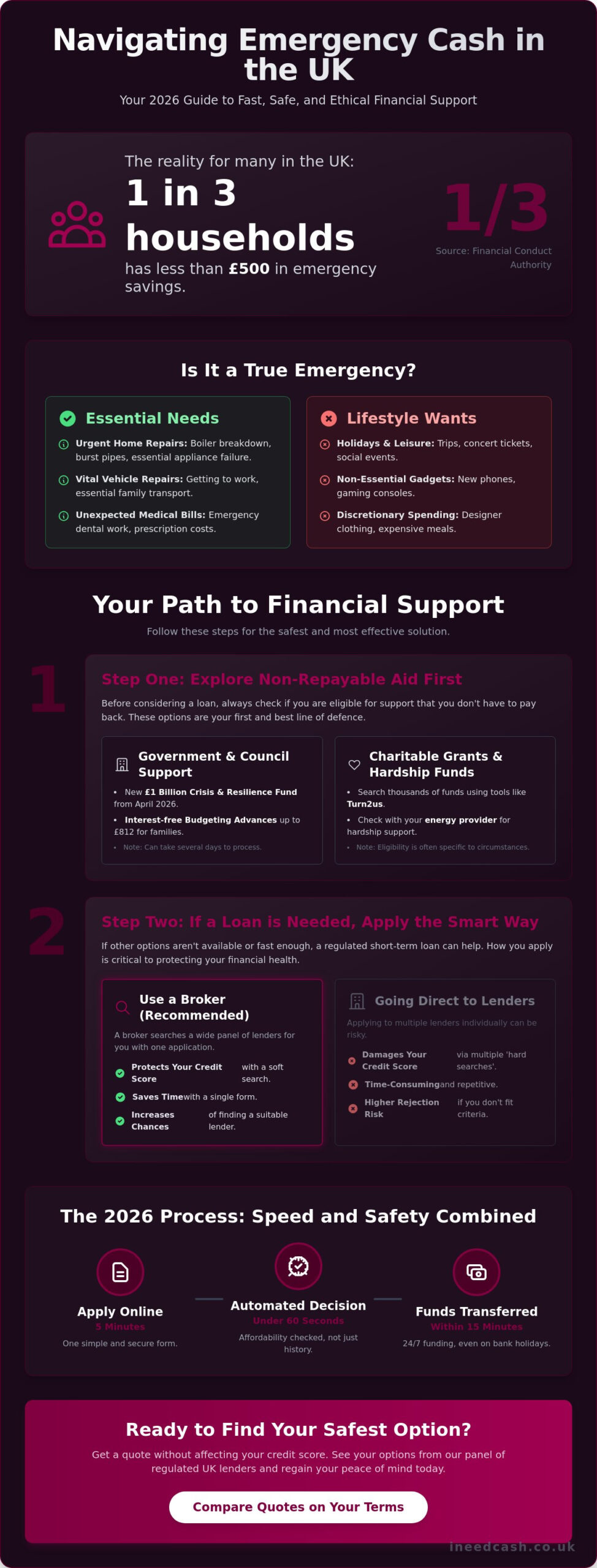
Did you know that one in three UK households now has less than £500 in emergency savings? This finding from the Financial Conduct Authority highlights why so many people feel the weight of urgent bills. If you’re facing a financial shock right now, you aren’t alone. It’s easy to feel trapped by a low credit score or confused by the difference between lenders and brokers, but getting emergency cash shouldn’t be a source of shame. You deserve a fast, ethical way to bridge the gap and keep your life moving.
We agree that the pressure of an unexpected expense is enough to handle without worrying about hidden fees or rejection. This guide promises to show you every available option for securing funds in 2026 whilst protecting your financial health. We’ll preview the new £1 billion Crisis and Resilience Fund launched in April, explain interest-free Budgeting Advances, and show you how to access regulated loans that don’t damage your credit score during the quote process. You’ll see how the I Need Cash ethic puts your needs first. It’s time to be in control on your terms and find the peace of mind you need today.

Key Takeaways
- Identify exactly when to use urgent funds for essentials like boiler breakdowns or vital vehicle repairs.
- Explore non-repayable support through local council schemes and charitable grants to ease immediate pressure.
- Discover how to access emergency cash safely through regulated short-term options designed for rapid response.
- Learn how using a broker protects your credit score whilst searching a varied panel of lenders for the best fit.
- Organise a clear repayment strategy that fits your budget and maintains your financial control for the future.
What is Emergency Cash and When Should You Use It?
Life doesn’t wait for payday. When your boiler packs up in mid-January or your car’s gearbox fails on the way to a shift, you need a solution that moves as fast as your problem. We define emergency cash as funds accessed rapidly to cover essential, unforeseen expenses that cannot wait. Ideally, everyone would have a substantial Emergency fund tucked away for these moments. However, with one in three UK households holding less than £500 in savings as of mid-2025, many people find themselves looking for external support when the unexpected hits. The I Need Cash ethic is built on being a non-judgmental facilitator. We aren’t here to act as a gatekeeper or lecture you on past credit mistakes. Instead, we want to help you find the right fit during a crisis so you can regain your peace of mind. This means helping you distinguish between “wants” and “needs.” A holiday or a new gaming console is a want; a broken pipe flooding your kitchen is a need. By focusing on essential crisis management, you protect your long-term financial health and ensure you only borrow what is truly necessary to stay afloat. If you’ve decided a loan is the right path for a genuine need, you can start your application to see your options without affecting your credit score.Identifying a Genuine Financial Emergency
A financial emergency is any expense that directly threatens your health, your home, or your ability to earn a living. It’s easy to panic when a bill lands on the doormat, but lifestyle spending should never be confused with essential crisis management. Taking a moment to breathe and assess the situation often leads to better financial decisions. Ask yourself if the cost can be delayed even by a week. If the answer is no because it risks your job or your family’s safety, you’re dealing with a genuine need for emergency cash. Remember that Citizens Advice helped over 400,000 people with debt in 2025; seeking help early is a sign of strength, not failure.The Speed of Modern Funding in 2026
The UK financial market has transformed, moving away from slow, paper-based systems. Digital processing has reduced wait times from days to mere minutes. Most providers now use 24/7 automated underwriting to assess applications instantly, even on weekends or bank holidays. This technology allows for a “financial fluidity” that traditional banks simply can’t match. However, “instant” doesn’t mean “unchecked.” Every regulated provider must still perform a check to keep you safe. These automated systems look at your current affordability rather than just your past, ensuring you get a decision that reflects your life today. Speed and safety now go hand in hand, giving you control on your terms when every second counts.Exploring Non-Loan Alternatives for Emergency Support
Before you commit to a credit agreement, it’s vital to check if you’re eligible for non-repayable help. The UK government launched a £1 billion Crisis and Resilience Fund in April 2026, replacing older schemes like the Household Support Fund. This new initiative provides local councils with stable funding until March 2029, allowing them to offer “cash-first” support. If you’re facing a sudden financial shock, your local authority might provide vouchers or direct payments for essentials like food and fuel. These grants don’t need to be paid back, making them a powerful tool for anyone seeking emergency cash without the burden of debt. Charitable grants are another underused resource. Tools like Turn2us allow you to search through thousands of grants based on your background, previous jobs, or health conditions. Many of these funds are designed specifically for one-off crises like boiler repairs or medical equipment. Additionally, most major energy providers now operate hardship funds. If you’ve fallen into gas or electricity arrears, these providers can sometimes write off debt or provide credit to keep your home warm. To explore these options in detail, you can get help with the cost of living through official advice channels.Government and Council Assistance
If you’re currently claiming Universal Credit, you might qualify for a Budgeting Advance. As of May 2026, these interest-free loans offer up to £348 for single people, £464 for couples, or £812 for those with children. You repay these through your monthly benefit payments, typically over a 24-month period. For those facing a temporary sanction or delay in payments, “Hardship Payments” can bridge the gap. Whilst these options are interest-free, the application process can take several days. If your situation is so urgent that you can’t wait for council processing times, you might want to check your eligibility for a faster alternative.Community Support and Credit Unions
Credit Unions are member-owned alternatives to traditional banks and high-cost lenders. They have a legal interest rate cap of 42.6% APR (3% per month), making them significantly cheaper than many short-term options. If you’re struggling with existing creditors, the “Breathing Space” scheme is a vital lifeline. It provides a 60-day legal protection period where creditors cannot contact you or add interest to your debts. Local food banks and charities can also provide immediate physical support, such as groceries or furniture, allowing you to divert your remaining money toward your most pressing bills. Using these community resources helps you stay in control on your terms whilst you organise a long-term plan.Emergency Loans: Comparing Your Options Safely
While the UK Government Emergency Financial Assistance is a vital first step, it isn’t always the right fit for everyone. You might find your income is just above the threshold for council grants, or perhaps you simply cannot wait for a local authority to process your request. When time is the enemy, regulated emergency cash solutions provide a necessary bridge. Using a broker gives you a distinct advantage here. Instead of risking a rejection from a single lender, you access a wide, varied panel of providers who compete for your business. This approach increases your chances of success whilst ensuring you remain in control on your terms. All short-term lending in the UK is strictly regulated by the Financial Conduct Authority (FCA). As of May 2026, interest and fees are capped at 0.8% of the principal per day. Additionally, default charges cannot exceed £15, and you will never pay back more than 100% of the amount you borrowed. These protections are designed to prevent debt spirals and provide peace of mind. We act as your financial ally, helping you find a solution that respects these rules and your current budget. Quotes won’t affect your credit score, so you can explore your options without fear of damaging your future ability to borrow.Short-Term and Bad Credit Solutions
Short-term loans typically range from £50 to £2,000 and are designed for rapid repayment. If you have a history of credit mistakes, don’t assume the door is closed. Modern lenders in 2026 prioritising your current “affordability” over a number on a credit report. They look at your regular income and outgoings to ensure the loan is sustainable. By using a soft search, we can show you which lenders are likely to accept you before you commit to a full application. This protects your credit file from unnecessary marks. You can learn about our bad credit and payday loan options to see how we can help you bridge the gap today.Homeowner Loans for Major Emergencies
Sometimes a small injection of cash isn’t enough. If you’re facing a major structural issue like a total roof failure or a collapsed garden wall, a short-term loan might not cover the costs. In these scenarios, using the equity in your property can be a smarter move. Homeowner loans often come with lower interest rates because the debt is secured against your home. This allows you to access larger sums with longer repayment terms that don’t strain your monthly fluidity. It’s a strategic way to handle significant repairs whilst keeping your interest costs manageable. Feel free to explore homeowner loan options for larger emergency repairs if you need a more robust financial solution.The 2026 Application Checklist: How to Apply Securely
Applying for emergency cash shouldn’t feel like a second crisis. When your car is stuck in the garage or a pipe has burst, you need a process that’s as fast as it is safe. In 2026, the UK lending market is more transparent than ever, but you still need to be organised to get the best result. Following a simple, secure checklist ensures you stay in control on your terms whilst protecting your credit score from unnecessary damage. Start your journey by following these five essential steps to secure your funding today:- Step 1: Gather your details. Have your photo ID, proof of income (like a recent payslip), and your bank details ready. Having these to hand saves vital minutes.
- Step 2: Use a broker. Don’t risk a hard search from a single lender. We scan a regulated panel of lenders to find your best match. Remember, quotes won’t affect your credit score.
- Step 3: Review the total cost. Always check the APR and the total amount repayable. Under FCA rules, you’ll never pay back more than 100% of the original loan amount.
- Step 4: Consent to Open Banking. This is the fastest way to prove your affordability without digging through old paperwork.
- Step 5: Receive funds. Once you’ve signed your digital agreement, money is often sent to your account within minutes of final approval.
Leveraging Open Banking for Speed
Open Banking has revolutionised how we help you access emergency cash. It’s a secure, read-only system that allows lenders to see your recent transaction history instantly. This technology removes the need for manual document uploads or waiting days for a human to review your bank statements. It’s entirely safe and you remain in full control of who sees your data. For a deeper dive into this technology, read our Open Banking Loans: A Modern Guide to Smarter Borrowing in 2026. This digital-first approach is why decisions that used to take 24 hours now happen in seconds.Red Flags and Safety Checks
Your safety is the core of the I Need Cash ethic. Always verify that a firm is on the FCA register before sharing your details. A major red flag is any company asking for an “upfront fee” or “processing charge” before granting a loan; legitimate brokers and lenders don’t do this. Check your browser’s address bar for the padlock symbol and an “https” connection to ensure your data is protected. Be wary of “loan sharks” or unregulated lenders who contact you via social media or text. These individuals don’t follow the 0.8% daily interest cap and can make your situation much worse. If you’re ready for a safe, regulated solution, get started with your quote today and see your options in minutes.Staying in Control: Life After Emergency Cash
Securing emergency cash provides immediate relief, but the ultimate goal is to move from a state of crisis to long-term peace of mind. Once you’ve handled the broken boiler or the urgent car repair, it’s time to focus on your next steps. The I Need Cash ethic means we don’t just help you find a loan; we act as a facilitator that supports your ongoing financial fluidity. Use this moment as a catalyst to transform your relationship with money. By setting up a clear repayment plan today, you ensure this temporary hurdle doesn’t become a permanent obstacle. You’ve taken the first step by solving the immediate problem; now you can start building a more resilient future. Managing a short-term commitment requires a proactive approach. Start by mapping out your income against your outgoings for the next six months. If you ever feel the situation is slipping out of your hands, remember that free, professional debt advice is always available. Organisations like Citizens Advice helped over 400,000 people with debt problems in 2025. Reaching out for help is a sign of strength and ensures you stay in the driver’s seat of your financial journey. We believe in empowering you to stay in control on your terms, even after the initial emergency has passed.Managing Your Repayments
Prioritise your loan repayments alongside essential “priority” bills like rent, mortgage, and council tax. These are the foundations of your home and must come first. If your circumstances change, such as losing a shift at work or facing another unexpected bill, contact your lender immediately. Regulated lenders have a duty to treat you fairly and can often offer a temporary breathing space or a restructured plan. Consistently meeting your repayments does more than just clear the debt. It demonstrates responsible emergency cash management to credit agencies. Over time, this positive behaviour helps repair your credit score, opening doors to more affordable financial products in the future.Building an Emergency Buffer
Break the cycle of borrowing by starting a “small wins” strategy. Even saving £10 a week into a dedicated pot can eventually prevent the need for credit when the next surprise bill arrives. Use modern banking apps to automate this behaviour; many offer “round-up” features that save your spare change every time you tap your card. These tools help you organise your spending without it feeling like a sacrifice. When you’re ready to explore your options with a team that values transparency and speed, you can get started with a quote that won’t affect your score. Stability isn’t about how much you earn; it’s about the control you have over where it goes.Take Control of Your Financial Future Today
Financial shocks are stressful, but they don’t have to define your future. Whether you’ve explored the £1 billion Crisis and Resilience Fund or decided a regulated loan is the right path, you now have the tools to move forward. You understand how Open Banking speeds up decisions and why checking the FCA register is non-negotiable for your safety. Finding emergency cash in 2026 is about making informed choices that protect your long-term fluidity and peace of mind. We are here to act as your financial ally. As an FCA authorised and regulated broker, we provide access to a wide varied panel of UK lenders who look at your current affordability. This means past mistakes don’t have to stand in your way today. Best of all, our quotes won’t affect your credit score, giving you a risk-free way to explore your options without any pressure. Be in control on your terms, get a no-obligation loan quote today You’ve got this. Take that first step toward financial stability and get your life back on track right now.Frequently Asked Questions
Can I get emergency cash with no credit check?
No regulated lender in the UK offers loans without a credit check. It is a legal requirement designed to protect you by ensuring the repayments are affordable. However, we use soft search technology that allows you to see your eligibility without leaving a mark on your credit file. This ensures you stay in control on your terms whilst exploring your options during a crisis.How quickly will I receive the money after approval?
Most lenders on our panel transfer funds within minutes of final approval. Modern digital systems and Open Banking have transformed wait times in 2026, allowing for near-instant processing even on weekends. Whilst the majority of payments are sent immediately, your bank’s specific clearing behaviour might mean it takes up to 2 hours for the funds to show in your available balance.What is the maximum amount I can borrow for an emergency?
You can typically borrow between £50 and £2,000 for short-term needs, though homeowner loans offer much larger sums for major repairs. The exact amount available to you depends on your regular income and current outgoings. We help you find the right amount of emergency cash to solve your problem without creating a long-term strain on your monthly fluidity.Will applying for emergency cash hurt my credit score?
Getting a quote through our service will not hurt your credit score. We use a soft search to scan our wide varied panel of lenders, which is invisible to other financial institutions. A hard search only occurs if you choose to accept a specific loan offer and move to the final contract stage. This risk-free approach allows you to compare your options with total peace of mind.What happens if I cannot afford to pay back my emergency loan?
You should contact your lender immediately if you find yourself unable to meet a repayment. Under FCA regulations, lenders must treat you with forbearance and work with you to find a solution, such as a temporary payment plan. The “I Need Cash” ethic is about transparency; keeping the lines of communication open helps you avoid default fees and protects your credit score from long-term damage.Are there any free ways to get emergency cash in the UK?
Yes, you can access non-repayable emergency cash through local council welfare schemes and charitable grants. These “cash-first” initiatives provide a vital lifeline for those in severe hardship and do not need to be paid back. Whilst these applications can take longer to process than a commercial loan, they are an excellent first port of call if your situation allows for a few days of waiting.Can I get an emergency loan if I am currently unemployed?
You can still be considered for a loan if you are unemployed, provided you have a regular income from benefits, a pension, or other sources. Lenders in 2026 prioritise your total affordability rather than just your job title. If your income is stable enough to cover your essential bills and the new repayment, many providers on our panel will be happy to assist you.Is it better to use a broker or a direct lender for emergency funds?
Using a broker is often better because it gives you access to a wide varied panel of lenders with a single application. Instead of risking a rejection from one direct lender, a broker helps you find the provider most likely to say “yes” based on your specific profile. This increases your chances of success and ensures you find a competitive deal that respects your financial future.
Article by
Mandy Paige
Social Content Writer and Blogger Mandy has been writing for various website for a number of years, especially for companies in the consumer finance industry. She started her career guiding customers wanting help when applying for finance at a Loan Brokerage. Speaking to individuals wanting guidance, it lead her to start writing help and guidance on finding the right solution for their needs. Outside of writing, she is a wiz with a pair of scissors as she originally trained as a hairdresser.