 Skip to content

Universal Credit Advance Payment Alternative: UK Guide 2026
- Michelle
- Bad Credit, Finance
What if the “help” you receive today is the very thing that makes you struggle to pay rent next month? It is a frustrating reality for many. A DWP advance solves the five-week wait. But automatic deductions can squeeze your budget for up to 24 months. If your advance has been refused, look for a universal credit advance payment alternative.
This can also help you avoid hardship in the future. This can give you peace of mind.We understand that financial stress is overwhelming, especially when you feel like traditional systems are working against you. You deserve to access the cash you need without sacrificing your future stability.
This guide shows how to navigate emergency support in 2026. It covers local council grants and ethical private lending options.
Related links Aid for Low Income Families (part 2): Emergency Money in the UK Cash advance financial control Aid for Low Income Families (part 3): Find Financial Aid Adaptive solutions for emergency cash Aid for Low Income Families (part 1): Government Emergency Loans ** **

- We’ll guide you through the new £1 billion Crisis and Resilience Fund.
- We’ll explain how credit unions offer a safer safety net.
- We’ll also highlight flexible short-term loans for those who need a fast, non-judgemental solution.
Key Takeaways
- Break the cycle of debt by understanding how DWP deductions impact your long-term budget and why seeking other options matters.
- Access the 2026 Crisis and Resilience Fund to find local grants and emergency support that don’t always require repayment.
- Discover a universal credit advance payment alternative that allows you to maintain your full monthly award for better household budgeting.
- Explore how short term loans or bad credit loans can provide immediate cash flow without the rigid constraints of government-managed deductions.
- Compare the true cost of interest-free advances against private lending to find the solution that offers you the most financial freedom.
What is a Universal Credit Advance and why seek an alternative?
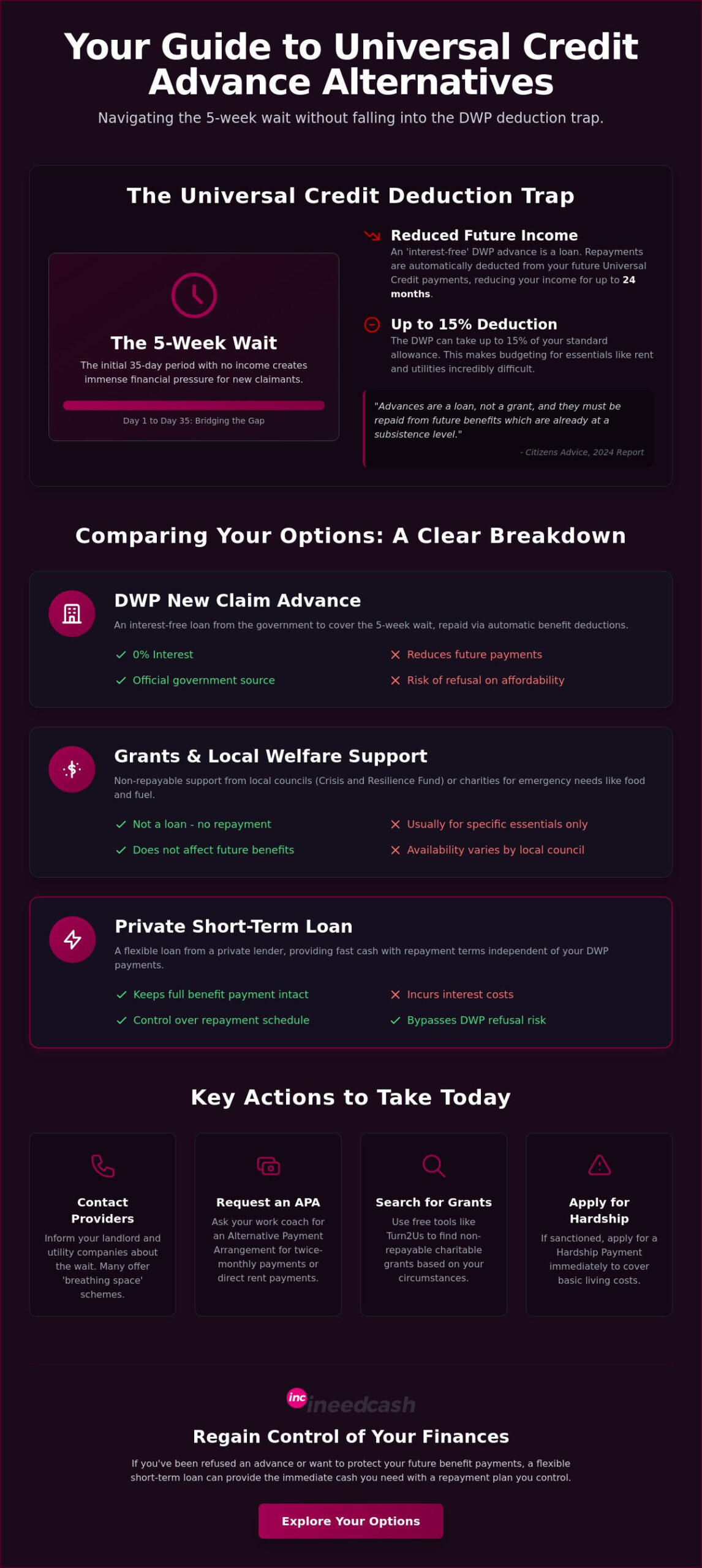
A Universal Credit advance is essentially a pre-payment of your first award. It exists to help you survive the initial 35-day waiting period. Whilst it’s interest-free, it isn’t a grant. You must pay back every penny. This creates a significant dent in your future income before you’ve even established a monthly budget.The deduction trap explained
Repayments for an advance are taken directly from your benefits. As of April 2025, the DWP capped these debt deductions at 15% of your standard allowance. This was a reduction from the previous 25% limit, yet losing 15% of your income for up to 24 months still creates immense pressure. Searching for a universal credit advance payment alternative is often about protecting your future autonomy. Even after the 6.2% uprating in April 2026, many say automatic deductions stop them covering rising utility costs.The 5-week wait: A financial hurdle
The 35-day wait is the most stressful part of the Universal Credit journey. It forces households to find over a month’s worth of rent, food, and bills with zero income. “Advances are a loan, not a grant, and they must be repaid from future benefits. These benefits are already at a subsistence level,” notes a 2024 Citizens Advice report on benefit-related debt. Top Tip: Organise your priority bills immediately after your initial interview. Contact your energy provider and landlord to explain the situation before you miss a payment. Many providers have internal “breathing space” schemes for those waiting on a first benefit payment. If you are a homeowner or a landlord, you may want to reduce your monthly costs. You can learn more about Compare Property Insurance. It may help you find more competitive cover rates.Why the DWP might refuse your advance
A work coach can deny your request if they believe you cannot afford the repayments. They perform strict affordability checks. If you have existing debts or high outgoings, they may see an advance as a risk to your long-term stability. A refusal feels like a dead end, but it simply means you need a different route. If you need a cash loan with fixed terms, not benefit deductions, private options may be your best bet.Government-backed alternatives: Grants and support schemes
Searching for a universal credit advance payment alternative often sends people back to the DWP. Many miss non-repayable support that is available. If you’re in an immediate crisis, the new Crisis and Resilience Fund is your first port of call. Launched in April 2026, this fund provides £1 billion per year to local councils to help residents with food, fuel, and essential white goods. Unlike an advance, this support is often a grant. This means no money will be deducted from your future benefits.Alternative Payment Arrangements (APA)
If you struggle to manage a single monthly payment, ask your work coach for an APA. This can change your payment frequency to twice-monthly, making it easier to organise your household spending. You can also request that your rent is paid directly to your landlord to ensure your housing is secure. For a full breakdown of how to apply, see the MoneyHelper guidance on APAs. For those who have been on benefits for at least six months, a Budgeting Advance is another option. These are interest-free loans for one-off costs like a new cooker or work clothes. In 2026, you can borrow up to £348 as a single person, £464 for a couple, or £812 if you have children. Remember, these must still be repaid, so check for other financial support before committing to more debt.Charitable grants and local welfare
Don’t overlook the help available amongst UK charities. Tools like Turn2Us allow you to search for non-repayable grants based on your previous jobs, health conditions, or location. If your Universal Credit has been sanctioned, you should apply for a Hardship Payment immediately. This is a reduced payment to help you meet basic needs like food and heating whilst your standard award is stopped. If you need a more permanent way to bridge a gap, you can choose a flexible loan. It lets you manage repayments on your own terms.Private financial options: When to consider a short-term loan
DWP refusals happen often. If a work coach decides you can’t afford repayments, they’ll deny your request. This leaves you stranded during that 35-day wait. A private universal credit advance payment alternative allows you to bypass this gatekeeper. By opting for a short term loan, you maintain a “clean” relationship with the DWP. No automatic deductions. No surprise cuts to your monthly award. You manage the repayment yourself, which empowers you to budget on your own terms. It’s about personal autonomy and keeping your financial decisions in your own hands.Safety and regulation in 2026
Safety is paramount. Ensure any lender you use is authorised and regulated by the Financial Conduct Authority (FCA). Under 2026 regulations, interest on short-term loans is capped at 0.8% per day. The total amount you repay can never exceed 100% of what you borrowed. This legal safety net prevents the spiralling debt cycles of the past. Always check the official Government financial support for Universal Credit first. Private options also exist if the DWP turns you away.Finding a loan whilst on Universal Credit
Many high-street banks still struggle to recognise benefit-based income. However, specialist lenders now view Universal Credit as a stable, valid form of income for personal loans. They look at your overall affordability rather than just your employment status. This inclusivity is vital for those who have been marginalised by traditional institutions. If you need a quick decision without a work coach’s judgement, explore our short-term loan matching service today. Find a provider that understands your situation.The broker advantage for bad credit
A poor credit history shouldn’t stop you from accessing emergency cash. Brokers act as your advocate. Rather than applying to ten different lenders and harming your credit score with hard searches, a broker does the legwork. We match you with providers in our network who specifically offer bad credit loans. This streamlined process saves time and protects your financial record. Learn more about payday loan alternatives to see how we can help you find a tailored solution that fits your specific needs. Ready to take control of your finances? Apply now to find a lender that works for you and bridge the gap with confidence.Comparing the costs: Advance vs. Private Lending
Choosing a universal credit advance payment alternative requires a clear-eyed look at your monthly cash flow. On paper, the DWP advance is the cheapest option because it carries 0% APR. However, the true cost isn’t measured in interest; it’s measured in your ability to survive the following month. When the DWP deducts up to 15% of your standard allowance, it can leave a big gap in your budget. This can last for up to 24 months. This drop in daily cash flow often pushes households into a cycle of late payments to landlords or energy firms. “Borrowing is about the total cost of credit. It also affects your day-to-day cash flow,” says Sarah Coles, Senior Personal Finance Analyst at Hargreaves Lansdown. Whilst a private loan carries interest, it allows you to receive your full Universal Credit award every month. This predictability makes it easier for many to organise their priority bills without fear of a shrinking benefit payment. For those who value autonomy, keeping their DWP award intact is a strategic move to maintain financial stability.Understanding APR and total cost
Comparing these two routes involves looking at long-term impact. A short term loan has a higher APR, but the repayment terms are fixed and separate from your benefits. You know exactly what’s leaving your bank account and when. Conversely, a DWP advance is taken before the money even hits your account. Review the official GOV.UK Universal Credit Advance page. Check how the 24-month repayment schedule may affect your award amount.Next steps for immediate cash
Before you commit, take five minutes to list your unavoidable monthly costs. If a 15% cut to your income means you can’t pay rent, a DWP advance might be a risky choice. Calculate your monthly essentials before deciding which borrowing route to take. If you need a solution that protects your monthly award and gives a clear repayment plan, we can help. We will help you find a lender that fits. Don’t let the 5-week wait break your budget. Get a personalised loan quote today and bridge the gap on your own terms.Take Charge of Your Budget Today
The five-week wait doesn’t have to mean two years of financial struggle. You now know that the DWP’s interest-free loan isn’t the only path forward. Between local council grants and changing how often you pay, there are ways to bridge the gap. You can also protect your future income. Finding a universal credit advance payment alternative is about more than quick cash. It helps you stay in control and keep your monthly award for important bills. If you’ve been refused an advance or simply want to avoid automatic deductions, we’re here to help. As an FCA authorised and regulated broker, we offer access to a wide panel of UK lenders. They understand your situation. Our search service is completely free with no hidden fees, ensuring you find the right fit without any extra stress. Don’t let a temporary hurdle ruin your long-term stability. Check your eligibility for a flexible loan today and move from anxiety to empowerment. You deserve a solution that works for your life, not just the system’s rules. Take the first step toward financial tranquility now.Frequently Asked Questions
Can I get a loan if I have been refused a Universal Credit advance?
Yes, you can still access financial support even if a work coach has turned you down. DWP refusals often rely on narrow internal affordability checks. Many private lenders still see Universal Credit as stable and valid income. Choosing a private loan lets you bypass the DWP’s decision. You can also find a lender who checks if you can manage repayments now.Will a private loan affect my Universal Credit payments?
No. A private loan is separate from the benefits system. It will not cause automatic deductions from your award. Unlike an advance, you stay in control of the repayment process through your own bank account. This means you will still receive your full monthly allowance. This makes it easier to manage rent and utility bills. There will be no surprise cuts to your income.What is the fastest alternative to a Universal Credit advance?
Short-term loans are often the quickest universal credit advance payment alternative. Many lenders offer same-day decisions and fast transfers. If you’re looking for a grant, the local Crisis and Resilience Fund is also designed for speed. Most councils prioritise these applications so you can access food or fuel vouchers within 24 to 48 hours.Are there any grants available that I do not have to pay back?
Yes, there are several non-repayable options available for those in urgent need. The £1 billion Crisis and Resilience Fund is a government-backed scheme run by local councils. It provides grants for essentials like white goods or emergency energy credit. You can also look for charity grants through groups like Turn2Us. They can match you with funds that you do not need to repay.How long do I have to pay back a Budgeting Advance?
You usually have up to 24 months to repay a Budgeting Advance through deductions from your Universal Credit. Repayments start as soon as you receive the cash. The DWP caps the deduction at 15% of your standard allowance. It is a useful way to cover one-off costs, like a new cooker. This works if you can manage a slightly lower monthly budget while the loan is active.Related links Aid for Low Income Families (part 2): Emergency Money in the UK Cash advance financial control Aid for Low Income Families (part 3): Find Financial Aid Adaptive solutions for emergency cash Aid for Low Income Families (part 1): Government Emergency Loans ** **
Article by
Mandy Paige
Social Content Writer and Blogger Mandy has been writing for various website for a number of years, especially for companies in the consumer finance industry. She started her career guiding customers wanting help when applying for finance at a Loan Brokerage. Speaking to individuals wanting guidance, it lead her to start writing help and guidance on finding the right solution for their needs. Outside of writing, she is a wiz with a pair of scissors as she originally trained as a hairdresser.