 Skip to content

How Long Does a Loan Stay on Your Credit File? A 2026 UK Guide
- Michelle
- Finance
Imagine a five-year-old financial mistake blocking your path to a new home. It’s a common fear for UK borrowers who feel past slips are permanent. You’re likely asking: how long does a loan stay on your credit file? According to StepChange, most information remains for six years. Take control now.
‘Accuracy is key,’ notes the Information Commissioner’s Office (ICO) in their recent guidance. This guide provides removal timelines and tips for your reputation. We’ll explore the difference between settled and defaulted loans, providing the confidence you need to apply for credit again in 2026 whilst protecting your future.
Key Takeaways
- Understand the six-year standard for UK credit data and learn exactly when the “clock” starts for both settled and defaulted loans.
- Leverage your history by keeping positive marks visible, as settled accounts boost your score whilst they remain on your file.
- Use a Notice of Correction to add your voice to your file. This simple 200-word explanation helps lenders see the person behind the numbers.
- Get a clear timeline on how long does a loan stay on your credit file so you can plan your next big move with total confidence.
- Unlock new possibilities with homeowner loans designed for those with complex credit, ensuring your past doesn’t dictate your future.
The Six-Year Rule: Understanding the Lifecycle of a UK Loan
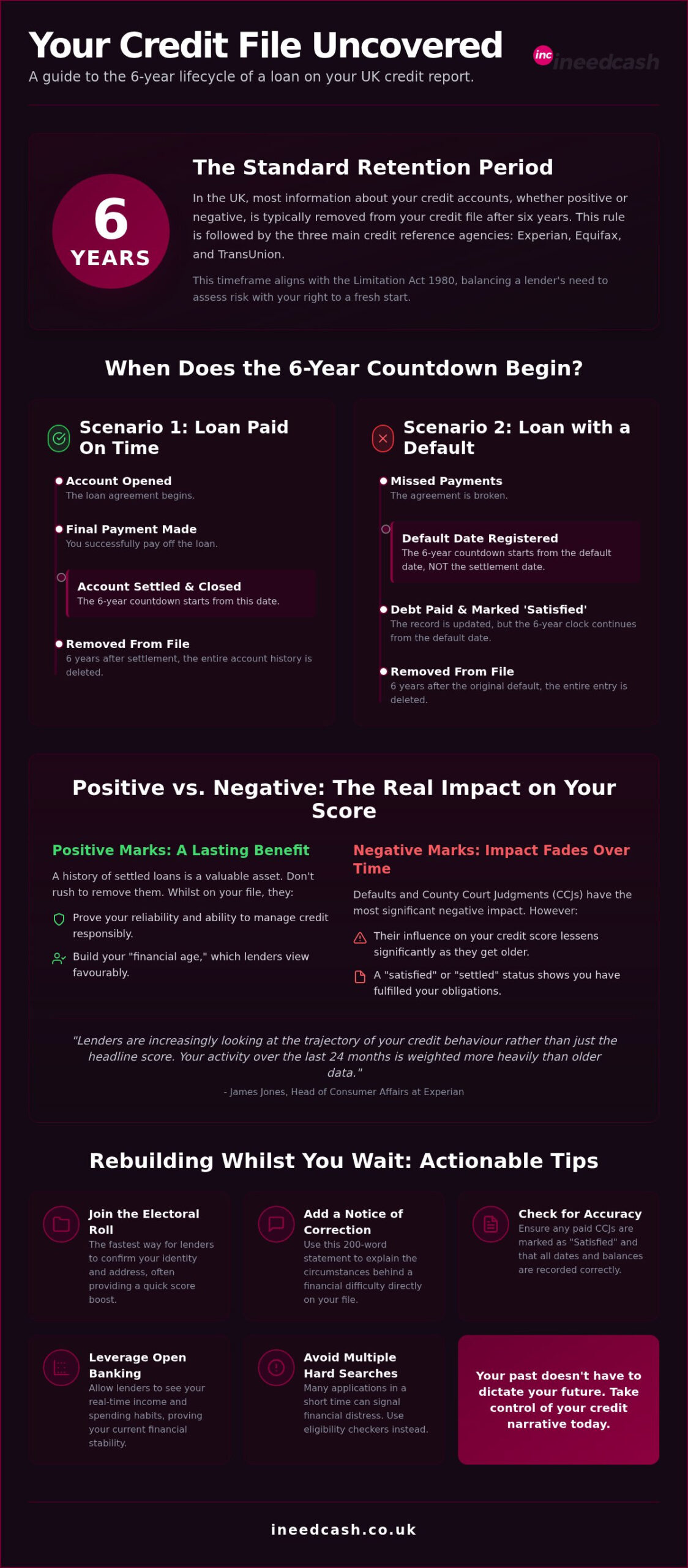
Your credit report isn’t a permanent record of every financial move you’ve ever made. In the UK, the major credit reference agencies; Experian, Equifax, and TransUnion; generally follow a standard six-year retention period. This means that whether you’ve had a personal loan, a credit card, or a mortgage, the data typically vanishes after 72 months. Understanding exactly how long does a loan stay on your credit file is the first step toward reclaiming your financial peace of mind.
The status of the account matters immensely during this window. “A ‘settled’ status is vital because it shows future lenders that you have fulfilled your obligations, even if there were bumps along the way,” explains a senior advisor at StepChange Debt Charity. Even if a debt was previously in default, marking it as ‘satisfied’ or ‘settled’ tells a story of responsibility to any new provider you approach.
Why do Credit Reference Agencies keep data for six years?
This specific timeframe isn’t random. It aligns with the Limitation Act 1980, which sets the legal limit for creditors to take court action to recover most debts in England and Wales. The Financial Conduct Authority (FCA) ensures that agencies balance a lender’s need to see your history with your right to privacy. Think of statute barred debt as any debt that has passed the legal time limit for a creditor to sue you for payment. Whilst the debt still exists, they can’t use the court system to force you to pay it.
When does the six-year countdown actually start?
The “clock” starts differently depending on the situation. For a loan you’ve paid off perfectly, the six years start from the date the account was settled and closed. If things went wrong and a default was registered, the six-year countdown begins from the default date itself. Even if you pay off that defaulted amount two years later, the mark won’t stay for an extra six years; it simply updates to ‘satisfied’ and disappears when the original six-year period ends. If you have equity in your property, a homeowner loan can sometimes be an option even whilst these older marks are still visible.
Positive vs Negative Marks: How Loan Status Changes the Impact
Not all marks on your file are equal. Whilst people often ask how long does a loan stay on your credit file, the status of that entry is what truly influences a lender’s decision. A “satisfied” default carries more weight than an outstanding debt. This status shows you’ve taken responsibility for past mistakes and corrected your course.
The importance of recent financial behaviour
“Lenders are increasingly looking at the trajectory of your credit behaviour rather than just the headline score,” notes James Jones, Head of Consumer Affairs at Experian, in a recent UK credit report. Your activity over the last 24 months is weighted more heavily than older data. Even negative marks lose their impact as they age, according to how long information stays on your credit file. If you’ve corrected your course, you can check your eligibility for finance that reflects your current stability.
The impact of settled loans on your credit score
Having zero credit history is often worse than having a settled loan. Closed accounts in good standing provide proof of reliability. Don’t rush to remove positive entries; they build your “financial age” and act as a foundation for your score whilst they remain visible on your report. This history helps lenders assess risk more accurately.
Default notices and CCJs: The heavier hitters
A County Court Judgment (CCJ) stays on your file for six years. To ensure accuracy, follow this verification checklist:
- Check your public records section in a free credit app.
- Verify any paid CCJ is marked as “Satisfied.”
- Check that the satisfaction date is recorded correctly.
- Keep your Certificate of Satisfaction as proof for future applications.
Rebuilding Whilst You Wait: Actionable Tips for Credit Health
Don’t stay in financial limbo whilst you wait for old debts to expire. Even as you track how long does a loan stay on your credit file, you can take active steps to improve your standing. Start by ensuring you are on the electoral roll at your current address. This is the fastest way to verify your identity and boost your score. Avoid making multiple “hard” credit applications, as these can signal financial distress to lenders.
Leverage Open Banking for real-time proof
Lenders now use Open Banking Loans to assess your actual income and spending habits. This modern approach bypasses static credit scores. “Open Banking provides a much fairer view of affordability for those with previous credit blemishes,” explains Charlotte Crosswell, OBE, in a report for Open Banking Ltd. It allows you to prove your current reliability, showing you can manage credit today regardless of mistakes made years ago.
Correcting errors on your credit report
Check your file for incorrect dates or settled debts still showing as active. If you find a mistake, dispute it with the Credit Reference Agency (CRA) immediately. The Information Commissioner’s Office (ICO) states that agencies have a 28-day statutory period to investigate your claim. If they cannot verify the data, they must remove it. This prevents clerical errors from unfairly extending your 72-month countdown.
Small daily wins for a better score
Aim for a credit utilisation ratio under 30% to show lenders you aren’t overstretched. If your credit limit is £1,000, try to keep your balance below £300. You can also use “Notice of Correction” statements to explain past hardships. These 200-word notes help humanise your data during manual underwriting. Ready to see what options are available for your current situation? Get started today and find a lender that values your progress.
Finding the Right Financial Ally with a Blemished File
Waiting six years for a clean slate isn’t always an option when life happens. If you need funds today, a specialist broker acts as your advocate rather than a gatekeeper. Traditional banks often rely on rigid “computer says no” algorithms that punish you for years. We do things differently. Our network of independent UK lenders looks at your current circumstances. They understand that a missed payment from several years ago shouldn’t block your progress in 2026.
Modern technology has changed the lending game. By using Open Banking, providers can now assess your real-time affordability. This means the anxiety surrounding how long does a loan stay on your credit file is becoming a thing of the past. Lenders care more about your current disposable income and spending habits than an old default. You can get started right now with a soft-search quote that has zero impact on your credit score.
How homeowner loans can help consolidate debt
If you own your home, your equity is a valuable asset that can outweigh a less-than-perfect history. A homeowner loan allows you to access larger sums by securing the debt against your property. This is a strategic way to consolidate high-interest debts into one lower monthly payment. It simplifies your finances and gives your credit score the space to recover whilst older marks eventually disappear from your file.
The non-judgmental approach to modern lending
We believe in a non-judgmental, problem-solution approach. Every borrower’s situation is unique, and we match you with lenders who specialise in non-standard credit. Many providers amongst our panel focus specifically on helping those with complex financial backgrounds. This ensures speed and accessibility when you need it most. We provide a supportive path to finance that values your personal autonomy and your future potential over your past mistakes.
Reclaim Your Financial Freedom Today
Your credit history is a narrative that changes every day. Whilst the standard six-year rule determines how long does a loan stay on your credit file, it doesn’t have to be a barrier to your goals in 2026. By focusing on your current affordability and using proactive tools like a Notice of Correction, you can shift a lender’s focus from past slips to your current strengths. Your recent behaviour is a far more powerful indicator of your reliability than a mistake made half a decade ago.
We are an FCA-regulated broker with deep expertise in homeowner loans and bad credit solutions. Our advanced soft search technology allows you to explore your options with absolutely no impact on your credit score. We believe in providing a supportive, non-judgmental path to the finance you need, regardless of your previous challenges. Don’t let the past dictate your future when flexible solutions are just a few clicks away.
Find a loan that fits your history and get your quote now
Take control of your financial reputation today. You’ve done the hard work of understanding the rules; now it’s time to put a plan into action and move forward with total confidence.
Frequently Asked Questions
Can a loan be removed from my credit file before six years?
A loan can only be removed early if it was recorded in error. If the information is factually correct, UK credit reference agencies are legally required to maintain it for the full six-year term. If you spot a mistake, you must raise a dispute with the agency. They are required to investigate within 28 days. Once they verify the error, they will remove the entry immediately to ensure your record accurately reflects your financial behaviour.
Does paying off a loan early make it disappear from my report?
Paying off a loan early does not remove it from your report; instead, it updates the status to “settled.” This is a positive outcome for your credit score. The account will remain visible for six years from the date it was closed. This history helps future lenders see that you are capable of clearing debt. It builds a foundation of trust that can improve your chances when applying for new credit in the future.
What happens to my credit file after the six-year period ends?
Once the six-year window closes, the account and its entire history are automatically deleted from your file. This includes the record of the loan itself and any associated missed payments or defaults. Future lenders will no longer see this data when they perform a credit search. It provides a clean slate, though it also means the positive impact of a well-managed old loan will vanish from your record at the same time.
Can a lender re-add a default after it has been removed?
Lenders cannot re-add a default once the six-year period from the original default date has passed. This is a strict rule followed by Experian, Equifax, and TransUnion. Even if the debt remains unpaid, the negative marker must disappear. If you find a lender attempting to refresh the date to keep a mark active, you should contact the Financial Ombudsman Service to protect your rights and ensure your file is corrected immediately.
Will a payday loan stay on my file longer than a personal loan?
All credit accounts follow the same retention timeline regardless of the loan type. Whether you are looking at a personal loan or a payday loan, the question of how long does a loan stay on your credit file always has the same answer: six years. Whilst the duration is identical, some lenders may view the presence of high-interest borrowing more cautiously than a standard personal loan during the manual underwriting process.

Article by
Mandy Paige
Social Content Writer and Blogger
Mandy has been writing for various website for a number of years, especially for companies in the consumer finance industry. She started her career guiding customers wanting help when applying for finance at a Loan Brokerage. Speaking to individuals wanting guidance, it lead her to start writing help and guidance on finding the right solution for their needs. Outside of writing, she is a wiz with a pair of scissors as she originally trained as a hairdresser.
Disclaimer
The content of this article/blog was correct to our knowledge on the date/time it was published.